
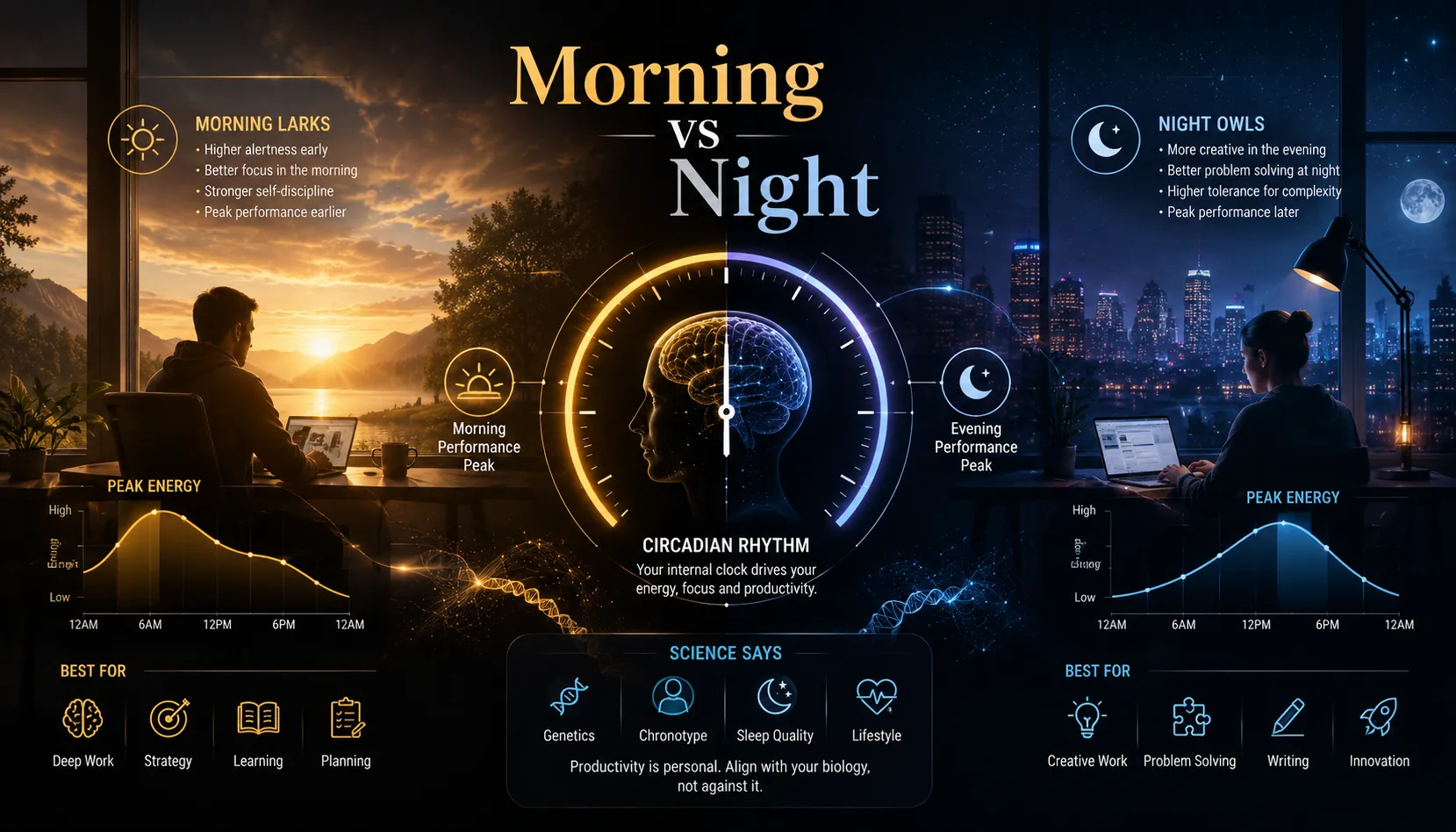
Tim Cook wakes up at 3:45am. Winston Churchill woke up at 10am. Barack Obama reads late into the night. Apple’s CEO and one of history’s most productive leaders occupied opposite ends of the sleep schedule. So does waking up at 5am actually make you more productive?
A 2026 analysis published in The Conversation, summarizing current chronobiology research, had a clear answer: waking early does not inherently make you more productive. What matters is whether your wake time aligns with your chronotype.
Here is what the science actually shows.
What a Chronotype Is
A chronotype is your body’s natural preference for sleeping and waking. It is shaped primarily by genetics and your circadian biology, and it changes across the lifespan. Adolescents tend toward later chronotypes (which is why expecting teenagers to perform well at 7am is biologically unreasonable). Adults typically shift earlier as they age.
Most people are not extreme larks or extreme owls. They fall somewhere in between. Dr. Michael Breus, a sleep specialist, categorizes people into four types:
- Lions (15%): early risers, productive from dawn until noon, tend to tire by 9 to 10pm
- Bears (40%): aligned roughly with the sun, most productive between 11am and 6pm
- Wolves (30%): classic night owls, peak energy and creativity in the evening and at night
- Dolphins (15%): light sleepers with irregular patterns; prone to insomnia
The critical point: forcing a Wolf chronotype into a Lion’s schedule does not make them more productive. It gives them sleep debt, cognitive impairment, and the appearance of productivity while their actual output suffers.
What the 5 AM Club Gets Right
The popular appeal of 5am productivity culture, including Robin Sharma’s The 5AM Club, is not entirely without merit. What it gets right: the value of protected, quiet time at the start of the day for deep work, exercise, and intention-setting before the reactive demands of the day begin.
Those benefits are real. The mistake is assuming they can only be obtained at 5am, and that they will work equally for people with different chronotypes.
If you are a Lion or Bear chronotype, a morning routine built around your natural early alertness is genuinely powerful. If you are a Wolf forced awake at 5am, you are operating on sleep debt during what should be your productive peak hours later in the day.
What Morning Types Genuinely Have in Their Favor
Research does find some advantages for morning types, though context matters:
- Better academic outcomes: studies find morning types tend to report better school and university performance, but researchers note this may be partly because academic schedules favor morning hours, not that morning chronotypes are inherently smarter or more diligent
- Lower rates of substance use: morning types show lower rates of smoking, alcohol use, and drug use on average
- Higher rates of regular exercise: morning types are more likely to exercise regularly, possibly because gyms and outdoor spaces are more accessible in early hours
Evening types, on average, show higher rates of burnout and poorer reported mental and physical health. But researchers attribute much of this to chronic misalignment: living in a society structured for morning types when your biology favors evenings is genuinely taxing.
Can You Change Your Chronotype?
Partially. Chronotype is largely genetic and not easily altered. Small adjustments are possible: going to bed slightly earlier each day, getting morning daylight exposure, and limiting screens in the evening can shift sleep timing by one to two hours over several weeks.
Forcing more than that produces sleep deprivation, not a new chronotype. The 2026 research consensus from MedicalXPress is direct: ‘The real productivity advantage lies not in waking earlier, but in designing routines that match how the brain and body actually function.’
What Actually Predicts Productive Mornings
| What Matters | Why |
| Alignment with your chronotype | Working during your natural peak alertness window produces better cognitive output than fighting your biology |
| Consistency over timing | A consistent sleep schedule (same wake time daily) improves sleep quality more than an early wake time on weekdays compensated by sleeping late on weekends |
| Protected time for deep work | Two hours of undistracted focus at your peak time outperforms eight hours of distracted work at a non-optimal time |
| Sufficient total sleep | Sleep deprivation from early rising impairs decision-making, memory, and performance regardless of wake time |
The Practical Conclusion
If you naturally wake up alert before 6am and feel energized through the morning, a structured early routine is working with your biology and the benefits are real.
If you drag yourself out of bed at 5am while your brain does not actually reach peak function until 10am, you are not joining a productivity club. You are accumulating sleep debt and calling it discipline.
Find your actual peak performance window. Build your most demanding, creative, and important work around it. That is what the chronobiology research actually recommends.
FAQ
Does waking up at 5am actually make you more productive?
Only if 5am aligns with your natural chronotype. Research from 2026 confirms that waking early does not inherently increase productivity. For natural morning types, an early structured routine is genuinely beneficial. For evening types, it produces sleep debt and impaired performance during what could have been peak productive hours later in the day.
What is a chronotype and can you change it?
A chronotype is your biological preference for sleeping and waking, largely determined by genetics and circadian biology. It shifts across the lifespan (teenagers run late; older adults run early). Small adjustments of 1 to 2 hours are possible through consistent sleep timing and morning light exposure. Forcing larger changes against your biology produces sleep deprivation rather than a new chronotype.
Is there scientific evidence for morning routines improving performance?
There is evidence that morning types have some performance advantages in studies, but researchers attribute much of this to academic and professional schedules being structured for morning types. The more robust finding: aligning your most demanding work with your personal peak alertness window, whenever that is, consistently outperforms working against your biology regardless of timing.
The most effective routines are the ones you can sustain. WritoryBuzz creates evidence-based health and productivity content that helps readers build habits aligned with how people actually think, work, and perform.