
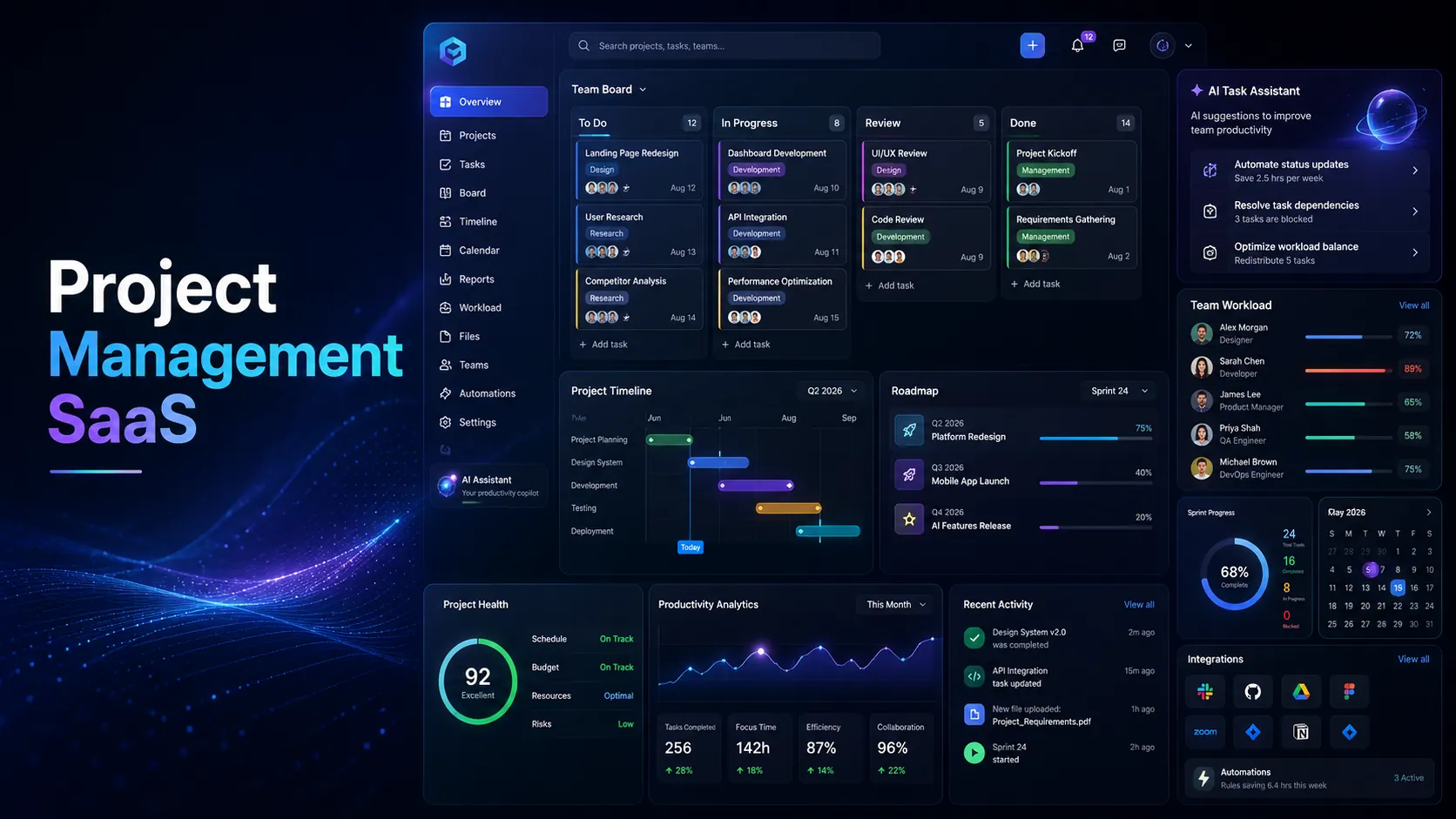
There are dozens of project management tools. Most teams waste weeks evaluating them. Here is the honest breakdown: which tool wins for which team type, and what the over-hyped alternatives miss.
The right project management tool is not the one with the most features. It is the one that matches how your specific team actually works at your current scale. The best tool for a 5-person startup engineering team is almost never the best tool for a 50-person cross-functional marketing and ops organisation.
Linear: Best for Engineering and Product Teams
Linear has become the default for software development teams in 2026. Keyboard-driven navigation, automatic GitHub integration that updates issues when PRs merge, and a clean interface that gets out of the way. Consistently cited as 10 to 20 times faster to navigate than Jira.
Cycles (their term for sprints) track automatically. The 2026 AI features include issue triage, priority suggestions, and duplicate detection. For engineering teams who tried Jira and found it too heavy, Linear is almost universally the right answer below 100 engineers.
Best for: Software teams, startups, product-led companies. Pricing: Free up to 250 issues. Paid from $8/user/month.
Asana: Best for Non-Technical and Cross-Functional Teams
Asana handles marketing campaigns, client projects, HR processes, and product launches equally well. The timeline and portfolio views provide cross-project visibility that managers need. AI Studio (2025 feature) for building automated workflows and AI teammates for autonomous task execution are the most advanced AI implementations in project management in 2026.
Best for: Marketing, operations, HR, mixed technical and non-technical teams. Pricing: Free up to 10 users. Paid from $10.99/user/month.
Jira: Best for Large Engineering Organisations
Jira remains dominant in enterprise software by market share. Its depth and Atlassian ecosystem integration (Confluence, Bitbucket, JSM) make it right for organisations with existing Atlassian investment. The genuine criticism: Jira is slow, complex to administer, and requires significant setup. For teams under 30 engineers not already on Jira, Linear is almost always better.
Best for: Large engineering orgs, enterprises with Atlassian investment. Pricing: Free up to 10. Standard from $7.53/user/month.
Notion: Best for Documentation-Forward Teams
Notion combines wiki, database, and project management. For teams where knowledge management and project tracking need to coexist, its flexibility is unmatched. Limitation: lacks native sprint functionality, roadmap views are manual, and developer tool integration is shallower than Linear or Jira.
Best for: Content teams, agencies, startups building internal knowledge bases. Pricing: Free personal. Plus from $10/user/month.
Monday.com: Best for Visual and Client-Facing Work
Monday’s visual board interface and templates make it the fastest tool to get value from without training. Strong for agency, client services, or construction contexts. Criticism: more expensive than competitors at comparable tiers.
Best for: Visual teams, agencies, client status tracking. Pricing: From $9/user/month (minimum 3 seats).
| Tool | Team Type | AI Features | Starting Price |
| Linear | Engineering / product | Issue triage, sprint AI | $8/user/mo |
| Asana | Cross-functional | AI Studio, AI teammates | $10.99/user/mo |
| Jira | Large engineering | Atlassian Intelligence | $7.53/user/mo |
| Notion | Documentation + projects | Writing, Q&A on data | $10/user/mo |
| Monday.com | Visual, client-facing | AI automation blocks | $9/user/mo |
How to Choose
- Does your team primarily write code? Start with Linear.
- Does your team include non-technical members on the same projects? Asana handles mixed teams better than any alternative.
- Already invested in Atlassian (Confluence, Bitbucket)? Stay with Jira. Migration cost outweighs productivity gain.
Is Linear better than Jira for software teams?
For teams under 100 engineers, almost universally yes. Linear is faster, simpler, and has better developer experience. For larger organisations with complex multi-team release processes and existing Atlassian investment, Jira’s depth remains relevant.
Which PM tool works best for remote teams?
Asana and Notion both work exceptionally well for distributed teams. Linear is excellent for remote engineering teams specifically. All three have strong async update features and cross-timezone collaboration tools.
Stop Evaluating, Start Using
Every major PM tool has a free tier. Pick the one that matches your team type from the guidance above and spend one week on a real project. That week tells you more than any feature comparison.