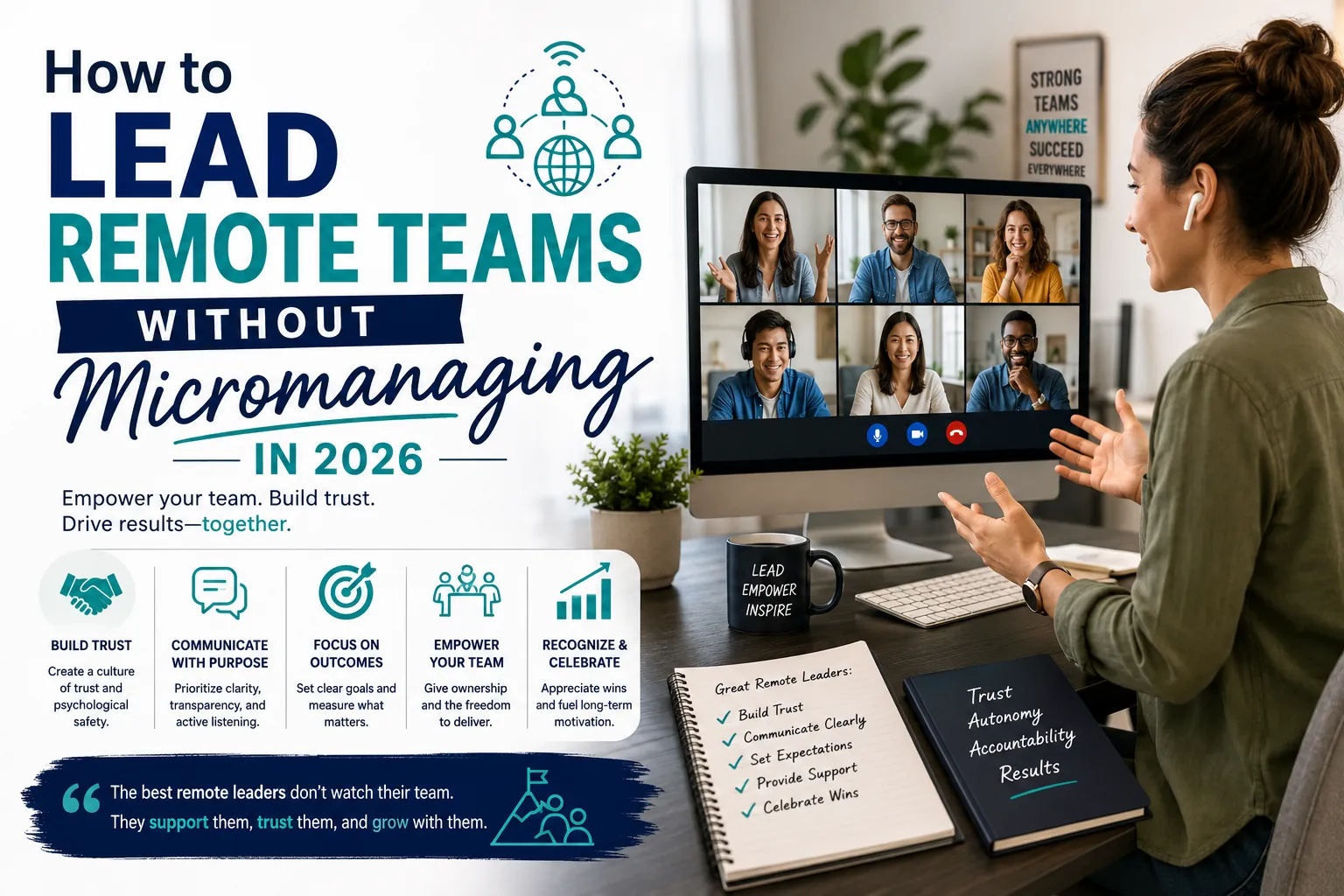
Micromanagement is destructive in any context. In remote work, it is also futile you cannot see the work happening, only its outputs. The managers leading remote teams effectively have accepted this and built a different kind of accountability.
The shift to distributed work has forced a leadership transition that was probably overdue: from presence-based management (the worker is at their desk, therefore they must be working) to output-based management (the work was delivered at the agreed quality and time, therefore the work was done).
The managers who struggle most with remote teams are those who interpret their inability to see continuous activity as a loss of control that must be compensated for through surveillance, excessive check-ins, or constant availability demands. These behaviours destroy the trust and autonomy that make remote work productive.
The Micromanagement Signs in Remote Contexts
- Requiring employees to be on camera continuously during the workday
- Expecting immediate responses to messages regardless of what the employee is working on
- Checking in multiple times per day on the status of tasks that have a clear deadline
- Using monitoring software to track keystrokes, screenshots, or application usage
- Requiring detailed time logs for every 30-minute block of the workday
- Feeling uncomfortable when employees are not visibly online
Each of these behaviours signals distrust. They produce the opposite of their intended effect: employees spend more time managing the manager’s anxiety than doing the work.
The Foundation: Clarity Over Surveillance
The core shift in effective remote leadership is from activity monitoring to outcome clarity. The question is not ‘is this person working right now?’ but ‘are they delivering the right outputs at the right quality on the right timeline?’
This requires doing the work upfront that presence-based management does not: defining what good looks like, what the deliverables are, what the standards are, and how success will be measured. This clarity is more work initially and pays back many times over in reduced need for oversight.
Set clear goals with specific success criteria. Every project and task should have a defined outcome, quality standard, and timeline. ‘Work on the marketing deck’ is not a goal. ‘Deliver a 10-slide draft covering Q3 results and Q4 projections by Thursday 5 PM, aligned with the brand guidelines in the shared folder’ is a goal that requires no micromanagement.
Establish response time norms explicitly. Remote teams need explicit agreements about response time expectations. If someone should respond to Slack messages within 4 hours during their work hours, say that. If 24 hours is fine for non-urgent email, say that. Without these agreements, both managers and employees operate with undefined and often incompatible assumptions.
Separate synchronous and asynchronous work deliberately. Not every communication needs a meeting. Not every question needs a real-time response. Good remote managers distinguish between situations that genuinely require synchronous interaction (complex problem-solving, sensitive conversations, team alignment) and those that work better asynchronously (status updates, routine approvals, information sharing).
Building Trust With Remote Teams
Consistent One-on-Ones
Weekly 30-minute one-on-ones are more important in remote settings than in office settings. In an office, informal corridor conversations provide ongoing micro-feedback and relationship maintenance. In remote work, the one-on-one is often the only space for the employee to raise concerns, receive developmental feedback, and feel seen as an individual rather than a function.
The agenda should be led by the employee. The manager’s job in the one-on-one is primarily to listen, not to report. What are they working on, what is blocking them, what do they need? These conversations build the trust that makes oversight unnecessary.
Visible Transparency About Decisions
Remote teams do not receive the organic context that office environments provide about why decisions are being made. Oversharing context and reasoning more than you think is necessary builds the trust that allows employees to act with autonomy rather than waiting for direction at every step.
When you change priorities, explain why. When something the team expected does not happen, say so. When you make a decision that affects their work, tell them before they discover it rather than after.
Celebrating Outputs Publicly
In remote settings, good work is invisible by default. A project delivered quietly and well receives no ambient recognition. Publicly acknowledging specific contributions in team channels, all-hands meetings, or written updates compensates for the recognition that happens naturally in shared physical spaces. Specific recognition (‘the way Sarah handled the client concern last Thursday was exactly right’) builds team culture more effectively than generic praise.
The Tools That Support Effective Remote Management
Project management software (Linear, Asana, Jira): Provides visibility into what is being worked on without requiring status update requests. The work is visible in the tool.
Async video (Loom, Claap): For complex explanations, feedback on work, or context-sharing that would require a 30-minute meeting, a 3-minute async video is faster for the sender and more flexible for the receiver.
Clear documentation culture (Notion, Confluence): Remote teams that document decisions, processes, and institutional knowledge operate far more efficiently than those that rely on remembered conversations. Documentation reduces dependency on individuals and enables asynchronous work.
How do you hold remote employees accountable without micromanaging?
Accountability in remote settings comes from goal clarity, not activity monitoring. Define what good looks like before work starts. Agree on check-in points that are milestone-based rather than activity-based. Review outputs against agreed standards. The manager’s role is to remove blockers and provide feedback, not to verify continuous activity.
What are signs you are micromanaging remote employees?
Requiring constant camera-on presence, expecting immediate message responses regardless of context, tracking activity rather than outputs, checking in multiple times daily on clearly progressing work, and feeling uncomfortable when employees are not visibly online. All of these signal distrust that destroys the motivation and autonomy that make remote work productive.
Lead the Work, Not the Hours
The remote managers with the highest-performing teams in 2026 are those who have accepted a simple shift: their job is to create the conditions for excellent work and to evaluate its results. Not to ensure that excellent work-adjacent behaviours are happening at every moment of the day.
This requires more trust than traditional management. It also produces better work, stronger retention, and less of the exhausting performance of productivity that surveillance-based remote management encourages.