
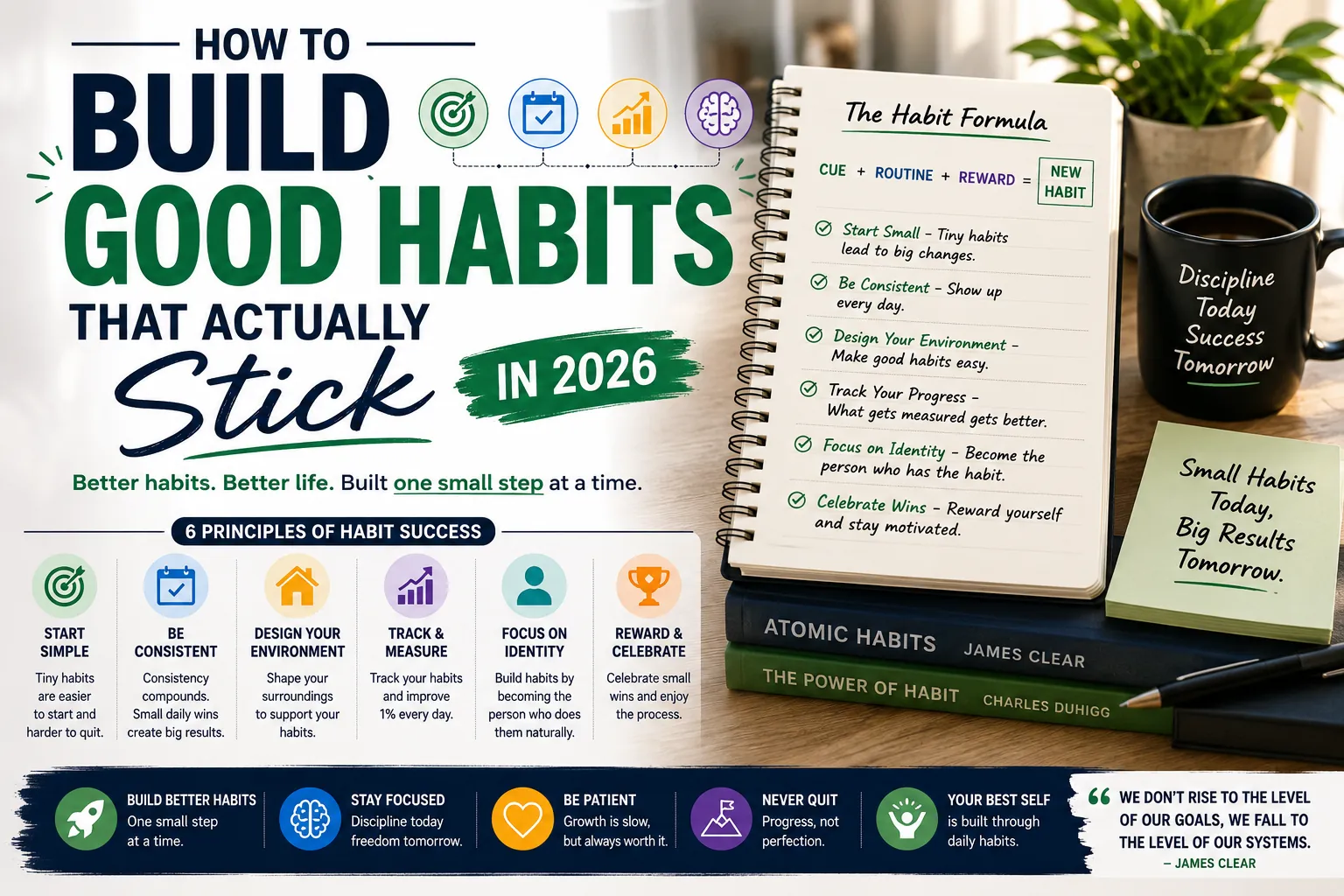
Most habit advice focuses on motivation. Research focuses on environment. The difference explains why most new habits fail in week two regardless of how determined you felt in week one.
The habit formation research of the past decade has shifted understanding significantly. The popular model of willpower as the primary driver of habit change has been largely replaced by a more accurate and more useful model: habits are formed and maintained by environment design, friction management, and neurological reward cycles – not by the intensity of your intention.
This is not discouraging. It is practical. It means you can engineer the conditions that make habits likely rather than relying on motivation that fluctuates daily.
The Science Behind Habit Formation
Charles Duhigg’s work on habit loops (cue, routine, reward) and James Clear’s Atomic Habits popularised the neurological model of habit formation. The core mechanism is accurate: repeated behaviour associated with a consistent cue and a rewarding outcome becomes progressively automated as the associated neural pathway strengthens.
The research suggests it takes anywhere from 18 to 254 days for a behaviour to become automatic, with 66 days as the median in a study by Phillippa Lally at University College London. The ’21 days to form a habit’ claim is a myth. Simpler behaviours become automatic faster than complex ones.
Why Most Habits Fail
The behaviour requires more friction than the competing behaviour. If you want to start running in the mornings but your running shoes are in the cupboard and your phone (the competing behaviour) is on your bedside table, the phone wins. This is not weakness. It is the architecture of competing choices.
The reward is too distant. Exercise produces better health outcomes over years. The brain’s reward system responds to immediate dopamine signals. A habit that requires sustained effort for a distant reward is genuinely harder to maintain than one with an immediate positive signal.
The goal is too ambitious initially. ‘Exercise 5 days a week’ fails for most people not because it is impossible but because the size of the behaviour change requires consistent high motivation. ‘Put on running shoes and walk to the end of the street’ maintains almost universally because the friction is near zero.
Context and environment do not support it. You want to read more but you sit on the sofa next to the television every evening. You want to eat better but the kitchen is stocked with the foods you are trying to avoid. The environment sends stronger signals than intention.
The Strategies That Work
Implementation Intentions: The Highest-Return Technique
Implementation intentions are specific plans of the form: ‘When X happens, I will do Y.’ Research by Peter Gollwitzer shows that this simple technique increases the probability of a target behaviour by 200 to 300 percent compared to a general intention to do the behaviour.
‘I will exercise more’ produces little behavioural change. ‘When I finish my coffee on Monday, Wednesday, and Friday morning, I will put on my running shoes and walk for 10 minutes’ produces significant behavioural change. The specificity pre-commits the decision so you are not making it again in the moment when friction and competing options are present.
Habit Stacking
Habit stacking (coined by S.J. Scott, expanded by James Clear) attaches a new behaviour to an existing, already-automatic behaviour. ‘After I pour my morning coffee, I will write three sentences in my journal.’ The existing habit (making coffee) provides the cue. The new behaviour (journalling) is attached to it.
This works because existing habits have strong neurological cues already in place. Piggy-backing new behaviours on existing cue-routine-reward cycles requires less new habit formation than starting from a new cue.
Environment Design: Making the Right Choice the Easy Choice
BJ Fogg’s Tiny Habits research demonstrates that environment – the physical and digital context you inhabit – predicts behaviour more reliably than intention. This suggests that redesigning the environment to reduce friction for desired behaviours and increase friction for competing ones is the highest-leverage habit intervention.
- Place your gym bag by the front door the night before
- Remove the notification from social media apps you use compulsively
- Put a book on your pillow so it is the first thing you encounter at bedtime
- Prepare tomorrow’s healthy lunch while cooking tonight’s dinner
- Place your phone charger in a room other than the bedroom
- Set out the vitamins on the counter where you will see them at breakfast
Each of these is a 30-second environment change that adjusts the friction calculus for competing behaviours without requiring willpower.
The Two-Minute Rule
James Clear’s two-minute rule: any habit should start with a version that takes two minutes or less. The goal is not to limit the behaviour to two minutes — it is to make the behaviour so easy to start that it happens consistently. A 10km run starts with putting on running shoes. A 2-minute version of the habit establishes the cue-routine connection before increasing the behaviour to full size.
Once you have done the 2-minute version consistently for two weeks, the longer version becomes easier because the cue is already established and the friction of starting is already gone.
Identity-Based Habits
Behaviour change that aligns with an identity is more durable than behaviour change that conflicts with one. ‘I want to run more’ is a goal. ‘I am someone who exercises regularly’ is an identity. Each instance of the behaviour is evidence for the identity, which reinforces the behaviour.
The practical application: when you successfully execute your desired behaviour, frame it in identity terms internally (‘That’s what I do’) rather than achievement terms (‘I did it today’). The identity framing builds the psychological foundation that sustains the behaviour when motivation is low.
Tracking and Recovery
Habit tracking (Jerry Seinfeld’s ‘don’t break the chain’ method, habit tracking apps) works for two reasons: it provides immediate visual feedback that is intrinsically rewarding, and it creates a streak that has value to protect. Research supports its effectiveness for the first 8 to 12 weeks.
The most important rule of habit tracking: never miss twice. Missing one day is a mistake. Missing two days is the beginning of a new habit of not doing the behaviour. A single missed day does not meaningfully damage habit formation. Two consecutive missed days significantly increases the probability of abandonment.
| The Most Important Habit Insight
Motivation is not a reliable foundation for habit change. It fluctuates with sleep quality, stress, mood, and circumstances. A habit built on motivation will fail whenever motivation is low — which is regularly. A habit built on a clear cue, minimal friction, and a small immediate reward will continue through motivational troughs because it does not require motivation to execute. Design for low-motivation days, not high-motivation ones. |
How long does it take to form a habit?
The popular claim of 21 days is not supported by research. A 2010 UCL study by Phillippa Lally found an average of 66 days for new behaviours to become automatic, with a range of 18 to 254 days. Simpler behaviours (drinking a glass of water with breakfast) become automatic faster than complex ones (going to the gym). The key variable is consistency, not the specific number of days.
Why do new habits fail after a few weeks?
Most habit failures occur because the target behaviour requires more friction than the competing behaviour in the moment, or because the behaviour was too ambitious to execute consistently without high motivation. Environment design (reducing friction), implementation intentions (specific when-then plans), and starting with a 2-minute version are the three most evidence-backed interventions for preventing this failure.
One Habit, Then Another
The biggest practical error in habit formation is trying to change multiple habits simultaneously. Focus on one habit for 60 to 90 days. Design the environment, implement the two-minute start, create a specific implementation intention. Let it become automatic before adding the next one.
Slow is smooth. Smooth is sustainable.