
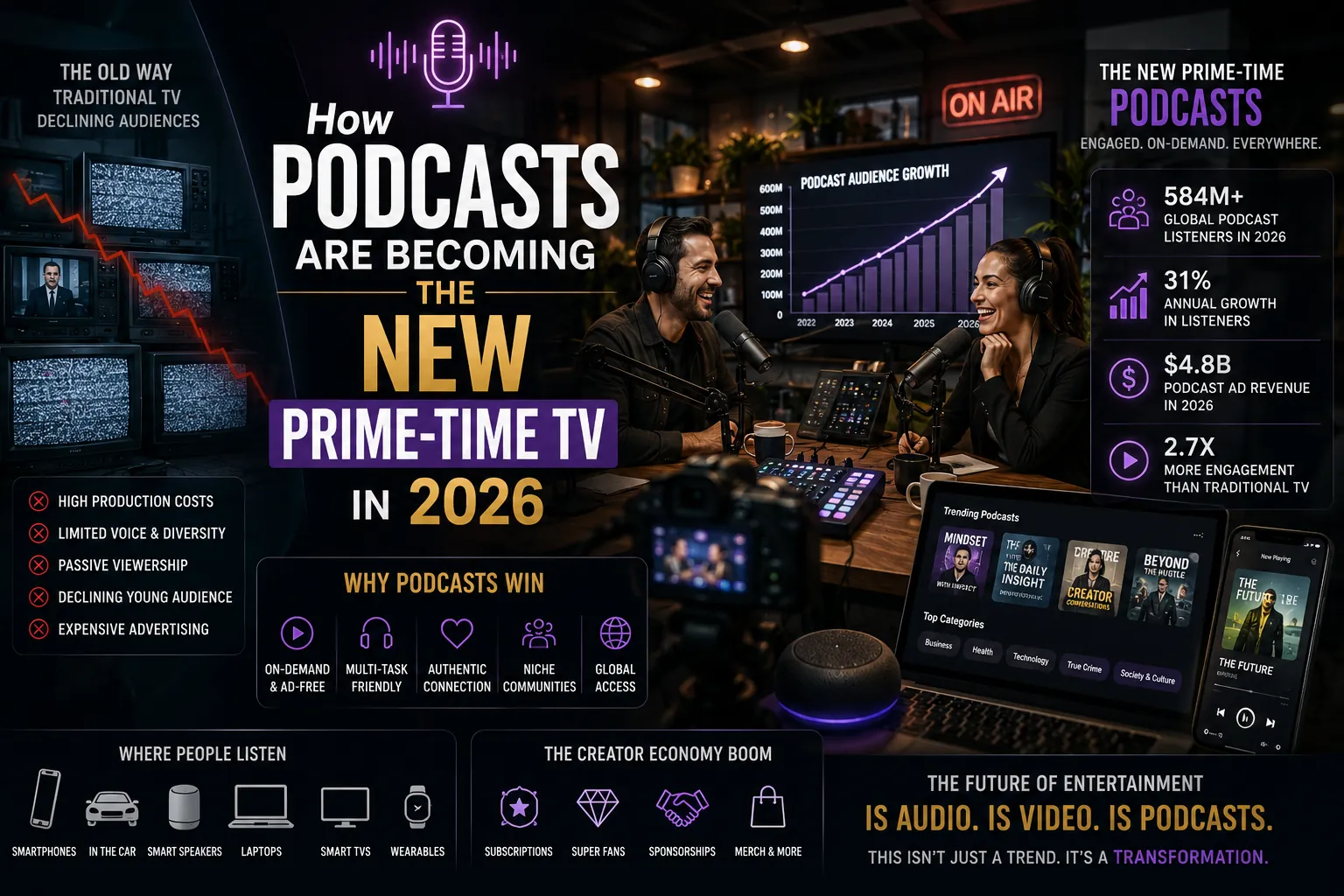
The comparison between podcasts and television used to be a stretch. It is no longer. Monthly podcast listeners in the US crossed 135 million in 2025. Average weekly listening time for regular podcast consumers now exceeds three hours. Spotify, Apple, Amazon, and iHeart have collectively invested billions in podcast content deals, exclusive contracts, and audio technology. None of that investment reflects a niche medium.
What is more interesting than the growth numbers is the reason they are growing. Podcasts do something television cannot do in the attention economy of 2026, and understanding that difference explains where the medium is heading.
Why Podcasts Win the Attention Competition
Television requires visual attention. Podcasts do not. This sounds like a limitation, but in a period where screens compete for attention from every direction, audio-only content occupies a category of time that screens cannot reach: the commute, the gym, cooking dinner, gardening, the walk with the dog.
The screentime squeeze is real. The average adult in developed countries spends seven to nine hours per day looking at screens for work and entertainment. Adding two more hours of screen-based entertainment is cognitively exhausting. Two hours of audio requires no such trade-off.
The intimacy of the format adds a dimension that television rarely achieves. A podcast listener who has heard the same host three times a week for two years feels something closer to a genuine relationship with that host than a television viewer feels with a presenter they watch once a week. That parasocial intimacy is why podcast advertising converts at rates that broadcast television advertising cannot match.
The Numbers That Have Changed the Industry
| Metric | 2020 | 2026 |
|---|---|---|
| US monthly podcast listeners | 100M | 135M+ |
| Global podcast titles | 900,000 | 4M+ |
| US podcast ad revenue | $800M | $2.5B+ |
| Average weekly listening (regular listeners) | 6 hours | 8+ hours |
| Video podcast consumption | Niche | 40%+ of top shows have video |
The Spotify and Apple Content Wars
Spotify’s aggressive move into exclusive podcast content began in 2019 with the Joe Rogan deal and continued through acquisitions of Gimlet Media, Anchor, and Parcast. The strategy mirrored Netflix’s content investment model: build an exclusive content library that makes the platform itself valuable, not just the distribution.
The Rogan deal, reportedly worth $200 million over multiple years, signalled that podcasting had crossed into the category where rights fees reflect mainstream media valuations rather than digital audio niche economics. Similar deals for Alex Cooper’s Call Her Daddy, Conan O’Brien, and multiple sports and news formats followed.
Apple responded by expanding its podcast network, investing in editorial curation, and launching subscription podcasting that allows creators to offer premium content to paying subscribers. iHeart, the largest traditional radio company in the US, has moved aggressively into podcasting to defend its audio advertising market share.
Video Podcasts: The Format That Changed the Growth Curve
The emergence of video podcasting, recording the conversation on camera and distributing the video to YouTube alongside the audio to podcast platforms, significantly changed the medium’s growth dynamics.
YouTube’s recommendation algorithm, one of the most powerful content distribution mechanisms in digital media, now actively promotes long-form conversational video. A podcast episode posted to YouTube as a full-length video, with clips distributed on Instagram Reels, TikTok, and YouTube Shorts, reaches audiences who would never find the same content through a podcast app search.
The Diary of a CEO with Steven Bartlett, Lex Fridman Podcast, and Huberman Lab are among the most subscribed podcasts globally in 2026, and all three generate comparable or greater viewership on YouTube than they do on audio-only platforms. The format is platform-agnostic in a way earlier podcasting was not.
Advertising: Why Podcast Ads Work Differently
Podcast advertising has always been distinguished from broadcast radio advertising by the host-read format. When a trusted voice personally endorses a product in the middle of a conversation the listener chose to have, the response rates differ significantly from a pre-recorded ad interrupting a programme.
The Edison Research Infinite Dial 2025 found that 46% of podcast listeners said they had purchased a product or service after hearing it advertised on a podcast. No other advertising medium produces comparable self-reported purchase rates at comparable ad rates.
Programmatic podcast advertising, automated buying of mid-roll slots across many shows simultaneously, has grown significantly and now competes with dynamic host-read ads for budget share. It scales more easily than host-read ads but generates lower conversion rates. The smartest advertisers use both: programmatic for reach, host-read for conversion.
The Creator Economy Angle: Podcasting as a Business
The economics of independent podcasting have shifted significantly with the growth of subscription models. Patreon, Substack, Apple Podcast Subscriptions, and Spotify’s subscription tools allow podcast creators to monetise directly from their audience without advertiser dependency.
A podcast with 20,000 regular listeners and 5% subscriber conversion at £7 per month generates £84,000 annually before any advertising. That figure would have seemed aspirational for most independent creators five years ago; it is now a realistic mid-tier business for shows with engaged audiences and consistent content output.
The combination of advertising revenue at scale plus subscription revenue from the most engaged listeners plus live event income is the full-stack media business model that the most successful podcasters are building in 2026.
What Podcasting Still Cannot Do
Live events, the sports final, the awards show, the breaking news moment, remain television’s irreplaceable territory. Podcasting is almost exclusively pre-recorded and asynchronous; it does not capture collective live audience moments the way broadcast television does.
Discovery remains a significant challenge. Unlike YouTube’s algorithm or Spotify’s music recommendation engine, podcast discovery is still significantly driven by word of mouth, Apple’s editorial charts, and podcast-within-podcast promotion. A genuinely good new podcast without an existing audience still struggles to grow.
The medium skews toward verbal and conversational content. Visual storytelling, sport, drama, and documentary formats that depend on image require video, which moves podcasting into streaming video territory where the competition is significantly tougher.
FAQs
Are podcasts profitable for most creators?
The podcast industry follows a steep power law distribution. The top few thousand shows generate most of the revenue. The vast majority of the four million plus podcasts generate minimal income. Profitability requires consistent audience growth, which requires consistent quality content over a period of one to three years before most shows reach significant listener numbers.
Will video kill audio-only podcasting?
Unlikely. The core use case for audio-only podcasting, multitasking during commutes, exercise, and household tasks, is not served by video. The most successful podcast creators in 2026 publish both formats simultaneously. The audience segments are overlapping but not identical.
How is podcast measurement improving?
Podcast measurement has historically been weak relative to digital advertising. Downloads do not equal listens. The IAB Podcast Measurement Technical Guidelines have improved standardisation. Spotify’s first-party data on actual listening behaviour is significantly more granular than industry-wide download figures. Improvement is real but the industry remains behind digital video measurement standards.
Where the Medium Goes Next
AI-generated podcasting is already appearing, though AI-only shows without human hosts have not broken through in terms of audience engagement. The more likely near-term AI application is in production: automated transcription, clip generation, show notes creation, and translation for global markets.
International podcast growth is the clearest growth vector. India, Brazil, Nigeria, and Indonesia are all seeing rapid podcast audience growth from smaller bases. The content libraries in regional languages are still thin relative to demand, which represents significant opportunity for creators and platforms building in those markets.
For media industry analysis, creator economy coverage, and entertainment trends throughout 2026, WritoryBuzz tracks the full range of digital media developments as they happen.