Ethereum processes around 15 to 30 transactions per second on its base layer. Visa processes around 24,000. That gap, between what a decentralised blockchain delivers and what mainstream financial infrastructure requires, is the scalability problem that Layer 2 solutions exist to solve.
Layer 2 is not a single technology. It is a category of approaches that share a common principle: process transactions off the main chain (Layer 1) to increase throughput and reduce fees, while inheriting the security guarantees of the main chain for settlement and dispute resolution.
The implementations differ significantly in how they achieve this, and understanding which approach is used by a specific platform determines its security model, latency characteristics, and appropriate use cases.
The Scalability Trilemma: Why This Problem Is Hard
Vitalik Buterin described the blockchain trilemma as the difficulty of simultaneously achieving decentralisation, security, and scalability in a single system. Most base layer blockchains prioritise decentralisation and security at the cost of scalability. Layer 2 solutions accept a narrower security model for specific transaction types in exchange for dramatically higher throughput.
The key insight is that not every transaction needs the same security guarantee. A coffee purchase does not need the same finality guarantees as a large property transfer. Layer 2 solutions optimise for the common case, keeping the base layer as the ultimate arbiter for disputes and final settlement.
Rollups: The Dominant Layer 2 Architecture in 2026
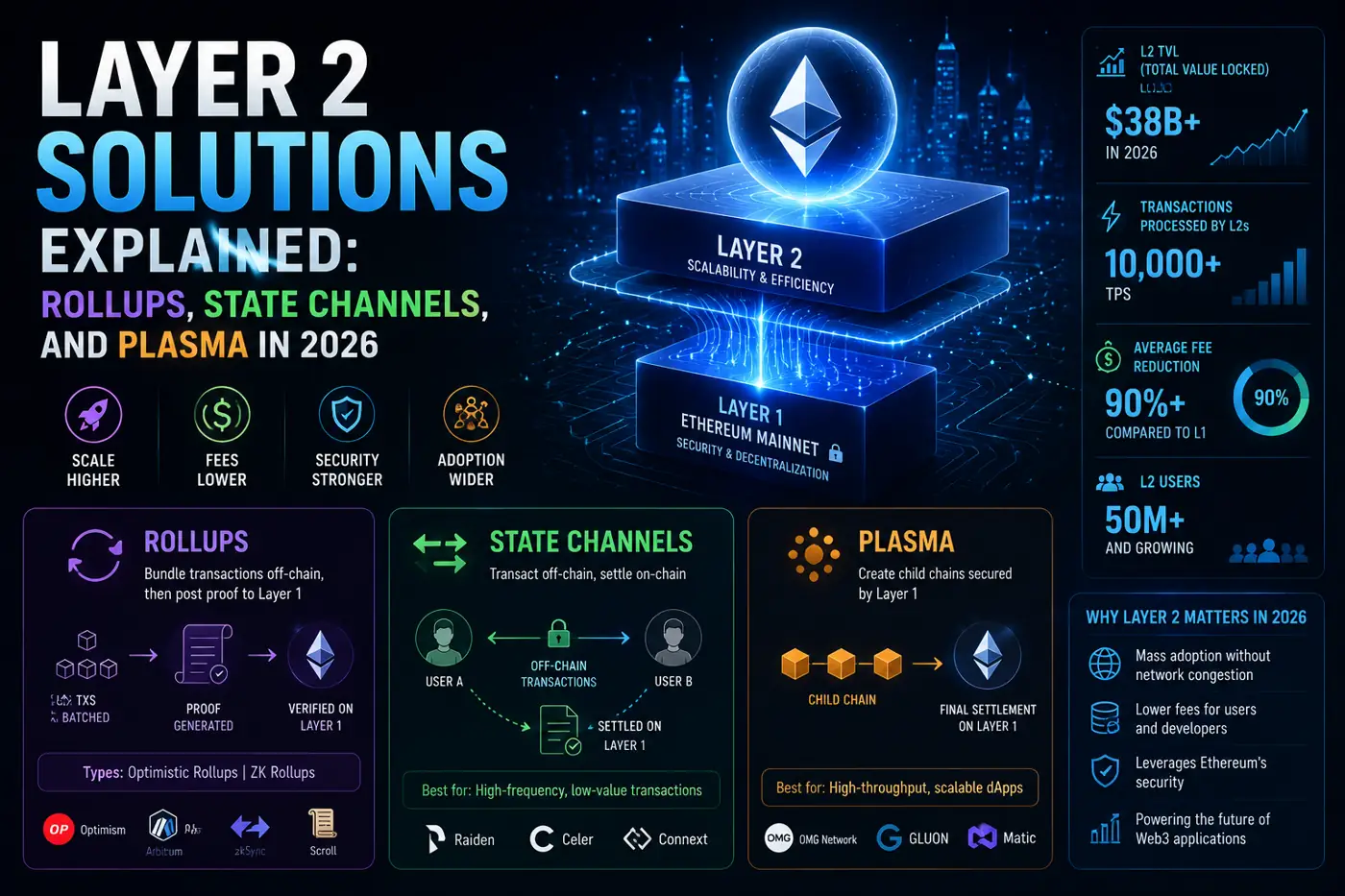
Rollups batch multiple transactions together, execute them off-chain, and submit a compressed summary plus proof to the main chain. The base chain verifies the batch rather than each individual transaction, which multiplies throughput by hundreds or thousands depending on the rollup design.
Two rollup variants have emerged as the primary competition in 2026: Optimistic Rollups and ZK Rollups.
Optimistic Rollups
Optimistic Rollups assume transactions are valid and post batches to the main chain without cryptographic proof of correctness. A challenge period, typically seven days, allows anyone to dispute a fraudulent batch by submitting a fraud proof. If no valid challenge is raised, the batch is finalised.
The seven-day challenge window is the primary limitation. Withdrawing funds from an Optimistic Rollup to the base chain takes seven days because the withdrawal must survive the full challenge period. Fast withdrawal services exist that provide liquidity immediately in exchange for a fee, but they add complexity and cost.
Arbitrum and Optimism are the largest Optimistic Rollup networks by transaction volume and total value locked (TVL). Coinbase’s Base chain, built on Optimism’s OP Stack, has emerged as a significant layer 2 in 2024 and 2025 due to Coinbase’s distribution reach and lower gas fees.
ZK Rollups
ZK (Zero-Knowledge) Rollups generate cryptographic proofs of transaction validity, called validity proofs or ZK-SNARKs, that are submitted alongside each batch. The main chain verifies the proof mathematically rather than relying on a challenge period. If the proof is valid, the batch is immediately final.
The security model of ZK Rollups is stronger than Optimistic Rollups because correctness is mathematically proven rather than assumed. The withdrawal time to Layer 1 is minutes rather than seven days. The trade-off historically was computational cost: generating ZK proofs is expensive.
That trade-off has narrowed significantly. zkSync Era, StarkNet, Polygon zkEVM, and Linea have all launched ZK Rollup networks compatible with the Ethereum Virtual Machine (EVM), meaning smart contracts written for Ethereum can run on them with minimal modification. ZK Rollups are increasingly considered the long-term winning architecture.
State Channels: The Oldest Layer 2 Approach
State channels allow two or more parties to conduct multiple transactions between themselves off-chain, settling only the final net result on the main chain. The Bitcoin Lightning Network is the most widely deployed state channel network.
The mechanism: two parties each lock funds in a multi-signature on-chain contract (the channel opening). They then exchange signed state updates off-chain as many times as needed, each update reflecting the new balance distribution. When they are done, they submit the final state to the main chain, which settles and releases the locked funds.
State channels are extraordinarily efficient for specific use cases: high-frequency payments between known parties, micropayments, and streaming payments. They are poorly suited for interactions involving parties who do not have pre-established channels or for general smart contract execution.
Plasma: The Precursor That Lost the Competition
Plasma was proposed by Vitalik Buterin and Joseph Poon in 2017 as a Layer 2 architecture using child chains anchored to the Ethereum main chain. Each child chain runs its own consensus mechanism and periodically commits state roots to the main chain.
Plasma had a fundamental problem called the data availability problem. If a Plasma operator withholds block data, users cannot construct fraud proofs to protect their funds. The mass exit problem, where all users need to exit simultaneously when an operator behaves maliciously, could overwhelm the main chain.
These problems were never cleanly solved. Rollups, which solve the data availability problem by posting transaction data on-chain, superseded Plasma as the primary Layer 2 research direction by 2020. Polygon (now Polygon POS) runs a related but distinct architecture; most of what is called Plasma today is better described as a sidechain with periodic checkpoints.
Current Layer 2 Ecosystem in 2026
| Network | Type | Notable Feature | Approximate TVL |
|---|---|---|---|
| Arbitrum One | Optimistic Rollup | Largest L2 by TVL, strong DeFi ecosystem | $15B+ |
| Base | Optimistic Rollup (OP Stack) | Coinbase-backed, strong consumer app growth | $8B+ |
| Optimism | Optimistic Rollup | OP Stack ecosystem builder | $6B+ |
| zkSync Era | ZK Rollup (EVM-compatible) | Native account abstraction | $4B+ |
| StarkNet | ZK Rollup (Cairo VM) | High throughput, gaming focus | $2B+ |
| Polygon zkEVM | ZK Rollup | Polygon ecosystem integration | $1B+ |
| Lightning Network | State Channel | Bitcoin micropayments, global adoption | $500M+ |
Which Layer 2 to Use for What
For DeFi applications requiring maximum security and fast finality: ZK Rollups, particularly zkSync Era or StarkNet for complex smart contracts, or Arbitrum for the deepest existing DeFi liquidity.
For consumer applications and high-volume transactions where seven-day withdrawal is acceptable: Optimistic Rollups, particularly Base for Coinbase-adjacent applications or Optimism for the OP Stack ecosystem.
For high-frequency Bitcoin micropayments and streaming payments between known parties: Lightning Network state channels remain the most practical option.
For general Ethereum-compatible development with gradual ZK migration: Polygon’s zkEVM provides a familiar development environment with improving ZK security guarantees.
Common Misconceptions About Layer 2
That Layer 2 is less secure than Layer 1. A well-designed rollup inherits Ethereum’s security for settlement and dispute resolution. The trust model is different from Layer 1 but not weaker for most practical applications. The risk is in the specific implementation, not the category.
That all Layer 2 solutions are interoperable. They are not. Moving assets between Arbitrum, Optimism, and zkSync requires bridging, which introduces additional smart contract risk and delay. Cross-layer 2 bridging is an active development area but fragmentation remains a real usability issue.
FAQs
Are assets on Layer 2 as safe as on Ethereum mainnet?
For rollups with proven track records and no history of exploits, the risk profile for assets is similar to mainnet for most users. The additional risks are: bridge contracts (which hold funds between layers and have been exploited in the past), sequencer centralisation in most current rollups, and smart contract bugs in the rollup implementation itself. Mature rollups with large bug bounty programmes and long operational histories have significantly lower risk profiles than new or unaudited Layer 2 deployments.
What is a sequencer and why does it matter?
A sequencer is the entity that orders transactions before batching them for submission to Layer 1. Most current rollups use a single centralised sequencer operated by the development team. A centralised sequencer can censor transactions or temporarily halt the chain. Decentralising the sequencer is an active research and development priority for all major rollup networks.
Will Layer 2 make Ethereum gas fees irrelevant?
Layer 2 has already reduced the cost of most common transactions by 90 to 99% compared to Ethereum mainnet. EIP-4844, implemented in the Dencun upgrade in March 2024, further reduced Layer 2 data posting costs significantly. For most consumer applications, Layer 2 transaction costs are now comparable to traditional payment processing fees.
The Road Ahead
The ZK Rollup versus Optimistic Rollup competition will likely resolve in favour of ZK over a five to ten year horizon as ZK proof generation costs continue to fall and EVM compatibility matures. The transition will not be sudden; Optimistic Rollups have too much deployed capital and application ecosystem to be displaced quickly.
The next major challenge for the Layer 2 ecosystem is composability: enabling seamless interaction between applications on different Layer 2 networks without the friction of manual bridging. Solutions including shared sequencing, interoperability protocols, and Ethereum’s own roadmap toward a rollup-centric architecture are converging on this problem.
For blockchain infrastructure coverage, DeFi protocol analysis, and Ethereum ecosystem updates throughout 2026, WritoryBuzz tracks technical developments with practical context for developers and informed observers.