
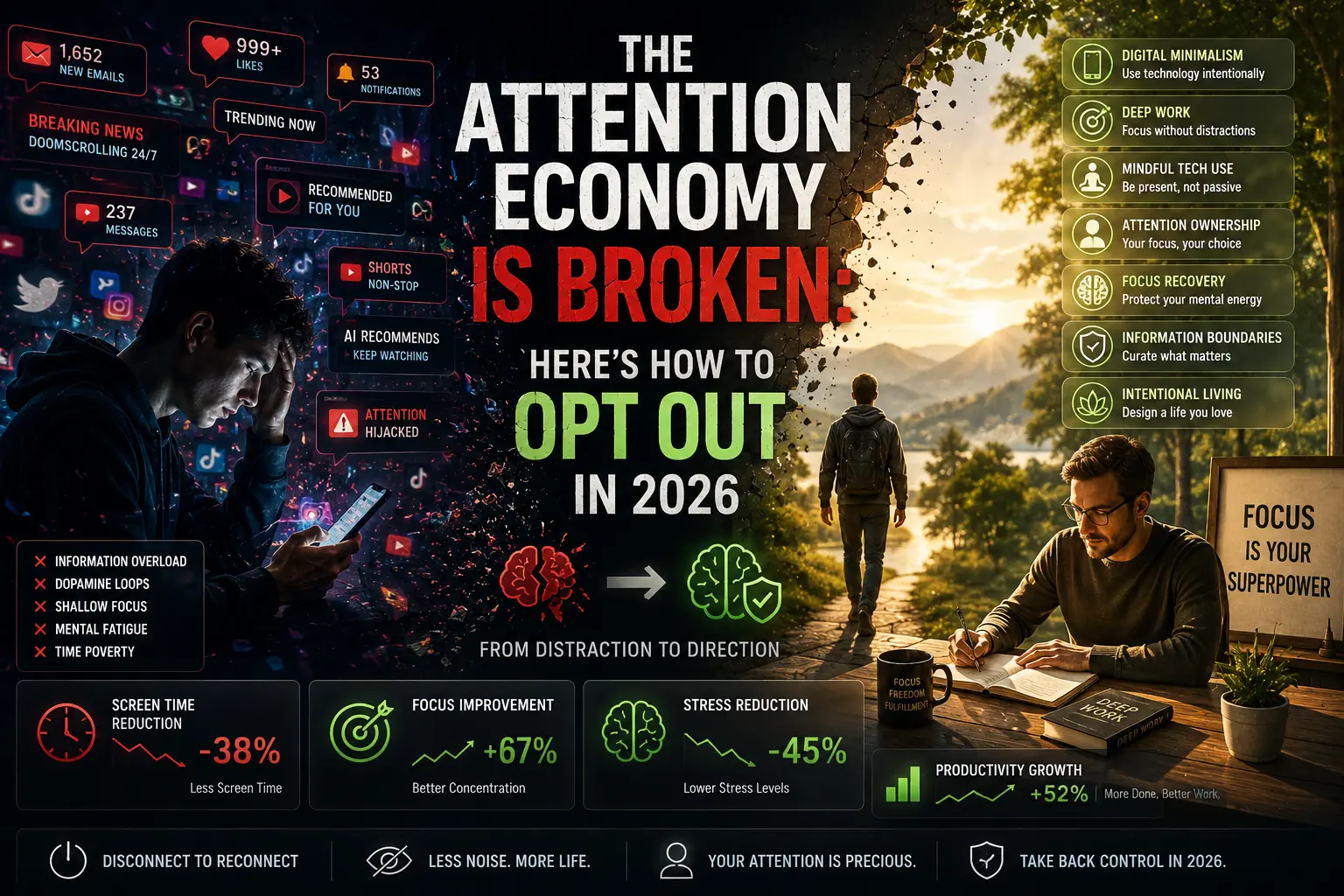
The business model of most free digital platforms is straightforward: convert your attention into advertising revenue. The more time you spend on the platform, the more ads you see, the more valuable you are to advertisers. Every design decision, the infinite scroll, the notification, the algorithmically served outrage, serves that model.
This is not a conspiracy. It is disclosed in every company’s investor report. The product you are using when you open Instagram, TikTok, Twitter/X, or Facebook is not the app. You are the product. Your attention is the commodity being sold. Knowing this changes how you evaluate your relationship with these platforms.
What the Attention Economy Actually Costs
The most obvious cost is time. The average adult in developed countries spends seven to nine hours per day on screens. Significant portions of that time are algorithmically optimised to produce continued engagement, not to serve the user’s stated goals. Time spent scrolling is time not spent on the activities that research consistently associates with wellbeing: face-to-face social interaction, physical activity, creative work, sleep.
The less obvious cost is cognitive. Attention is a finite resource. Every notification interrupts a train of thought and imposes a recovery cost. Research by Gloria Mark at the University of California found that interruptions from digital notifications took an average of 23 minutes to fully recover from cognitively. A morning of 15 notifications costs most of the morning’s deep work capacity.
The most contested cost is psychological. The research on social media and mental health is genuinely complex and not as simple as platform-causes-depression. But specific mechanisms are reasonably well-established: social comparison on curated highlight reels increases negative affect; infinite variable reward (the next post might be interesting) produces compulsive checking behaviour; algorithmic amplification of outrage content increases ambient anger and anxiety.
How the Platforms Engineer Engagement
| Mechanism | How It Works | The Effect on You |
|---|---|---|
| Infinite scroll | Removes natural stopping points | Eliminates the ‘I’m done’ moment |
| Variable reward | Unpredictable content quality keeps you checking | Same mechanism as slot machines |
| Social validation loops | Likes and comments create checking compulsion | Status anxiety drives return visits |
| Autoplay | Next content loads without decision | Passive continuation without intent |
| Notifications | Manufactured urgency to return to app | Interrupted focus and false social obligation |
| Algorithmic outrage | Emotionally activating content drives engagement | Elevated anxiety and anger as ambient state |
These mechanisms were not invented maliciously. They were optimised for engagement metrics over years of A/B testing. The fact that the outcome is psychologically costly does not mean the intent was harmful. It means the optimisation target was wrong: engagement rather than user benefit.
The Distinction Between Platforms Worth Keeping and Those That Are Not
Opting out of the attention economy does not require deleting all social media or disconnecting from digital communication. It requires distinguishing between platforms and tools that serve your actual goals and those that exist primarily to convert your attention into advertising revenue.
Email, calendar applications, messaging apps used for specific relationships, and tools that execute defined tasks serve the user’s interests and are worth keeping. The distinction for social media platforms is whether you use them intentionally for a defined purpose (staying connected with specific people, following specific professional content, distributing your own work) or whether the platform primarily uses you.
The test: if you put the app down after achieving what you came for, you are using it as a tool. If you cannot identify what you came for and routinely spend far longer than intended, the algorithm is driving your behaviour more than your intention is.
Practical Steps to Reclaim Attention
Step 1: Remove Social Media Apps From Your Phone
The majority of social media consumption happens on mobile, in short bursts across the day, driven by habit and notification. Removing the apps from your phone does not prevent you from using the platforms; it requires the slightly higher friction of a browser. That friction, small as it is, interrupts the automatic checking behaviour that produces most compulsive use.
Most people who do this report immediate, significant reduction in total use without feeling like they are missing important content. The browser experience is also intentionally inferior to the app experience, which further reduces the reward of the behaviour.
Step 2: Turn Off All Non-Human Notifications
Notifications from people you have genuine relationships with (messages, calls) serve communication. Notifications from algorithms (likes, comments from strangers, suggested content, app badges) serve engagement metrics. Turn off every notification category that is not a human contacting you specifically.
This single change, taking less than five minutes per app, measurably reduces daily interruptions and the cognitive cost they carry. Most people discover, within a week, that they missed nothing important from the notifications they eliminated.
Step 3: Designate Specific Times for Checking
Continuous partial attention, checking social media and messages throughout the day without designated windows, is the mode of use that produces the highest cognitive cost. Replacing it with two or three designated checking windows, for example at noon and at 6pm, converts reactive checking into intentional use.
The first three days of this change typically feel uncomfortable because the habit of checking is strong. By day seven, most people report that the discomfort has largely passed and that the checking windows feel sufficient for staying connected.
Step 4: Redesign Your Phone’s Home Screen
The apps on your phone’s home screen are the ones you open most often. If social media and short-video apps are on the home screen, you open them habitually when you unlock your phone, regardless of intent. Move them off the home screen into a folder, or remove them entirely from the phone.
Replace them with the apps that serve your actual goals: reading, exercise tracking, communication with specific people, productivity tools. What you see first shapes what you do first, repeatedly across the day.
Building Time for Depth
The most consistent finding in research on attention and performance is that deep work, sustained, focused engagement on cognitively demanding tasks without interruption, produces both higher quality output and greater satisfaction than fragmented, interrupted work. Cal Newport’s research at Georgetown documented this across multiple professional domains.
Building blocks of protected time for deep work requires the same mechanisms as any other attention management strategy: scheduled windows, phone not in the room, notifications off, a clear task before the session begins. Two hours of uninterrupted deep work daily produces more meaningful output for most knowledge workers than six hours of interrupted, distracted work.
The Social Dimension of Opting Out
Opting out of attention-economy platforms has a social cost that should be honestly acknowledged. If your social circle primarily communicates through Instagram stories, leaving Instagram has a relationship cost. If professional networking in your field happens on LinkedIn, abandoning it is a career cost.
The goal is not purity or total disconnection. It is intentionality. Using a platform with a clear purpose, for a defined amount of time, on a schedule you choose, is fundamentally different from opening the app habitually whenever you have an idle moment. The same platform can serve you or use you depending entirely on how you approach it.
FAQs
Is social media use always harmful?
No. Research on social media and wellbeing consistently shows that the relationship depends on how it is used. Active, intentional use (communicating with specific people, pursuing specific interests) is associated with neutral to positive outcomes. Passive, scrolling consumption is associated with negative affect and social comparison. The type of use matters more than the amount of use in most studies.
How do I handle FOMO (fear of missing out) when reducing social media use?
FOMO is partly real (you will miss some content) and partly manufactured (the platform is designed to make you feel that you are missing things when you are not using it). Most people who significantly reduce social media use report that their FOMO decreases within two to four weeks, because they discover that the content they were not seeing was not providing genuine value.
What is the most effective single change for reducing compulsive phone use?
Charging your phone outside the bedroom overnight. This eliminates the morning phone check before getting out of bed and the late-night scrolling before sleep, two of the highest-volume compulsive use periods. It also improves sleep quality, which improves attentional capacity the following day. The change is simple, free, and has a significant impact disproportionate to its ease.
The Longer View
The attention economy will not reform itself. The business models that create these incentives are not going away because of user discomfort. Meaningful change, if it comes, will come from regulation, from platform business model diversification, and from enough users making enough individual choices that the engagement metrics advertisers pay for become less reliable.
What you can control is your individual relationship with the platforms you use. That relationship can be intentional or reactive. Making it intentional does not require dramatic disconnection. It requires consistent small choices about where your attention goes and who benefits from it going there.
For digital wellbeing guides, technology culture analysis, and media literacy content throughout 2026, WritoryBuzz covers the relationship between technology and human attention without either technophobia or uncritical optimism.