
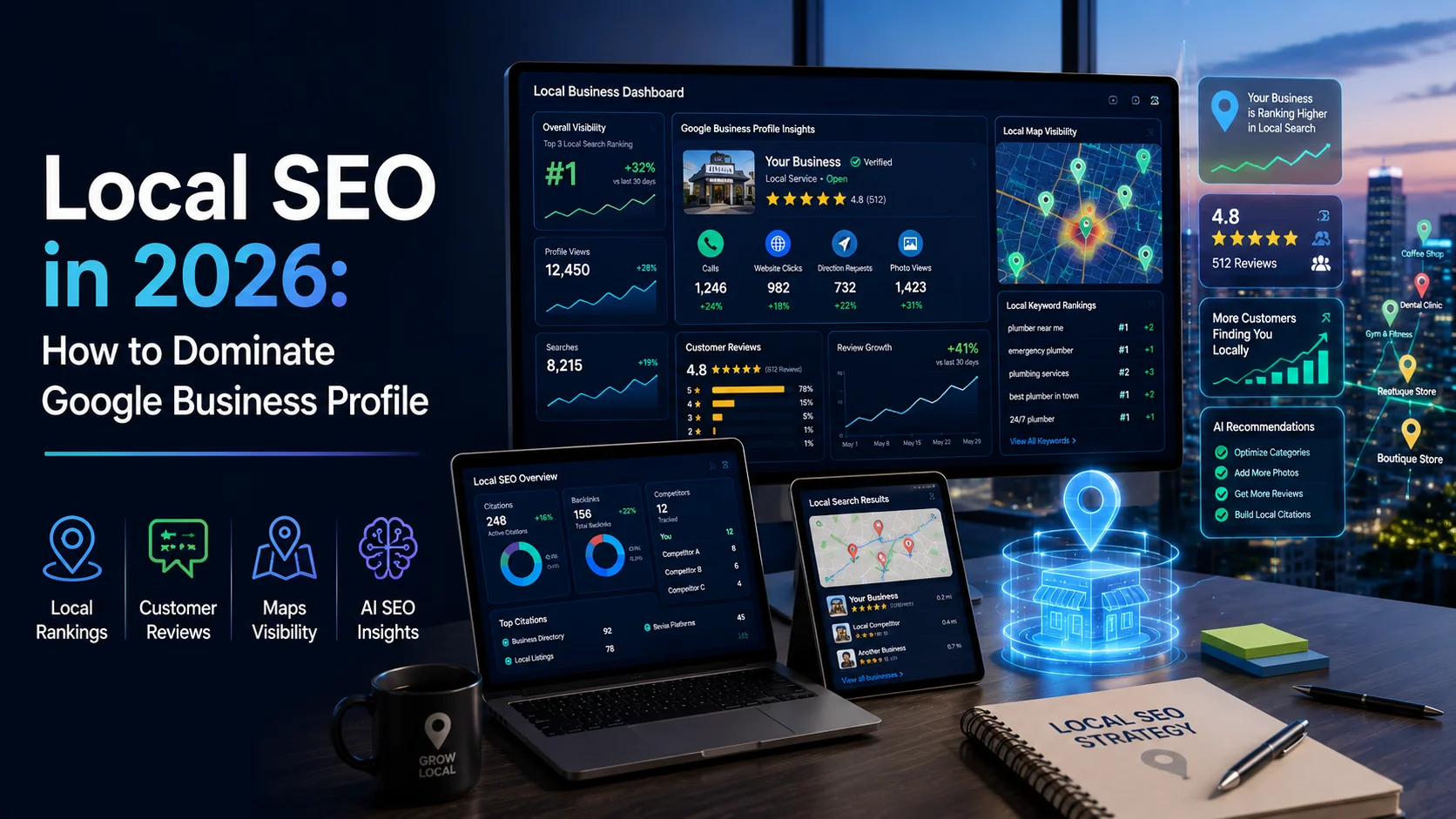
Whitespark’s 2026 Local Search Ranking Factors survey found proximity accounts for 55 percent of local ranking decisions. GBP signals account for 32 percent. Reviews account for 16 to 20 percent. You cannot move proximity. You can completely control the other 48 percent that determines whether you show in the Local Pack for your target area.
Local SEO in 2026 is the practice of optimising your business’s online presence so it appears prominently in Google’s Local Pack (the three map results above organic results), Google Maps, and localised organic search results. For businesses with physical locations or service areas, Local Pack visibility often drives more leads than organic SEO and paid search combined, because the intent is immediate and the searcher is proximate.
The 2026 Local Ranking Factors: What the Data Shows
Google’s local ranking algorithm evaluates three primary dimensions: relevance (how well the business matches the search query), proximity (how close the business is to the searcher), and prominence (how well-known and trusted the business is based on reviews, links, and citations).
| Ranking Factor | Weight (Whitespark 2026) | Your Control |
| Proximity to searcher | ~55% | Cannot control |
| GBP signals (category, completeness) | ~32% | Full control |
| Review signals (quantity, velocity, response) | 16-20% | High control |
| On-page SEO (local landing pages) | ~19% | Full control |
| Citation signals (NAP consistency) | ~11% | Full control |
| Behavioural signals (clicks, calls, directions) | ~8% | Indirect control |
Google Business Profile: The Foundation
Primary Category Is Your Most Important Decision
Your primary GBP category carries more ranking weight than almost any other controllable factor. It determines whether you appear when someone searches for your type of business. Getting this wrong means no amount of optimisation elsewhere compensates. Use Google’s exact category names rather than creating your own descriptions.
Research competitors: view the categories of top-ranking businesses in your area. Add secondary categories for all services you offer. A dentist might use ‘Dentist’ as primary and add ‘Cosmetic Dentist’, ‘Emergency Dental Service’, and ‘Pediatric Dentist’ as secondary to capture all relevant searches.
Profile Completeness Signals Trust
Business description: 750 characters maximum. Include your primary keyword and location naturally in the first 250 characters (what appears without expanding). Describe your specialisations, not generic descriptions any competitor could claim.
Services and products: List every service with its own name, description, and price where applicable. These service entries are individually indexed and matchable to specific search queries.
Attributes: Google’s algorithm rewards specific, accurate attributes. In 2026, attributes including accessibility features, sustainability practices, health and safety provisions, and service guarantees differentiate profiles in competitive markets.
Photos: Add minimum 10 high-quality photos of your premises, team, products, and work. Update photos regularly. Geotagged photos (with location metadata embedded) may improve local relevance signals.
Hours accuracy: Inaccurate hours are among the top causes of negative reviews. Update for holidays, seasonal changes, and temporary closures before they happen. Google uses hours data to determine when your profile appears in searches.
Reviews: The Highest-Leverage Controllable Factor
Reviews account for 16 to 20 percent of local ranking weight and rising. What matters is not just the total count but velocity (getting new reviews consistently), response rate, and recency. A business accumulating fresh reviews consistently outranks a competitor with more total reviews but no recent activity.
Responding to reviews: Businesses that respond to 80 percent or more of reviews see a measurable ranking boost. Responses should be specific rather than generic, include the business name and location naturally, and address the reviewer’s specific comment. This is also a public signal to potential customers about how you treat existing ones.
Generating review velocity: Ask at the moment of maximum satisfaction: immediately after a successful service, delivery, or positive interaction. Provide a direct link to your GBP review page. Email and SMS follow-up sequences with a review link improve conversion from request to completed review.
Never fake reviews: Google detects and removes fake reviews and penalises profiles that accumulate them. The algorithmic and reputational risk is severe. Review policies also prohibit incentivising reviews (offering discounts or gifts for reviews). Genuine ask-at-the-right-moment strategies are both compliant and effective.
NAP Consistency: The Foundation Nobody Talks About
NAP (Name, Address, Phone Number) must be identical across your GBP, website, and every online directory. Google cross-references NAP data across hundreds of sources to verify business legitimacy and location. Even minor inconsistencies, such as ‘Street’ versus ‘St.’ or different phone number formats, suppress rankings.
Audit your NAP across major directories: Google Business Profile, Apple Maps, Bing Places, Yelp, Facebook, and any industry-specific directories. Use BrightLocal or Whitespark’s Local Citation Finder to identify inconsistencies and find citation opportunities you are missing.
Local Landing Pages for Multi-Location Businesses
Each service area or location should have a dedicated page on your website with LocalBusiness schema markup, city-specific title tags, and location-relevant content. The GBP listing should link to the specific location page, not the homepage. This creates a reinforcing signal between your GBP and your website for the specific location.
A fully optimised GBP linked to a well-optimised local landing page with consistent citations and 20-plus reviews can achieve Local Pack positions within 30 to 90 days in moderately competitive markets, according to SEO research from Sterling Sky and Whitespark.
GBP Posts: Do They Actually Move Rankings?
A controlled 9-week study by Sterling Sky tracking 441 keywords found zero ranking movement from GBP posts. Posts do not move the Local Pack needle. They do improve click-through rates and engagement signals once you are ranking. Use posts for offers, events, and product announcements to improve conversion from the profile, but do not expect them to improve your position in it.
What Does Move Rankings in 2026
- Primary category selection aligned exactly with your main service
- Review velocity: consistently acquiring new reviews from verified customers
- Review response rate above 80 percent of all reviews
- NAP consistency across all major directories and citations
- City-specific landing pages linked from GBP with LocalBusiness schema
- Website authority: external links to your site still influence Local Pack prominence
- Behavioural signals: click-through from the SERP, calls, and direction requests
What are the most important local SEO ranking factors in 2026?
Whitespark’s 2026 survey finds proximity (55%), GBP signals (32%), review signals (16-20%), and on-page local SEO (19%) are the primary factors. The most controllable high-impact factors are GBP category selection, review velocity, review response rate, and NAP consistency across citations.
How do you optimise Google Business Profile for local search?
Select the most precise primary category. Complete all sections: description with local keywords, services list, attributes, regular updated photos, and accurate hours. Build review velocity by asking satisfied customers at the right moment. Link to a city-specific landing page with LocalBusiness schema.
Do Google Business Profile posts help with local SEO rankings?
No, according to a controlled Sterling Sky study tracking 441 keywords over 9 weeks. GBP posts did not move Local Pack rankings. They do improve click-through rates and engagement once ranking, so they are valuable for conversion optimisation but should not be prioritised as a ranking tactic.
What is NAP consistency and why does it matter for local SEO?
NAP (Name, Address, Phone Number) consistency means your business details are formatted identically across every online directory, your GBP, and your website. Google cross-references NAP data to verify business legitimacy. Even minor inconsistencies suppress rankings. Audit major directories and use citation management tools to maintain consistency.
How do reviews affect local search rankings?
Reviews account for 16 to 20 percent of local ranking weight according to Whitespark 2026 data. Velocity (consistently getting new reviews), response rate (businesses responding to 80 percent or more see ranking boosts), and total count all influence ranking. Recency matters: consistent new reviews outrank a competitor with more total reviews but no recent activity.
How long does local SEO take to see results?
In moderately competitive markets, a fully optimised GBP with consistent citations and 20-plus reviews can achieve Local Pack positions within 30 to 90 days according to Sterling Sky research. Highly competitive markets with strong incumbents take longer. Ongoing review velocity and citation building compound over time.
Focus on the Controllable
Local SEO’s most actionable insight is this: proximity determines 55 percent of results and you cannot control it. The entire optimisation effort sits in the remaining 45 percent. Category selection, reviews, NAP consistency, and local pages all fall there. Businesses that master these controllable factors outperform competitors who either ignore them or focus on tactics (like GBP posts) that data shows do not move rankings.