
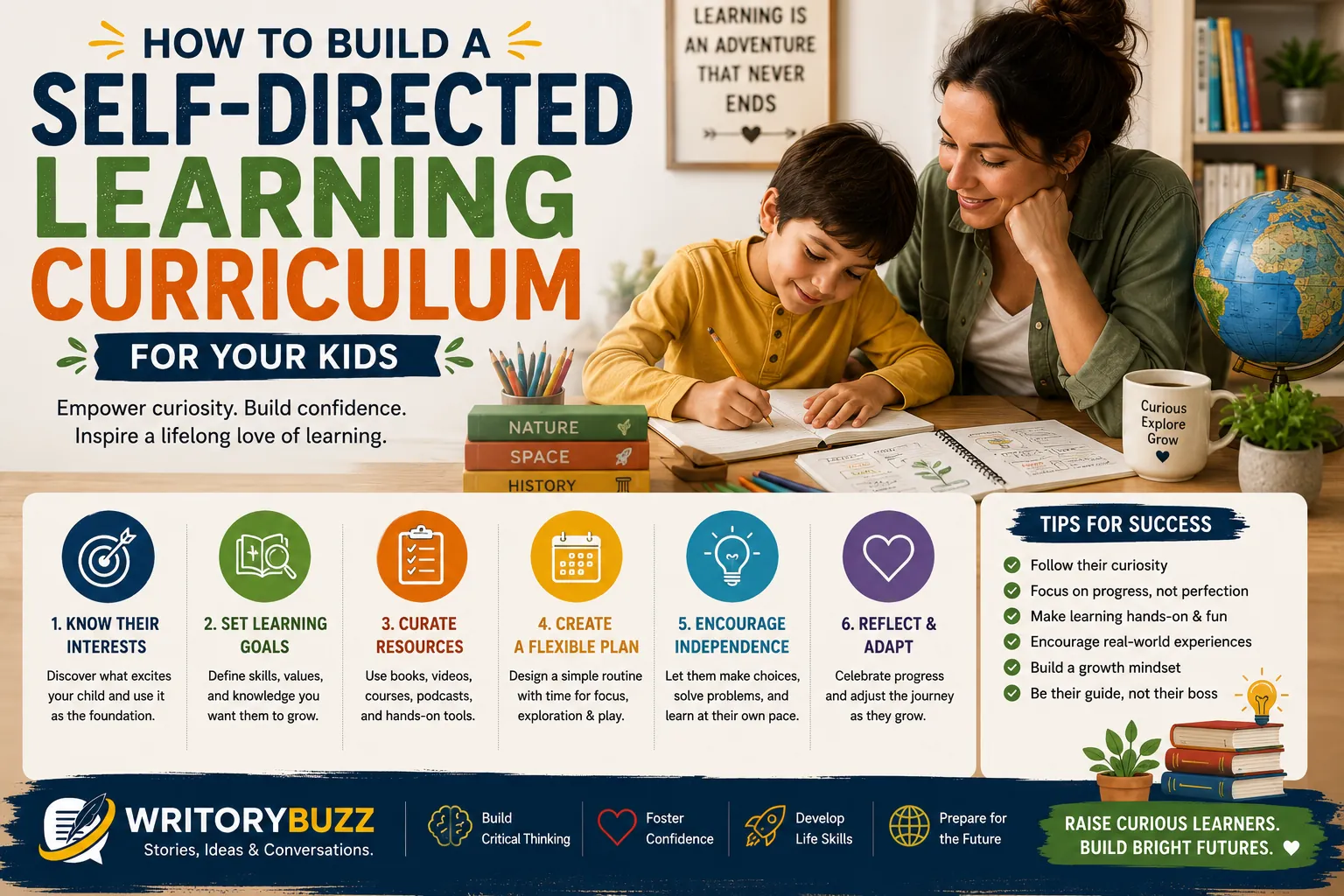
Self-directed learning does not mean unguided learning. It means that children exercise agency in the direction of their education, pursuing genuine curiosity with adult support rather than adult prescription. Research from the Alliance for Self-Directed Education and longitudinal studies of democratic school graduates consistently shows that intrinsic motivation produces deeper, more durable learning than external requirements.
Building a self-directed learning curriculum involves providing the conditions, resources, and structure within which children can direct their own learning journeys. The adult role shifts from instructor to learning environment designer and resource provider. This requires more thoughtfulness than delivering a standard curriculum, not less.
The Foundation: Understanding Self-Directed Learning
Self-directed learning exists on a spectrum. At one end, unschooling trusts completely in children’s natural curiosity without any prescribed curriculum. At the other end, structured homeschooling closely follows national curriculum standards with adult-directed instruction. Most effective self-directed learning for home-educated children sits in a productive middle: core skills with structured support, and significant freedom in the application and extension of those skills.
What research shows: Dr. Peter Gray’s research on children educated through self-directed approaches found they develop strong self-regulation, intrinsic motivation, and ability to identify and pursue meaningful goals. They perform comparably to traditionally educated peers on standardised assessments despite spending significantly less time on direct instruction.
Building the Framework by Age
Ages 5 to 8: Playful Foundations
At this age, learning and play are not meaningfully separate. The curriculum objective is broad: numeracy exposure (counting, patterns, basic operations through games and daily life), literacy development (read-aloud, phonics games, early writing), and rich exposure to science, history, art, and music through books, documentaries, and hands-on activities. No formal sit-down lessons are required and in most cases are counterproductive for this age group.
Practical structure: Morning read-aloud (20 to 30 minutes daily is the single most impactful literacy activity), free play time, one structured activity choosing from arts, nature, or a simple project. Weekly library visit. No formal assessments.
Ages 9 to 12: Developing Autonomy
The middle childhood years are where self-directed learning frameworks establish their long-term effectiveness. Children this age can engage with longer projects, develop specific interests into real competence, and begin to understand their own learning preferences.
Weekly structure: Core skills daily (mathematics through Khan Academy or similar, writing practice through journaling or project documentation, reading both chosen and guided texts). Interest project 2 to 3 hours weekly. Physical activity. Weekly planning conversation where the child identifies what they want to learn and the parent identifies any gaps to address.
The interest project: One extended project per term in an area of genuine interest. Medieval history, marine biology, game design, cooking, music composition. The project drives research, writing, maths application, and presentation skills through genuine motivation.
Ages 13 to 16: Deeper Specialisation
Teenagers in self-directed frameworks benefit from increasing autonomy and more significant real-world engagement: apprenticeships, online courses from real institutions (Khan Academy, Coursera, MIT OCW), community projects, and part-time work. Formal qualification pathways (GCSEs, IGCSEs, A-Levels, or equivalent) become relevant if university is a consideration.
Core Skills That Need Structured Support
Self-directed learning is not effective for foundational skills that require explicit, systematic instruction: phonics and decoding, basic numeracy, and writing mechanics. These require structured teaching, not just exposure. The error in many self-directed frameworks is under-investing in explicit phonics and maths fact fluency instruction in early years on the assumption that interest-led learning will eventually cover them. It usually does not.
Documentation and Portfolio
Building a learning portfolio serves multiple purposes: it provides the record required by home education authorities in many jurisdictions, it helps children see their own growth and development, and it documents competencies for future educational or employment applications.
Simple portfolio system: A physical folder or digital folder (Notion, Google Drive) organised by subject area. Weekly 5-minute review where the child adds one item from the week’s learning. Quarterly review where the family discusses progress and sets upcoming interests. This takes minimal time and produces a meaningful record.
What is self-directed learning for children?
Self-directed learning is education where children exercise agency in the direction of their learning, pursuing genuine curiosity with adult support rather than adult prescription. It ranges from fully unstructured unschooling to structured homeschooling with significant child agency. Research shows intrinsic motivation produces deeper and more durable learning than externally required instruction.
How do you structure self-directed learning for different ages?
Ages 5 to 8: playful, read-aloud focused, no formal instruction required. Ages 9 to 12: daily core skills (maths, writing, reading) with extended interest projects driving real learning depth. Ages 13 to 16: increasing autonomy, real-world engagement, online courses, and consideration of formal qualifications if relevant.
What core skills still need structured teaching in self-directed learning?
Phonics and reading decoding, basic numeracy and maths fact fluency, and writing mechanics require explicit systematic instruction that interest-led learning alone does not reliably produce. These foundational skills need structured teaching; everything built on them can then be self-directed.
How do you document self-directed learning for legal or portfolio purposes?
A simple portfolio: a physical or digital folder organised by subject where the child adds one item weekly from their learning. Quarterly reviews document progress and interests. Most home education authorities accept portfolios as evidence of educational provision. The child’s involvement in maintaining the portfolio develops metacognitive awareness.
Is self-directed learning better than traditional schooling?
Research shows self-directed learners develop strong intrinsic motivation and self-regulation. Traditional schooling provides systematic curriculum coverage, social environment, and credentialing infrastructure. Neither is universally superior. Self-directed learning works best when the home environment is rich, the child has genuine curiosity, and foundational skills are systematically supported.
What resources work best for self-directed home education?
Khan Academy for structured maths progression (free, self-paced). MIT OCW and Coursera for older learners. Library access for broad reading. Documentary platforms (BBC iPlayer, CuriosityStream) for science, history, and nature. Local community groups, museums, and apprenticeships for real-world engagement.
The Environment Is the Curriculum
The most important variable in self-directed learning is the richness of the environment: the books available, the conversations that happen, the places visited, the projects undertaken, and the adults who model curiosity and lifelong learning. Children learn what surrounds them. Design the environment and the curriculum follows.
Every child learns differently, and the right approach can inspire a lifelong love of learning. Discover more parenting advice, educational resources, and practical learning strategies with WritoryBuzz to help your child grow with confidence and curiosity.