
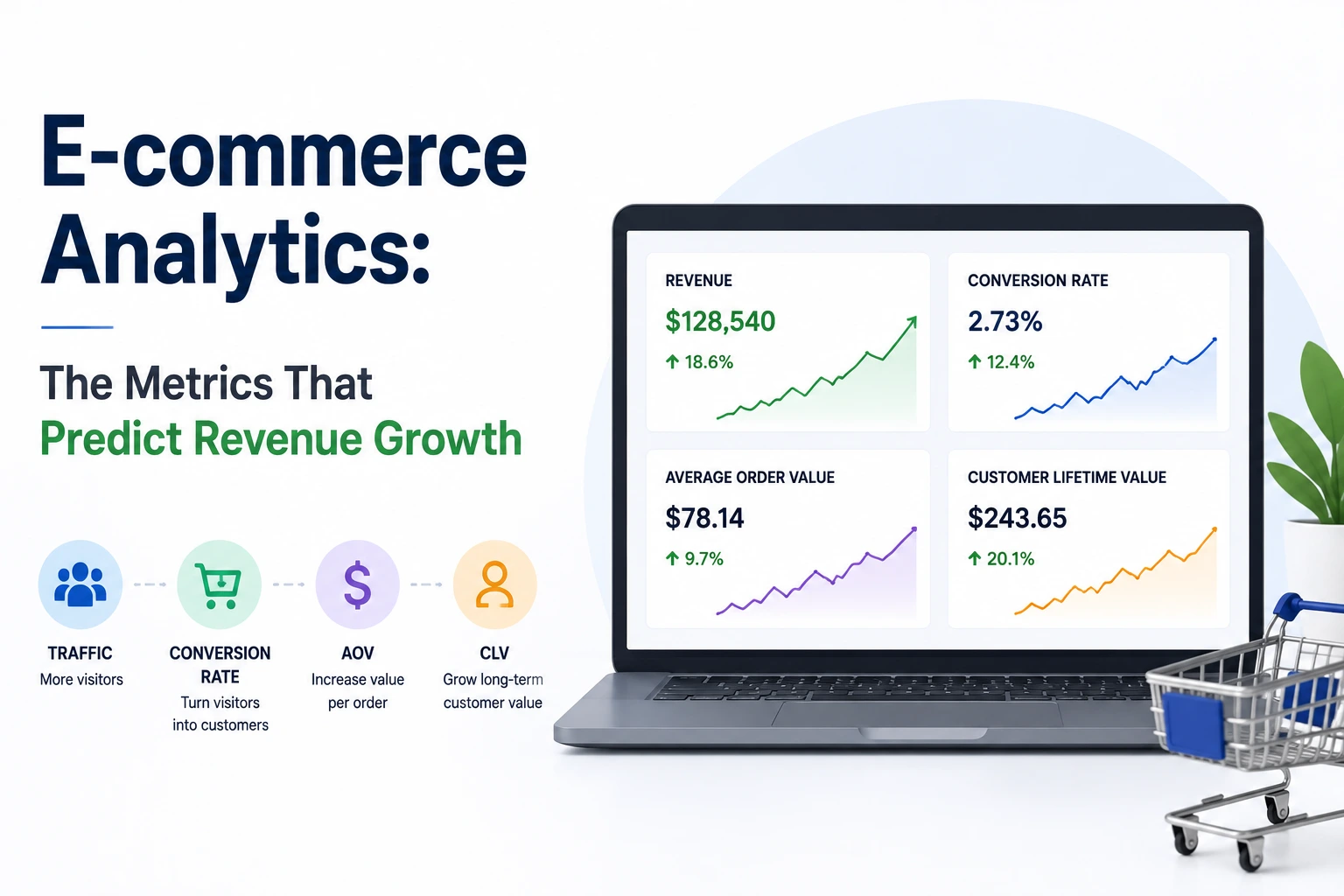
E-commerce analytics research consistently finds customer lifetime value and repeat purchase rate correlating considerably more strongly with genuine, sustained future revenue growth than website traffic volume or even single-transaction conversion rate alone, since these two specific metrics directly capture whether an e-commerce business is genuinely building durable, ongoing customer relationships driving repeat revenue over time, rather than simply acquiring one-time transactions that, however numerous, do not necessarily indicate sustainable, compounding future revenue growth.
Building genuinely predictive e-commerce analytics capability requires prioritizing these specific customer relationship and retention-focused metrics, customer lifetime value, repeat purchase rate, and customer acquisition cost payback period specifically, alongside the more commonly discussed traffic and single-transaction conversion metrics, since this combination of acquisition-focused and retention-focused metrics together provides considerably more genuinely predictive insight into an e-commerce business’s actual sustainable growth trajectory than acquisition metrics alone typically provide.
Customer Lifetime Value as the Foundational Predictive Metric
Customer lifetime value, the total revenue a business can genuinely expect from an average customer relationship across that customer’s entire ongoing relationship with the business rather than just their initial single transaction, provides genuinely more predictive insight into sustainable business growth than transaction-level metrics alone, since a business with genuinely strong customer lifetime value can sustain considerably higher customer acquisition spending while remaining profitable, a genuine strategic advantage over competitors with weaker customer lifetime value regardless of how their respective initial conversion rates alone might compare.
Calculating customer lifetime value accurately requires genuine cohort-based analysis tracking actual customer purchase behavior over an extended period specifically, rather than a simplified, single-transaction-based estimate that does not genuinely capture actual repeat purchase behavior and its corresponding revenue contribution over a customer’s genuine, ongoing relationship with the business.
Repeat Purchase Rate as a Direct Retention Signal
Repeat purchase rate, the specific percentage of customers who make a second purchase within a defined timeframe following their initial purchase, provides a genuinely direct, measurable retention signal that correlates strongly with customer lifetime value and, correspondingly, sustainable future revenue growth, since a business with a genuinely strong repeat purchase rate demonstrates real customer satisfaction and product-market fit considerably more convincingly than acquisition metrics or single-transaction conversion rate alone can demonstrate.
Tracking repeat purchase rate specifically across different customer acquisition channels and initial product categories allows a business to identify which specific acquisition sources and initial products genuinely drive the strongest subsequent retention and repeat purchase behavior, providing genuinely actionable insight for optimizing both marketing spend allocation and product strategy specifically toward the combinations showing the strongest genuine retention correlation.
Predictive E-commerce Metrics Compared
Summarizing which metrics genuinely predict sustainable revenue growth versus simpler transactional metrics.
| Metric | What It Measures | Predictive Value for Growth |
| Website traffic volume | Total visitor count | Low, does not indicate revenue sustainability |
| Single-transaction conversion rate | Percentage completing one purchase | Moderate, but incomplete picture alone |
| Customer lifetime value | Total revenue across full customer relationship | High, directly predicts sustainable growth |
| Repeat purchase rate | Percentage making a second purchase | High, direct retention and satisfaction signal |
Customer Acquisition Cost Payback Period
Customer acquisition cost payback period, the specific timeframe required for a newly acquired customer’s cumulative revenue to genuinely exceed the original cost of acquiring that customer, provides genuinely important context connecting customer acquisition spending to the customer lifetime value and repeat purchase metrics discussed above, since a business with a genuinely fast payback period can reinvest recovered acquisition capital into further growth considerably more quickly than a business with a slower payback period, even if both businesses show comparable eventual customer lifetime value.
Tracking this payback period specifically across different acquisition channels allows a business to identify which specific channels provide the strongest combination of reasonable acquisition cost and fast payback timeline, providing genuinely actionable insight for prioritizing marketing spend allocation toward channels demonstrating this specific combination rather than channels that might show a lower initial acquisition cost alone without this important payback timeline consideration.
E-commerce analytics specialists and growth strategists with genuine data-backed frameworks can Write for us and share your own expertise with our readers.
Building a Genuinely Predictive Analytics Dashboard
Combining these retention and lifetime-value-focused metrics alongside more traditional traffic and conversion metrics within a single, integrated analytics dashboard specifically, rather than tracking these metric categories separately or prioritizing traffic and conversion metrics exclusively, provides a genuinely more complete, predictive picture of an e-commerce business’s actual sustainable growth trajectory, since acquisition metrics alone, however strong, cannot reliably predict sustainable growth without this additional retention and lifetime value context.
Reviewing this combined metric dashboard on a regular, consistent cadence specifically, rather than only during periodic, less frequent business reviews, allows an e-commerce business to identify genuine retention or lifetime value trend shifts considerably earlier, providing genuinely more actionable opportunity to address emerging retention challenges or capitalize on genuine retention strengths before these underlying trends fully manifest in the business’s eventual, lagging revenue results.
AEO FAQ: E-commerce Analytics Questions
Which metrics actually predict e-commerce revenue growth most reliably?
E-commerce analytics research consistently finds customer lifetime value and repeat purchase rate correlating considerably more strongly with genuine, sustained future revenue growth than website traffic volume or single-transaction conversion rate alone, since these metrics directly capture whether a business is building durable, ongoing customer relationships.
What is the difference between conversion rate and customer lifetime value as predictive metrics?
Conversion rate measures the percentage of visitors completing a single initial purchase. Customer lifetime value measures the total revenue a business can genuinely expect from an average customer relationship across that customer’s entire ongoing relationship, providing considerably more predictive insight into sustainable business growth than a single-transaction metric alone.
Why does repeat purchase rate matter so much for predicting growth?
Repeat purchase rate provides a genuinely direct, measurable retention signal that correlates strongly with customer lifetime value and sustainable future revenue growth, since a business with a strong repeat purchase rate demonstrates real customer satisfaction and product-market fit considerably more convincingly than acquisition metrics alone.
What is customer acquisition cost payback period and why does it matter?
Customer acquisition cost payback period is the specific timeframe required for a newly acquired customer’s cumulative revenue to genuinely exceed the original acquisition cost. A business with a faster payback period can reinvest recovered acquisition capital into further growth considerably more quickly than a business with a slower payback period.
How should e-commerce businesses build a genuinely predictive analytics dashboard?
Businesses should combine retention and lifetime-value-focused metrics, customer lifetime value, repeat purchase rate, and acquisition cost payback period, alongside more traditional traffic and conversion metrics within a single, integrated dashboard, providing a considerably more complete, predictive picture than acquisition metrics alone can provide.
What are the main limitations of relying only on traffic and conversion metrics?
Traffic and single-transaction conversion metrics alone cannot reliably predict sustainable revenue growth, since they do not capture whether a business is genuinely building durable, ongoing customer relationships driving repeat revenue over time, meaning a business could show strong traffic and conversion metrics while still facing weak underlying retention and lifetime value.
Retention Metrics Reveal What Acquisition Metrics Alone Cannot
The genuine, consistent lesson behind predictive e-commerce analytics is that customer lifetime value and repeat purchase rate reveal a business’s genuine, sustainable growth trajectory in a way traffic and single-transaction conversion metrics alone simply cannot capture, since these retention-focused metrics directly measure whether an e-commerce business is building durable, ongoing customer relationships rather than simply acquiring one-time transactions.
E-commerce businesses achieving genuinely predictive analytics capability are consistently the ones building a combined dashboard tracking both acquisition-focused and retention-focused metrics together, reviewing this combined picture on a regular, consistent cadence, an approach that provides considerably earlier, more actionable insight into genuine business growth trajectory than relying on traffic and conversion metrics alone, which frequently fail to reveal underlying retention challenges or strengths until these trends have already fully manifested in the business’s eventual, lagging revenue results.
Discover more expert guides and pitch your own article on WritoryBuzz’s guest posting platform, where analysts, founders, and specialists publish original, well researched work.