
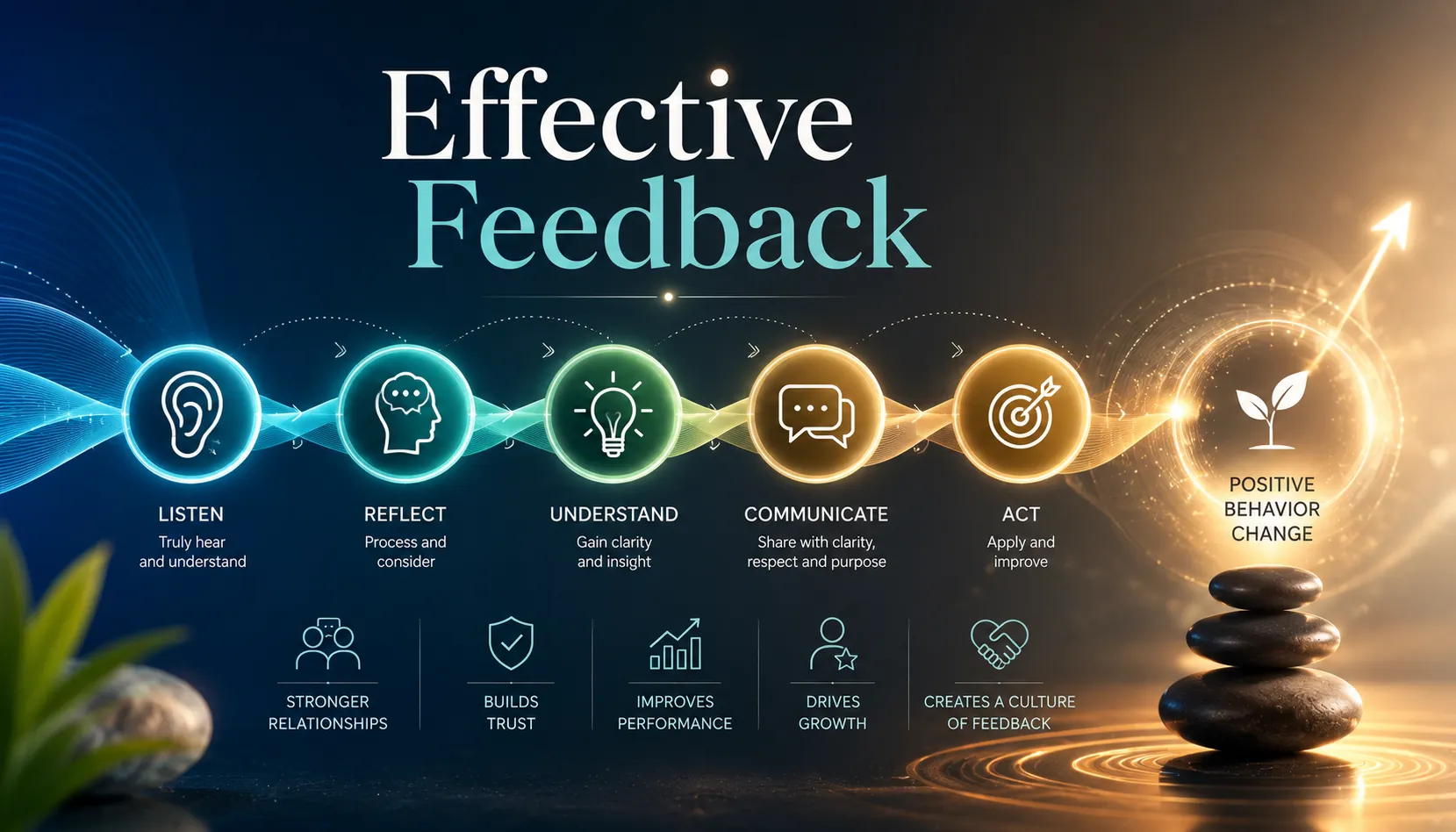
According to Gallup, only 26% of employees say the feedback they receive actually helps them do better work. That means three out of four feedback conversations are happening, taking time, sometimes damaging relationships, and producing nothing.
The problem is not that managers are giving too much feedback. It is that most feedback is too vague to act on, too personal to receive without defensiveness, or too delayed to connect to specific behavior.
Here is what research and practice show about feedback that genuinely changes how people work.
Why Vague Feedback Is Useless Feedback
‘You need to be more of a team player.’ What does that mean? Talk more in meetings? Volunteer for projects? Help colleagues without being asked? The person receiving this feedback cannot act on it because there is no specific behavior to change.
Vague feedback is often the result of a manager trying to be kind by softening the message. The kindness backfires. A person who does not know precisely what they did wrong cannot stop doing it. A person who does not know exactly what they did right cannot repeat it.
The SBI Model: What It Is and Why It Works
SBI stands for Situation, Behavior, Impact. Developed by the Center for Creative Leadership, it is the most rigorously researched framework for giving specific, actionable feedback.
| SBI Component | Example | Why It Matters |
| Situation | Anchor the feedback to a specific moment: ‘During Tuesday’s project review meeting’ | Removes ambiguity about when and where |
| Behavior | Describe the observable action, not the intention or personality trait: ‘you interrupted three colleagues before they finished their points’ | Focuses on what can be changed, not who the person is |
| Impact | State the effect of that behavior: ‘it meant two of the team’s concerns were not addressed before the decision was made’ | Connects the behavior to consequences the person can care about |
A complete SBI statement: ‘During Tuesday’s project review (Situation), you interrupted three colleagues before they finished their points (Behavior). As a result, two of the team’s concerns about the timeline were not addressed before the decision was made (Impact).’
Compare this to: ‘You need to let people finish speaking.’ The SBI version gives the person something specific to change, in a specific context, with a specific reason to change it.
SBII: Adding Intent for Complex Conversations
For situations where the impact and the person’s intent may have diverged, add a fourth step: Intent.
After stating the SBI, ask: ‘What were you trying to achieve in that moment?’ This opens a dialogue. It acknowledges that the person may have had good intentions and shows you are interested in understanding rather than just judging.
This is most useful for performance conversations where the behavior was not clearly negative, just misaligned with outcomes.
Why the Feedback Sandwich Does Not Work
The feedback sandwich (positive, negative, positive) is widely criticized because it trains people to brace for bad news every time they hear a compliment. Over time, the positive feedback loses its meaning and the negative feedback becomes something people learn to wait for and dismiss.
SBI is direct and specific without requiring softening. It does not need artificial positive framing because the approach itself is respectful: it focuses on observable behavior, not character.
The Timing and Delivery Principles
Give feedback as close to the event as possible
Feedback given a week after the behavior requires the person to reconstruct the context. Feedback given the same day, or the next morning, is immediately actionable. Saving feedback for quarterly reviews is one of the most common mistakes managers make.
Choose the right channel
Positive SBI feedback works well in written form (Slack, email) because people can re-read it and the public visibility can reinforce good behavior. Constructive SBI feedback should happen face-to-face or on video, where tone and body language prevent misreading.
Make it a two-way conversation
After delivering SBI feedback, stop. Let the person respond. Listen to their perspective before explaining further. The most common mistake after good feedback delivery: continuing to talk and burying the core message in additional context.
Feedback for Different Situations
| Scenario | How to Apply SBI |
| Positive reinforcement | SBI: ‘In this morning’s sprint planning (S), you summarized the team’s concerns clearly before moving forward (B). It aligned everyone and saved 20 minutes of back-and-forth (I).’ |
| Performance correction | SBI: ‘During the client call on Wednesday (S), you committed us to a three-week timeline without checking with the team (B). We are now in a difficult position on resourcing (I).’ |
| Peer feedback | SBI works between colleagues too: same structure, same specificity, different relationship tone |
| Positive but privately | Written SBI on Slack works well; lets the person re-read and absorb without pressure |
Common Mistakes
- Giving feedback that describes a personality trait rather than an observable behavior: ‘you are disorganized’ instead of ‘the three reports this week were missing the data tables we agreed would be included’
- Saving all feedback for the annual review; behavioral change requires timely, specific feedback, not a year-end summary
- Using SBI once and expecting permanent change; repeated, specific feedback across multiple conversations builds habits
- Skipping the impact step; behavior without consequence gives the person no reason to change
FAQ
What is the SBI feedback model?
SBI stands for Situation, Behavior, Impact. Developed by the Center for Creative Leadership, it is a structured framework for giving feedback that is specific, behavior-focused, and actionable. It directs feedback toward observable actions rather than personality traits, making it easier to receive and act on.
Why does most workplace feedback fail to change behavior?
Because it is too vague, too delayed, or too personal. Vague feedback gives nothing specific to change. Delayed feedback cannot be connected to the specific moment it refers to. Personal feedback (attacking character rather than behavior) triggers defensiveness rather than reflection. SBI addresses all three problems.
How do I give feedback without the person getting defensive?
Focus on observable behavior rather than character or intention. Describe what you saw and its impact, not what it says about the person. Adding the Intent step from SBII (asking what they were trying to achieve) further reduces defensiveness by showing genuine curiosity rather than judgment.
Clear, actionable communication is one of the most valuable workplace skills. WritoryBuzz creates practical leadership and professional development content that helps readers improve performance, collaboration, and workplace relationships.