

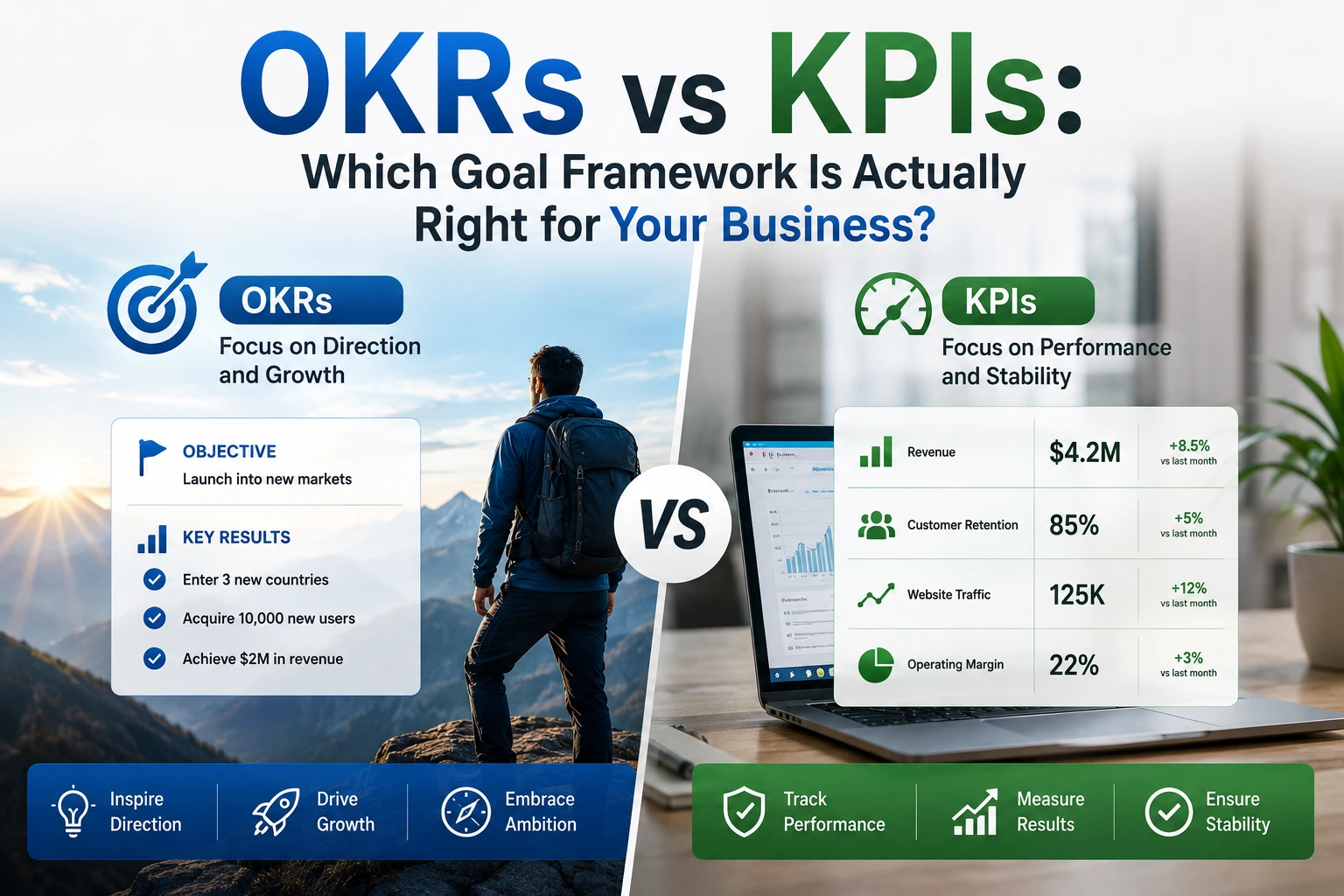
Google has used OKRs (Objectives and Key Results) since 1999, when John Doerr introduced the framework to a 40-person company. Intel developed the original OKR system under Andy Grove in the 1970s. LinkedIn, Airbnb, Twitter, and Spotify have all published accounts of their OKR implementations. At the same time, the vast majority of businesses running performance measurement systems rely on KPIs (Key Performance Indicators) as their primary tool. These are not competing systems with one correct answer. They solve different problems, and confusing them is one of the most common sources of measurement dysfunction in organisations.
The persistent confusion between OKRs and KPIs is not a naming problem. It is a conceptual problem. Most people introduced to OKRs for the first time attempt to translate their existing KPI list into OKR format without changing the underlying approach to goal setting, which produces OKRs that function as renamed KPIs and deliver none of the distinctive benefits of the framework.
What KPIs Are and What They Do Well
KPIs are metrics that track the ongoing health and performance of business operations against established standards. They answer the question: “How are we performing against the expected baseline?” A customer support team’s KPI of maintaining a first response time below four hours is not a goal to reach; it is a standard to maintain. A SaaS company’s KPI of keeping monthly churn below 1.5 percent is not an aspiration; it is the threshold below which the business is operating within parameters.
KPIs are most effective when: the business process being measured is well understood, the acceptable performance range is established, the metric can be tracked continuously rather than at quarterly intervals, and deviation from the standard is more important to identify than ambitious improvement. KPIs answer operational questions and keep business functions running within parameters. They are not designed to drive step-change improvement or organisational alignment around ambitious goals.
The limitations of KPI-only goal management are well documented in management literature. KPIs track what is already happening; they do not direct resources toward what should happen next. A business running only KPIs can maintain every metric within range while failing to make the strategic investments required for future competitive position. Blockbuster’s operational KPIs were reportedly in good standing for several years while Netflix’s subscriber growth was compounding.
What OKRs Are and What They Do Well
OKRs consist of an Objective (a qualitative statement of where the organisation is trying to go) and two to five Key Results (specific, measurable outcomes that define what reaching the Objective looks like). The Objective should be ambitious enough to require genuine prioritisation and resource allocation. The Key Results should be measurable with a specific target value, not a binary yes/no.
John Doerr’s formulation in “Measure What Matters” (2018) defines well-formed OKRs as: “I will [Objective] as measured by [Key Results].” Google’s documented approach expects teams to achieve 70 percent of each Key Result as a sign of appropriate ambition: consistent 100 percent achievement signals that the Key Results were not ambitious enough. Consistent 40 percent or below signals that they were unrealistic or under-resourced.
OKRs are most effective when: the organisation needs to make directional decisions about where to focus limited resources, teams need to align around shared priorities rather than optimise their individual functions independently, the improvement required is step-change rather than incremental, and the measure of success is outcome-level (revenue, customer satisfaction, product adoption) rather than activity-level (calls made, features shipped).
The Practical Difference: A Worked Example
A product team at a B2B SaaS company illustrates the distinction clearly.
Their KPI: feature deployment success rate above 98 percent with fewer than two customer-reported bugs per release. This is a standard of operational quality to maintain.
Their OKR for Q3 2026:
Objective: Become the first choice for enterprise onboarding in our category.
Key Result 1: Reduce time-to-first-value for enterprise customers from 14 days to 7 days.
Key Result 2: Achieve an onboarding NPS of 60 or above (from current 42).
Key Result 3: Launch three enterprise-specific onboarding templates used by at least 40 customers.
The KPI tells the team what quality floor to maintain. The OKR tells the team where to invest discretionary effort and what strategic outcome justifies trade-offs.
| Dimension | KPIs | OKRs |
|---|---|---|
| Time horizon | Ongoing / continuous | Quarterly or annual cycles |
| Purpose | Maintain standards | Drive change and alignment |
| Ambition level | Achievable (90–100% expected) | Stretch (70% achievement is healthy) |
| Direction | Operational health | Strategic direction |
| Audience | Functional teams | Cross-functional and leadership |
| Failure signal | Below-threshold requires investigation | Below 40% requires resourcing review |
| Example | Churn < 1.5% | Increase net revenue retention to 115% |
How to Use Both Systems Together
The most effective approach in practice is running both in parallel rather than choosing between them. KPIs provide the operational floor below which functions are failing. OKRs provide the strategic ceiling toward which resources should be directed each quarter. The two systems operate on different timescales and answer different questions.
The connection point between the two systems is that Key Results in OKRs often influence which KPIs are watched most closely in a given quarter. A company with an OKR focused on enterprise expansion will elevate enterprise-specific KPIs (enterprise churn, enterprise NPS, enterprise ARR) to more prominent monitoring status during that OKR cycle without abandoning the operational KPIs that keep the rest of the business functioning.
The common failure mode when combining both systems is KPI proliferation: adding new KPIs for every new initiative without retiring old ones, until the organisation is monitoring 40 or more metrics and can prioritise none of them. Ben Horowitz’s principle that every team should be able to answer “what is the one metric most important to the company right now” is a useful check on this pattern.