
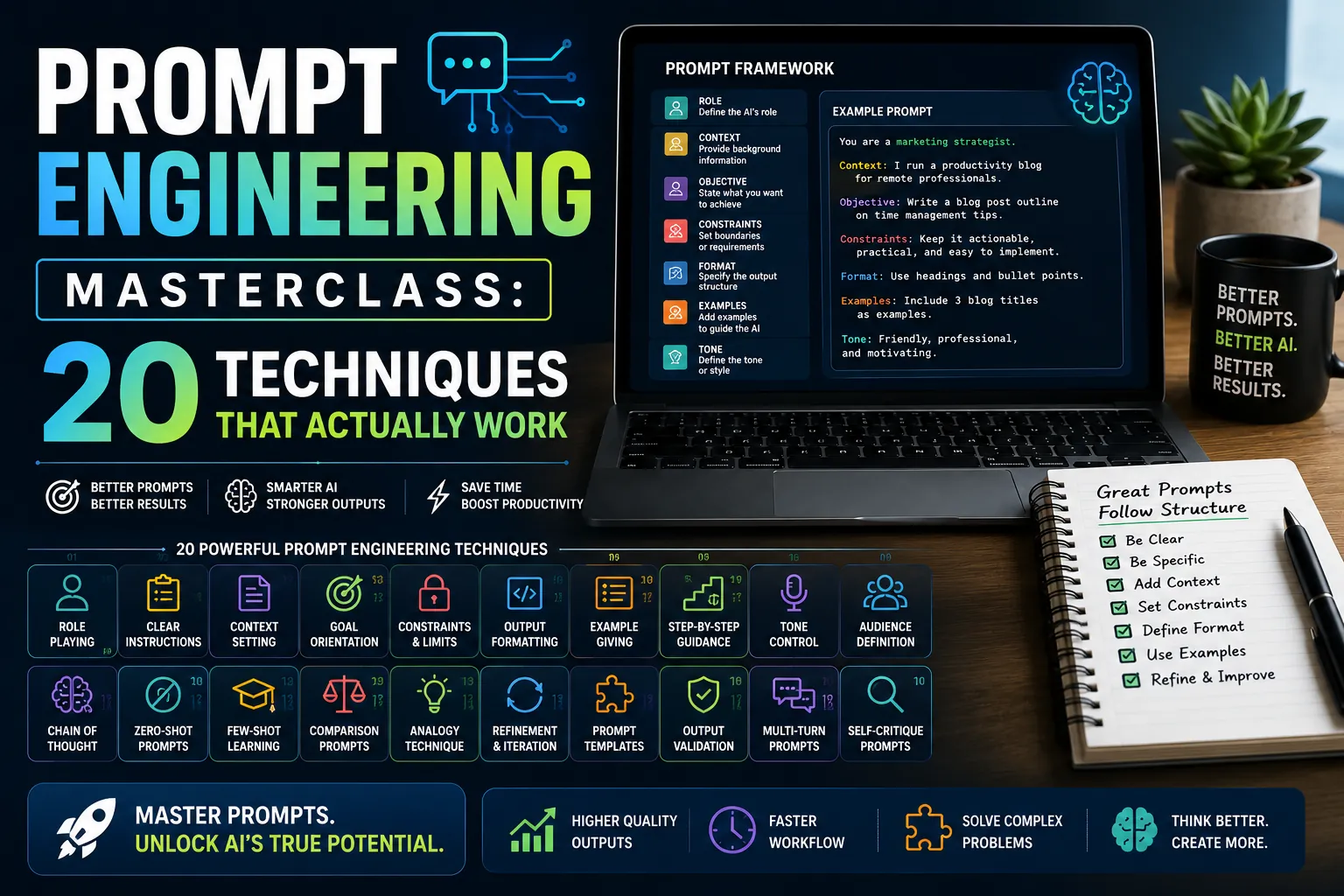
Prompt engineering is now a $6.95 billion discipline growing at 33 percent annually. The gap between amateur and expert prompting is measurable: research-backed techniques improve output quality by 20 to 60 percent on standardised benchmarks. Most people use AI at 10 percent of its potential.
The core insight behind all prompt engineering techniques is simple: the same AI model produces radically different outputs depending entirely on how the prompt is written. In 2026, with 90 percent of developers using at least one AI tool daily, the ability to write effective prompts separates people who get genuinely useful AI output from those who conclude that AI is not that impressive.
These 20 techniques are ordered from foundational to advanced. Start from the beginning even if you are experienced. The fundamentals explain why the advanced techniques work.
The 5 Foundational Prompt Engineering Techniques
1. Zero-Shot Prompting
Zero-shot prompting gives the model a clear task with no examples. It works when the task is common enough that the model has extensive training data to draw on. The quality depends entirely on specificity. ‘Write a product description’ is zero-shot but vague. ‘Write a 100-word product description for a standing desk targeting remote workers aged 25 to 40, emphasising posture and energy, in a conversational tone’ is zero-shot and specific. The second version produces usable output. The first produces generic text.
2. Few-Shot Prompting
Providing two to five input-output examples before your actual request teaches the model the pattern you want it to replicate. This is the single most reliable technique for controlling output format, tone, and style. If you want a specific kind of email subject line, show three examples of the subject lines you like, then ask for a new one in the same pattern. Few-shot prompting dramatically improves consistency across repeated tasks.
3. Role Prompting
Assigning the model a specific identity produces outputs shaped by that identity’s conventions, vocabulary, and perspective. ‘You are a senior direct-response copywriter with 15 years of experience in SaaS’ produces different output from a plain instruction. The role activates related knowledge clusters and applies the relevant professional conventions. Combine role prompting with few-shot examples for the highest control over output style.
4. Chain-of-Thought (CoT) Prompting
Chain-of-thought prompting instructs the model to work through a problem step by step before producing the final answer. It consistently improves performance on maths, logic, and multi-step reasoning tasks. Research shows CoT improves accuracy on maths and logic benchmarks by 15 to 40 percent compared to direct-answer prompting. The simplest implementation: add ‘Think through this step by step before answering’ to any analytical prompt. The model externalises its reasoning, which both improves accuracy and lets you check the logic.
5. Instruction Formatting: The RCTF Framework
Strong prompts contain four elements: Role (who the model is), Context (the specific situation), Task (exactly what to produce), and Format (length, structure, tone constraints). Most poor prompts are missing two or three of these. A prompt with all four consistently outperforms a prompt with one. Write prompts like a creative brief, not like a search query.
Intermediate Prompt Engineering Techniques
6. Negative Constraints
Telling the model what NOT to do is as important as telling it what to do. ‘Write a product description. Do not use the words innovative, seamless, or leverage. Do not use passive voice. Do not exceed 150 words.’ Negative constraints prevent the generic AI patterns that make outputs feel templated. Every professional prompt should include a do-not list.
7. Output Specification
Specify the exact format you want before the model writes anything. ‘Respond only in valid JSON. No other text.’ or ‘Use only H2 and H3 headings. No bullet points. Every paragraph under four sentences.’ Format specifications prevent the model from choosing defaults that do not match your workflow. This is especially important when AI outputs feed into automated pipelines.
8. Persona Separation
For long tasks or documents, instruct the model to maintain a consistent persona throughout. ‘You are writing as Maya, a financial journalist who is sceptical of crypto claims and always cites data sources. Maintain this voice for the entire article.’ Without persona anchoring on long outputs, the model drifts toward its default voice mid-document.
9. Self-Refinement Prompting
After receiving an initial output, prompt the model to critique and improve its own work. ‘Review your previous response. Identify the three weakest parts and rewrite them to be more specific and evidence-based.’ Self-refinement adds 10 to 25 percent quality improvement on analytical and creative tasks according to benchmark data. It is a faster route to a good result than writing a new prompt from scratch.
10. Iterative Decomposition
Break complex tasks into sequential steps with one prompt per step, feeding the output of each into the next. Summarise, then translate, then proofread, then format: four prompts in sequence rather than one overwhelming instruction. This pipeline approach dramatically improves quality on tasks involving multiple distinct operations. The model handles each sub-task with full attention rather than dividing focus across all steps simultaneously.
Advanced Prompt Engineering Techniques for 2026
11. Tree-of-Thought (ToT) Prompting
Tree-of-thought forces the model to explore multiple reasoning paths simultaneously and evaluate which is strongest before committing to a conclusion. Prompt: ‘Consider three different approaches to solving this problem. Evaluate the strengths and weaknesses of each, then recommend the best one with justification.’ ToT is particularly effective for strategic decisions, complex analysis, and problem-solving tasks where the first answer is rarely the best one.
12. Meta-Prompting
Prompt the model to write the optimal prompt for your goal, then use that prompt. ‘I want to generate a detailed competitive analysis of two SaaS products. Write the optimal prompt that would produce this. Then use that prompt.’ This recursive technique often produces more effective prompt structures than human intuition. Meta-prompting is also the foundation of automated prompt optimisation systems like DSPy.
13. ReAct (Reason + Act) Patterns
The ReAct pattern structures agentic AI tasks as a loop: Think about what to do, Act (use a tool or generate output), Observe the result, repeat. This Think-Act-Observe cycle is the foundation of autonomous AI agents. For complex multi-step tasks, structuring your prompts around this loop dramatically improves consistency. Important for anyone building workflows where AI takes sequential actions.
14. Constitutional Prompting
Define a set of principles the model must follow throughout a task, stated at the start of the system prompt. ‘In all responses: cite specific data when making factual claims, never use superlatives without evidence, flag uncertainty explicitly with phrases like “research is mixed” or “this is contested.”‘ Constitutional constraints apply globally to all outputs in the conversation, reducing the need to repeat constraints in every follow-up prompt.
15. Context Window Management
For long documents, use explicit document IDs and structured task breakdowns to maintain coherence. ‘Document A is the financial report. Document B is the analyst commentary. For each document, identify the three key claims. Then compare across documents in a table.’ Without explicit structure on large-context tasks, models lose track of which document they are currently working with. Explicit IDs solve this.
16. XML Tag Structuring (Claude-Specific)
Claude responds significantly better to XML tag structure than to markdown or plain text delimiters. Wrapping instructions in tags like <task>, <context>, <constraints>, and <format> provides unambiguous structure that Claude parses reliably. For complex multi-part prompts, XML structuring reduces misinterpretation. GPT models respond better to concise JSON-style schemas. Match your structuring approach to the model you are using.
17. Anchor and Reference Prompting
For multi-turn conversations, explicitly reference earlier outputs to maintain coherence. ‘Using the framework you outlined in your previous response, now apply it to these three case studies.’ Without explicit anchoring, models in long conversations sometimes drift from earlier decisions. Anchoring keeps the model working within the constraints it has already established.
18. Confidence Calibration
Instruct the model to state its confidence level for each claim it makes. ‘For each point in your analysis, indicate whether you are highly confident (based on well-established evidence), moderately confident (based on limited evidence), or uncertain (speculative). Separate these clearly.’ This technique is particularly valuable for research, medical, legal, and financial tasks where hallucination risk is high.
19. Adversarial Stress Testing
After generating an important output, prompt the model to argue against its own conclusions. ‘You just made the case for approach A. Now argue as strongly as possible for why approach B is better.’ This forces the model to surface counterarguments it may have underweighted. The output of this adversarial step often reveals genuine weaknesses in the original analysis that can then be addressed.
20. Prompt Chaining With Validation Gates
Build validation checkpoints into multi-step prompt pipelines. After each step, include a prompt that asks the model to verify the previous output meets specific criteria before proceeding. ‘Before continuing, verify that the outline contains at least three distinct perspectives and one piece of supporting data per section. If not, revise it now.’ Validation gates prevent errors from propagating through a long pipeline undetected.
| Technique | Best For | Quality Lift | Complexity |
| Zero-shot (specific) | Single clear tasks | Baseline | Low |
| Few-shot (2-5 examples) | Format and tone control | High | Low |
| Chain-of-thought | Maths, logic, analysis | 15-40% | Low |
| Self-refinement | Any quality-sensitive task | 10-25% | Low |
| Tree-of-thought | Strategy, complex decisions | High | Medium |
| Meta-prompting | Finding best prompt structure | Variable | Medium |
| XML structuring (Claude) | Multi-part instructions | High | Low |
| Constitutional constraints | Long consistent outputs | Medium | Low |
| Validation gates | Multi-step pipelines | High | Medium |
Frequently Asked Questions About Prompt Engineering
What is prompt engineering and why does it matter in 2026?
Prompt engineering is the practice of designing AI inputs to produce reliable, high-quality outputs. It matters because the same model produces dramatically different results based on how instructions are written. Research-backed techniques improve output quality by 20 to 60 percent on standardised benchmarks.
Which prompt engineering technique works best for business tasks?
For most business tasks, combining Role Prompting with the RCTF framework (Role, Context, Task, Format) and negative constraints produces the strongest results. Few-shot examples are essential when output format and tone must match specific standards. Chain-of-thought adds significant value for any analytical or decision-making task.
What is chain-of-thought prompting and when should you use it?
Chain-of-thought prompting asks the model to reason step by step before giving a final answer. It improves accuracy on maths, logic, and multi-step reasoning tasks by 15 to 40 percent. Use it whenever a task involves calculation, analysis, or decisions that benefit from explicit reasoning rather than direct answers.
Does Claude respond differently to prompts than ChatGPT?
Yes. Claude responds significantly better to XML tag structuring and longer, more detailed prompts. ChatGPT responds well to concise system messages and JSON-style schemas. Claude handles complex multi-part instructions with larger context windows more reliably. Both benefit from few-shot examples, role prompting, and chain-of-thought approaches.
How can I stop AI from hallucinating in my prompts?
Use confidence calibration (ask the model to flag uncertain claims), constitutional constraints (require citation of sources), and validation gate prompting to check outputs before they proceed. For high-stakes content, always verify specific facts, statistics, and citations independently.
What is meta-prompting and how does it work?
Meta-prompting asks the AI to design the optimal prompt for your goal before executing the task. You describe what you want to achieve and ask the model to write the best prompt to achieve it, then use that prompt. This recursive technique often produces more effective prompt structures than manual prompt writing.
Start With Three, Build From There
If you implement nothing else from this guide, use these three techniques immediately: the RCTF framework for structure, negative constraints to block generic patterns, and chain-of-thought for any analytical task. These three changes will produce noticeably better output quality within the first session.
The advanced techniques become valuable once you are consistently applying the fundamentals. Prompt engineering skill compounds: every technique you internalise makes the others more effective because they interact.