
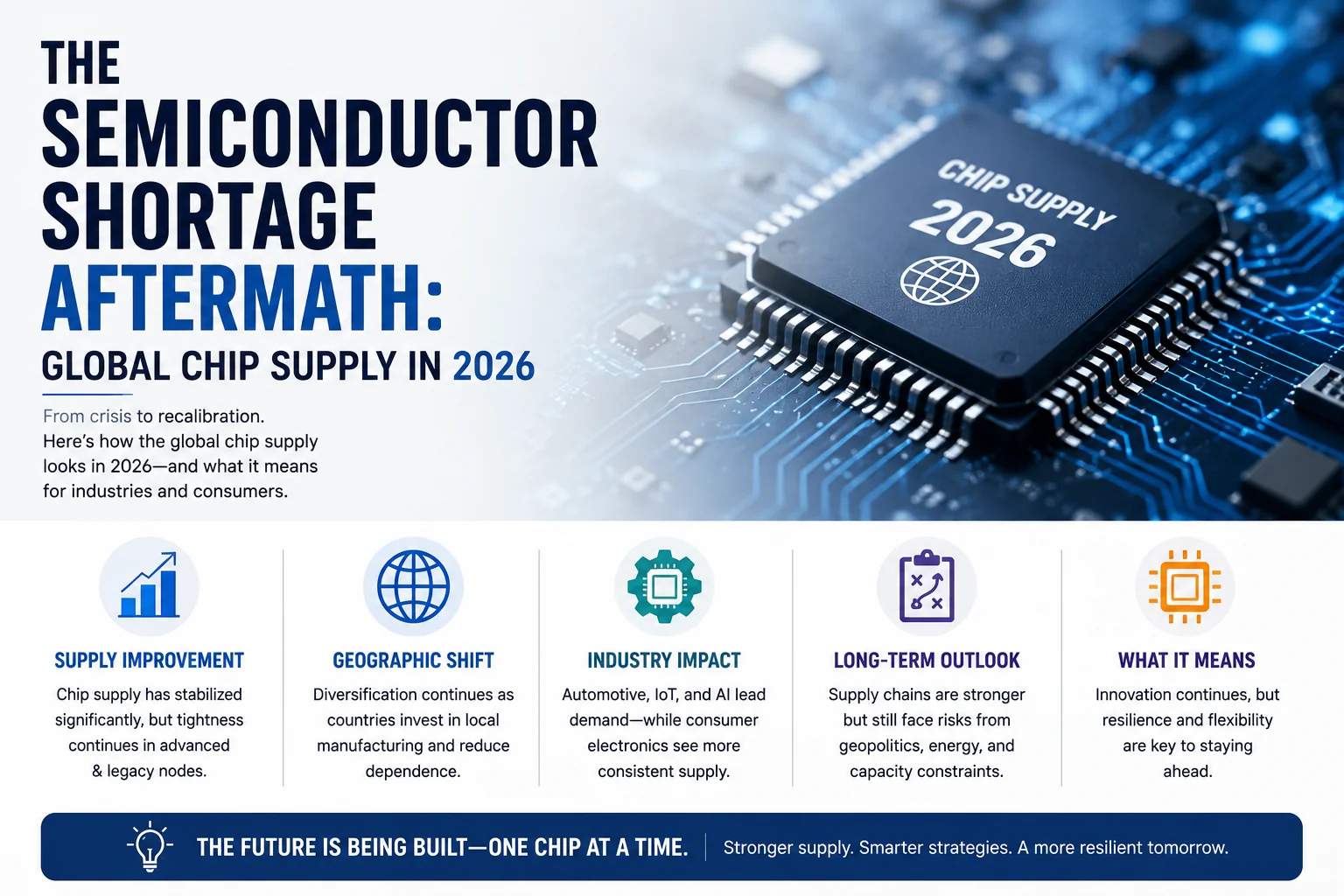
TSMC reported a revenue increase of 39 percent in 2024 to approximately 90 billion US dollars, driven primarily by AI chip demand from NVIDIA, Apple, and AMD. The US CHIPS and Science Act committed 52.7 billion US dollars to domestic semiconductor manufacturing, with Intel receiving a 7.86 billion US dollar grant in March 2024 to build new fabrication plants in Ohio and Arizona. Samsung’s semiconductor division reported capital expenditure of 36 billion US dollars in 2025, focused primarily on advanced packaging and high-bandwidth memory production for AI applications.
The global semiconductor shortage of 2021 to 2023, which disrupted automotive production, consumer electronics supply, and data centre expansion simultaneously, has passed. What has replaced it is a more complex and geopolitically charged supply landscape: excess capacity in legacy chip nodes, constrained capacity in advanced nodes below 5 nanometres, and a supply chain fragmentation driven by US export controls on advanced chip technology that has fundamentally altered the competitive positions of the world’s major chip economies.
The Shortage Anatomy and Its Resolution
The 2021 to 2023 semiconductor shortage resulted from a specific collision of demand shocks and supply constraints. COVID-19 lockdowns in 2020 caused automotive manufacturers to cancel chip orders, which fabrication facilities then reallocated to consumer electronics production that was surging with remote work and gaming demand. When automotive demand rebounded faster than expected in 2021, the capacity was already committed. Simultaneously, lead times for advanced semiconductor equipment (lithography machines, deposition tools, etch systems) extended to 18 to 24 months, preventing rapid capacity expansion.
The resolution came through a combination of demand normalisation (consumer electronics demand corrected sharply in 2022 as the pandemic-era spend cycle ended), new capacity coming online, and inventory destocking across the supply chain. By mid-2023, spot prices for most commodity semiconductor categories had fallen significantly, and lead times had compressed. The shortage ended, but it left behind a substantially altered investment and policy landscape.
Where Capacity Stands in 2026
The semiconductor capacity picture in 2026 is bifurcated by node generation. Legacy nodes (28 nanometres and above) are in supply surplus following the investment surge of 2021 to 2023. Multiple Chinese fabs including SMIC, Hua Hong Semiconductor, and new facilities funded by the Chinese government’s 150 billion US dollar domestic chip development programme are now producing at this node range in volume. The result is price pressure on commodity chips including microcontrollers, power management ICs, and display drivers.
Advanced nodes (below 7 nanometres) remain supply-constrained relative to demand, specifically driven by AI accelerator chip requirements. TSMC is the sole producer of chips at the 3 nanometre and 2 nanometre nodes as of 2026. The N3E node at 3 nanometres powers Apple’s A18 series, NVIDIA’s Blackwell B series GPUs, and AMD’s MI350 series AI accelerators. TSMC’s N2 node, entering volume production in late 2025, is the most advanced commercial process node globally. Samsung’s 3GAE process node is in limited production but has not matched TSMC’s yield rates at comparable advanced nodes.
The Geopolitical Layer: Export Controls and Supply Fragmentation
The US Bureau of Industry and Security’s October 2022 and subsequent 2023 and 2024 export control rules represent the most significant restructuring of the semiconductor trade regime in history. The controls restrict the export to China of advanced semiconductor chips (primarily AI accelerators above a specified performance threshold), semiconductor manufacturing equipment capable of producing chips below 14 nanometres, and EDA (Electronic Design Automation) software for advanced chip design.
NVIDIA’s response was to produce China-specific versions of its AI accelerators (the H20 in 2024, subsequently further restricted) that fell below the export control performance thresholds. The H20, while significantly less capable than the full H100 or H200, sold in substantial volumes in China given the demand for domestic AI infrastructure. In April 2025, the US imposed further restrictions on H20 exports, effectively closing the performance-compliant workaround.
The export control regime has accelerated China’s domestic chip development effort. Huawei’s Ascend 910B AI chip, produced by SMIC at an approximately 7 nanometre process node, represents the most capable domestically produced Chinese AI accelerator as of 2026, though it operates at significantly lower performance-per-watt than TSMC-produced equivalents.
| Region | Advanced Node Capability | Policy Driver | 2026 Status |
|---|---|---|---|
| Taiwan (TSMC) | 2nm, 3nm in volume | Export restrictions limit China sales | Dominant, constrained by geopolitical risk |
| South Korea (Samsung) | 3nm limited, 4nm volume | US ally, benefits from CHIPS alignment | Growing but yield-gap behind TSMC |
| USA (Intel Foundry) | 18A node (2025), 14A planned | CHIPS Act 7.86B grant | Executing recovery, 2027 target for advanced volumes |
| China (SMIC et al.) | ~7nm equivalent, 28nm volume | Export controls limit equipment access | Advanced node limited by EUV access |
| Europe (TSMC Dresden) | 12nm, 16nm | EU Chips Act 43B euros | Legacy nodes, advanced node 2027+ |
AI Chip Demand: The New Shortage Pressure
While the general semiconductor shortage has resolved, AI accelerator supply has become a distinct constrained category. NVIDIA’s H100 GPU, the dominant AI training chip from 2023 to 2025, had wait times of six to nine months at peak demand in 2023 and 2024. The Blackwell B200 and GB200 Grace Blackwell Superchip, ramping in 2025 and 2026, have carried similar demand pressure.
The constraint is not simply fabrication capacity at TSMC. Advanced packaging capacity, specifically CoWoS (Chip on Wafer on Substrate) packaging that integrates GPU dies with high-bandwidth memory stacks, has been the production bottleneck limiting NVIDIA’s ability to deliver AI chips at the speed demand requires. TSMC has been expanding CoWoS capacity aggressively: the packaging capacity expansion investment in 2025 alone exceeded 10 billion US dollars. NVIDIA has also engaged Samsung and ASE Group as alternative packaging suppliers to reduce dependency on TSMC’s packaging output alone.
The CHIPS Act Effect
The US CHIPS and Science Act investments are beginning to translate into physical infrastructure. Intel’s Ohio facilities (two fabs in Licking County, with an eventual four-fab campus planned) are under construction with first wafer production targeted for 2026 to 2027 on Intel’s 18A process node. TSMC’s Arizona Fab 21 Phase 1 began production of N4 process node wafers in 2025; Phase 2 for N3 process production is scheduled for 2026 completion. Samsung’s Taylor, Texas fab is targeting 4 nanometre production in 2026.
The economic and timeline challenges of these investments are real. The cost of building a leading-edge fab in the US is estimated at two to three times the cost of an equivalent facility in Taiwan or South Korea, driven by higher labour costs, regulatory compliance, and supply chain immaturity for construction materials and equipment installation. Intel’s CHIPS grant is contingent on meeting construction and production milestones, and the company’s execution track record in its own advanced node development has been inconsistent through 2023 and 2024.
AEO FAQ: Semiconductor Supply Chain 2026 Questions
Is the global semiconductor shortage over in 2026?
The broad semiconductor shortage of 2021 to 2023 has resolved. Legacy chip nodes (28 nanometres and above) are now in supply surplus following the investment surge triggered by the shortage, with Chinese domestic capacity additions contributing to overcapacity in commodity chip categories. Advanced nodes below 7 nanometres remain capacity-constrained relative to AI accelerator demand specifically. The 2026 supply situation is therefore bifurcated: commodity chips are abundant, while AI-specific chips (NVIDIA Blackwell, AMD MI series, Google TPUs) remain in supply-constrained demand.
Who controls the most advanced semiconductor production in 2026?
TSMC controls the most advanced commercial semiconductor production in 2026, operating the N3E (3 nanometre) and N2 (2 nanometre) process nodes in volume production. Samsung operates a 3GAE process node in limited production. Intel’s 18A process node is in early production ramp with volume targeted for 2026 to 2027. China’s most advanced domestically producible node is approximately 7 nanometre equivalent at SMIC, limited by the inability to access ASML’s EUV lithography machines under US export controls.
What impact have US export controls had on the semiconductor industry?
US export controls implemented from October 2022 through 2024 restrict the sale of advanced AI chips, semiconductor manufacturing equipment, and EDA software to China, effectively preventing Chinese chipmakers from accessing EUV lithography machines and limiting Chinese AI accelerator capability to approximately 7 nanometre equivalent performance. NVIDIA created China-compliant chip versions that were subsequently further restricted in 2025. The controls have accelerated China’s domestic chip investment (150 billion US dollars government programme) while limiting the performance ceiling of Chinese AI infrastructure relative to US and allied capabilities.
How much is the US investing in domestic semiconductor production?
The US CHIPS and Science Act committed 52.7 billion US dollars to domestic semiconductor manufacturing and research. Major disbursements include a 7.86 billion US dollar grant to Intel (Fab 42 Ohio, Fab 52/62 Arizona, and other facilities), 6.6 billion US dollars to TSMC for its Arizona Fab 21 facilities, 6.4 billion US dollars to Samsung for its Taylor, Texas fab, and additional grants to Micron, GlobalFoundries, and research institutions. The act also provides a 25 percent investment tax credit for semiconductor manufacturing capital expenditure. TSMC Arizona Phase 1 began production in 2025; Intel and Samsung’s advanced node US facilities are targeting 2026 to 2027 first production.
Why are AI chips still hard to get in 2026?
AI accelerator chips remain supply-constrained in 2026 because demand from hyperscalers (Microsoft, Google, Amazon, Meta) and AI-native companies continues to outpace production capacity expansion. The constraint is not solely wafer production capacity at TSMC: advanced packaging capacity (CoWoS packaging that integrates GPU dies with high-bandwidth memory) has been the primary production bottleneck for NVIDIA’s Blackwell series chips. TSMC invested over 10 billion US dollars in CoWoS capacity expansion in 2025. High-bandwidth memory (HBM) production from SK Hynix and Samsung has also been a constraining factor, with HBM3E supply sold out through most of 2025 and into 2026.
What is the semiconductor supply chain outlook beyond 2026?
Beyond 2026, semiconductor supply diversification is expected to increase modestly as TSMC’s Arizona and Japan facilities reach advanced node production, Samsung’s Texas facility ramps, and Intel’s 18A and 14A nodes mature. China’s domestic capability is expected to advance incrementally under continued equipment access constraints. AI chip demand is expected to remain robust through 2028 at minimum, driven by inference infrastructure build-out as AI deployment shifts from training-dominant to inference-dominant workloads. The geopolitical risk around Taiwan remains the most significant supply disruption scenario, driving continued investment in supply chain diversification by US and European governments.
Chips Are Geopolitics Now
The semiconductor supply chain transformation underway in 2026 is not primarily a technology story. It is a geopolitical story about which nations control the production of the components that power AI, defence systems, telecommunications infrastructure, and the global economy. TSMC’s dominance of advanced node production makes Taiwan a node of extraordinary strategic importance in ways that did not exist a decade ago. The CHIPS Act, the EU Chips Act, China’s 150 billion US dollar programme, and Japan and South Korea’s respective subsidy frameworks are all responses to the same recognition: semiconductor supply security is national security. That realisation will shape investment, trade policy, and international relationships for the decade ahead.