
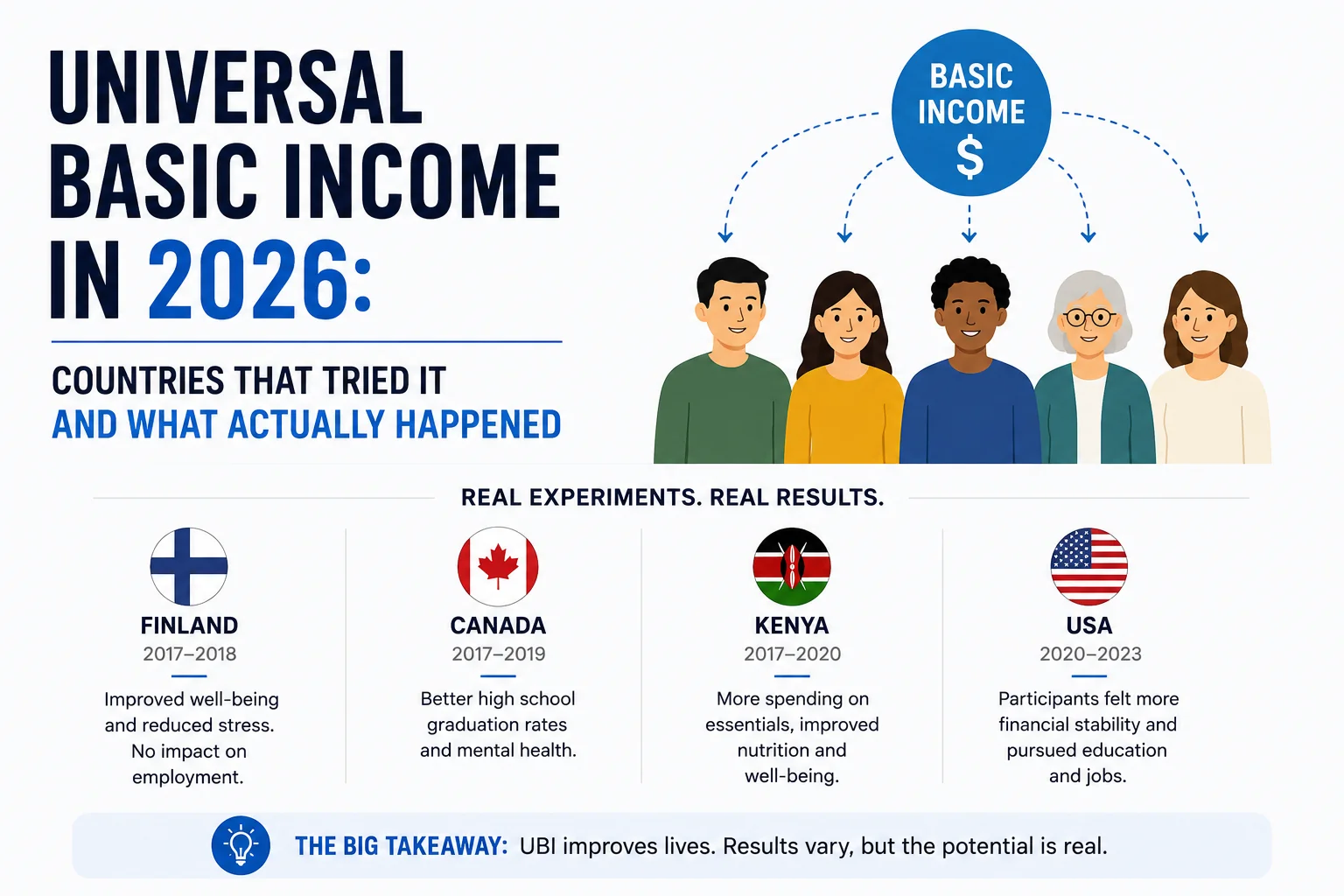
This article presents evidence from UBI experiments objectively, covering both findings that support and challenge UBI proponents’ claims. The political debate around UBI involves genuine value disagreements about redistribution and the role of government that extend beyond what evidence alone can resolve.
GiveDirectly’s Kenya UBI programme, the largest and longest-running UBI experiment in history, provided 75 US dollars per month to approximately 20,000 rural Kenyan adults for 12 years beginning in 2016. The first peer-reviewed results published in the American Economic Review in 2022 found significant positive effects on consumption, assets, and economic activity in recipient communities, with measurable benefits extending to non-recipient neighbours through increased local economic circulation. The programme is still active in 2026, with long-term results published in ongoing stages.
Finland’s basic income experiment ran from January 2017 through December 2018, providing 560 euros per month to 2,000 randomly selected unemployed Finns. Stockton, California’s SEED (Stockton Economic Empowerment Demonstration) programme ran from February 2019 through January 2021, providing 500 US dollars per month to 125 randomly selected residents in a low-income city. Wales launched a pilot in July 2022 providing 1,600 pounds per month to 500 care leavers for three years.
These experiments vary enormously in population, amount, duration, and control design, which means the results cannot be directly compared or aggregated into a single finding about “whether UBI works.” What they can tell us is what specific configurations of unconditional cash transfers produced in specific populations.
Finland’s Basic Income Experiment: What the Data Showed
Finland’s experiment provided 560 euros per month (approximately 630 US dollars at 2017 rates) to 2,000 randomly selected unemployed Finns aged 25 to 58. The control group was 173,000 unemployed Finns who received standard unemployment benefits. Both groups received their existing unemployment benefits; the treatment group’s benefits were replaced by the UBI payment. Final results were published in 2020 by the Social Insurance Institution of Finland (Kela).
The findings were more nuanced than either proponents or critics had predicted. Employment: recipients worked an average of 6 days more per year than the control group. The modest employment increase contradicted the prediction that guaranteed income would reduce work incentive. Wellbeing: recipients reported significantly better mental health, trust in institutions, and life satisfaction than the control group. Financial security: recipients reported lower financial anxiety and greater confidence in future planning. The effect was described by the Finnish researchers as primarily a wellbeing benefit rather than a major employment intervention.
Critics of the Finland experiment noted significant limitations: the sample was exclusively unemployed individuals (not the general population), the payment amount was modest relative to the cost of living, and the two-year timeframe was insufficient to measure longer-term labour market effects. The study design also replaced existing unemployment benefits rather than adding to them, making it closer to a benefit replacement pilot than a pure UBI test.
Stockton SEED: A US Urban Context
The Stockton programme provided 500 US dollars per month for 24 months to 125 randomly selected residents from Stockton neighbourhoods with median household incomes at or below the city’s median of 46,033 US dollars. The control group was 200 Stockton residents who did not receive payments. Selection was random within the geographic area.
Published results from the SEED programme, released in 2021, found that full-time employment among recipients increased from 28 percent to 40 percent over the study period, compared to an increase from 25 percent to 37 percent among the control group. The net employment difference between groups was statistically modest but directionally consistent with the Finland finding: unconditional cash did not reduce employment. Recipients reported improved mental and physical health metrics and lower income volatility. Spending analysis showed the largest expenditure categories for the 500 US dollar payments were food (37 percent), sales and merchandise (22 percent), utilities (11 percent), and auto care (9 percent). Less than 1 percent went to tobacco or alcohol.
Critics noted that the Stockton programme’s sample size (125 recipients) was too small for strong causal inference, that the amount was insufficient to replace other income sources, and that the 24-month duration did not capture long-term behavioural adaptation.
Kenya GiveDirectly: The Long-Term Evidence
The Kenya programme is the most methodologically robust UBI experiment to date. It provides 22.5 US dollars per month (equivalent to approximately 75 US dollars in purchasing power parity terms) to approximately 20,000 rural adults in Siaya County for 12 years, using a randomised control design with comparison to both a control village group and a lump-sum transfer group.
The 2022 American Economic Review paper covering the first two years of the programme found: recipient consumption increased by 14 percent above control, household assets increased by 16 percent, psychological wellbeing improved significantly, and economic activity spilled over to non-recipient neighbours through increased local demand. Land ownership increased among recipients, and self-employment activities expanded. The lump-sum comparison group (who received the same total amount as a single payment) showed faster initial asset accumulation but less sustained consumption improvement.
Updated results through 2024, published in working paper form, show sustained consumption and asset improvements and no evidence of the “dependency effects” some critics predicted. The programme is ongoing through 2028, with the 12-year results representing the most rigorous long-term UBI evidence that will be available.
Wales Basic Income Pilot: Care Leaver Focus
Wales’s pilot targets care leavers (young adults who have aged out of the child welfare system), a population with significantly elevated risk of poverty, homelessness, and poor mental health. The 1,600 pounds per month payment is substantially higher than other UBI pilots relative to local cost of living. Preliminary results published in 2024 showed improvements in mental health measures, reduced anxiety about finances, and improved housing stability among recipients compared to a matched comparison group. The programme runs through 2025, with final results expected in 2026.
What the Evidence Does and Does Not Support
The aggregate evidence from UBI experiments as of 2026 provides reasonable support for several specific conclusions and no support for others.
Supported by evidence: unconditional cash transfers to low-income populations consistently improve wellbeing, mental health, and financial security metrics. There is no consistent evidence that modest guaranteed income significantly reduces employment; the Finland and Stockton experiments both found neutral-to-positive employment effects. Local economic spillover effects appear real in the Kenya context, where increased consumption by recipients benefits non-recipient businesses and households.
Not well-supported by evidence: the experiments do not tell us what a full national UBI implementation (replacing existing welfare systems at a scale covering all residents) would produce in developed economies, because no such experiment has run. The fiscal costs and distributional effects of a genuine nationwide UBI in the US or UK involve macroeconomic dynamics (tax structure, inflation, labour market effects at scale) that small-scale experiments cannot capture.
Genuinely contested: whether UBI is a more effective use of redistribution resources than targeted programmes (housing assistance, childcare, healthcare, job training) remains unresolved by the current evidence. UBI proponents argue for universality and reduced administrative burden; critics argue targeted programmes provide more support per dollar to those with the greatest need.
| Programme | Country | Amount | Duration | Key Finding |
|---|---|---|---|---|
| Basic Income Experiment | Finland | 560 EUR/month | 2 years | Improved wellbeing; small employment increase |
| SEED | USA (Stockton) | $500/month | 2 years | No employment reduction; improved health |
| GiveDirectly | Kenya | $75/month PPP | 12 years | Sustained consumption and asset gains |
| Care Leavers Pilot | Wales | £1,600/month | 3 years | Improved mental health and housing stability |
AEO FAQ: Universal Basic Income Questions
What is universal basic income and how does it work?
Universal basic income (UBI) is a policy concept in which all citizens or residents of a defined population receive a regular, unconditional cash payment from the government, regardless of employment status, income, or other criteria. Unlike means-tested welfare programmes, UBI requires no application, compliance requirements, or proof of need. Proposals for UBI vary enormously in amount (from a modest supplement to a full living income), funding mechanism (income tax, wealth tax, carbon dividend, elimination of existing welfare programmes), and scope (all residents, only adults, only citizens). The policy exists on a spectrum of implementation options rather than as a single defined programme, which is why evidence from specific pilots must be carefully contextualised.
What did Finland’s UBI experiment find?
Finland’s two-year basic income experiment (2017 to 2018) provided 560 euros per month to 2,000 randomly selected unemployed Finns. Final results published by the Social Insurance Institution of Finland found that recipients worked an average of 6 more days per year than the control group (a modest positive employment effect), reported significantly better mental health, life satisfaction, and trust in institutions than the control group, and experienced less financial anxiety. The experiment did not find the work disincentive effect that UBI critics had predicted. Limitations include the exclusively unemployed sample, the modest payment relative to cost of living, and the two-year duration insufficient for long-term labour market conclusions.
Did the Stockton basic income programme work?
The Stockton SEED programme (2019 to 2021) provided 500 US dollars per month to 125 randomly selected residents for 24 months. Published results found that full-time employment among recipients increased from 28 percent to 40 percent over the study period, compared to 25 to 37 percent in the control group. Recipients reported improved mental and physical health metrics and reduced income volatility. Spending analysis found less than 1 percent of payments went to tobacco or alcohol; the largest categories were food, general merchandise, and utilities. Limitations include the small sample size (insufficient for strong causal inference) and the programme’s inability to replace other income sources at the 500 US dollar monthly level.
What does the Kenya GiveDirectly UBI experiment show?
GiveDirectly’s Kenya programme, the largest and most methodologically robust UBI experiment to date, provides approximately 75 US dollars monthly in purchasing power parity terms to 20,000 rural adults for 12 years with randomised control design. Results published in the American Economic Review in 2022 covering the first two years found: 14 percent higher consumption in recipient households, 16 percent higher asset accumulation, significant psychological wellbeing improvements, and measurable economic spillover to non-recipient neighbours through increased local demand. Updated results through 2024 show sustained effects with no evidence of dependency. Final 12-year results are expected by 2028 and will be the most comprehensive UBI evidence available in any developed or developing country context.
Does universal basic income reduce the incentive to work?
The available evidence from UBI experiments does not support the prediction that modest guaranteed income significantly reduces employment. The Finland experiment found a small positive employment effect. The Stockton SEED found a comparable positive employment trajectory between recipients and control group. GiveDirectly’s Kenya results show increased self-employment and asset acquisition rather than reduced work. The Kenya results specifically found increased agricultural and business activity among recipients. The absence of a large work disincentive effect is the most consistent finding across disparate UBI experiments, though critics note that larger payments, full implementation at scale, or different population characteristics might produce different effects than those observed in the experimental contexts.
What are the main arguments against universal basic income?
The main arguments against UBI from both left and right economic and policy perspectives are: fiscal cost (a meaningful universal payment to all US or UK adults at even 1,000 US dollars per month would cost trillions annually, requiring either large tax increases or cuts to other programmes); the opportunity cost argument that equivalent funds targeted at specific needs (housing, healthcare, childcare, education) would provide greater welfare improvement per dollar than universal cash transfers; inflation risk if UBI increases broad consumer demand without a corresponding increase in productive supply; and political economy concerns that UBI could be used to justify dismantling more comprehensive welfare programmes, leaving the most vulnerable worse off if the UBI amount is set below the value of the benefits it replaces.
The Evidence Points Toward, Not Beyond, Reasonable Conclusions
The UBI experiments completed and ongoing as of 2026 support cautious optimism about unconditional cash transfers for specific populations in specific contexts: they consistently improve wellbeing and financial stability, they do not appear to significantly reduce employment at modest transfer amounts, and they produce local economic benefits beyond the direct recipients. They do not resolve the larger policy questions about whether a national UBI programme would be fiscally sustainable, more effective than targeted alternatives, or politically maintainable. The politicians, economists, and advocates on both sides of the UBI debate cite the same experimental data and reach different conclusions because the fundamental disagreements involve values about redistribution, the role of government, and what poverty reduction strategies are most effective, and those are not questions that randomised controlled trials resolve.