
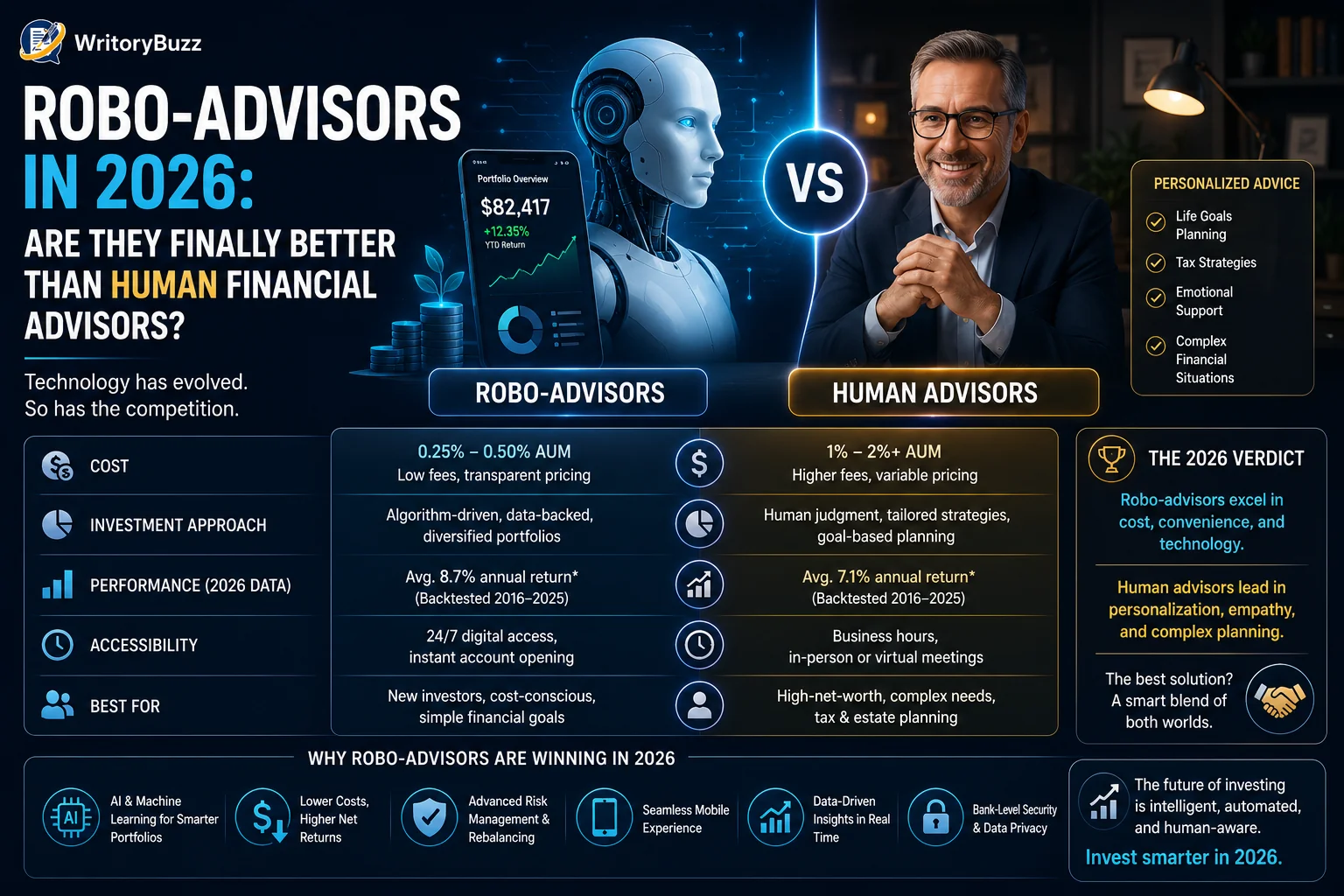
Robo-advisors now manage over $1.8 trillion in assets in the United States alone, up from $1.4 trillion at the start of 2025. The platforms have evolved far beyond simple portfolio rebalancing. In 2026, AI financial advisors handle tax-loss harvesting, retirement income planning, estate coordination, and real-time portfolio adjustments. The question is no longer whether robo-advisors are serious. It is which situations they are better than humans for.
The robo-advisor vs human advisor question has a more nuanced answer in 2026 than it did in 2015. Both categories have improved. Robo-advisors have added AI planning conversations, multi-goal optimisation, and tax sophistication. Human advisors have retained the holistic life planning, behavioural coaching, and complex situation management that algorithmic systems genuinely cannot replicate. The honest comparison is about fit, not universal superiority.
The Fee Difference and Its Compounding Impact
The primary numerical case for robo-advisors is straightforward. Most robo-advisors charge 0.25 percent of AUM annually. Human financial advisors typically charge 0.80 to 1.25 percent of AUM annually. On a $500,000 portfolio, a 0.75 percent fee difference compounds to roughly $240,000 less over 30 years.
This is real money. It must be weighed against the value a good human advisor delivers. Vanguard’s ‘Advisor’s Alpha’ framework estimates a skilled financial advisor can add approximately 3 percent in net annual value through behavioural coaching, tax optimisation, and coordinated financial planning. If that figure is accurate, the fee more than pays for itself. If the advisor primarily provides rebalancing and asset allocation that a robo-advisor handles equivalently, the fee is pure cost.
The Leading Robo-Advisors in 2026
Betterment
The most well-rounded platform. AUM $45 billion-plus. Digital tier: 0.25 percent fee with automated portfolio management, tax-loss harvesting, and goal-based planning. Premium tier ($100,000 minimum, 0.65 percent fee): unlimited access to certified financial planners via video call. In 2026, Betterment’s AI planning assistant handles multi-goal optimisation simultaneously balancing retirement, house purchase, and college funding.
Wealthfront
The technology leader among robo-advisors. Flat 0.25 percent fee, $500 minimum. Direct indexing for accounts over $100,000 (holding individual stocks rather than ETFs to maximise tax-loss harvesting opportunities). No human advisor access — purely algorithmic. Best for investors who want maximum tax optimisation without human interaction.
Fidelity Go
Free for balances below $25,000, 0.35 percent above. Uses Fidelity’s own zero-expense-ratio index funds. No investment expenses at the fund level means the all-in cost is among the lowest available. Best for cost-conscious investors already using Fidelity.
Schwab Intelligent Portfolios
No management fee but requires cash allocation (approximately 6 to 10 percent of portfolio) that acts as a cash drag on returns. Schwab discontinued its premium CFP-access tier in 2026. Best for investors comfortable with the cash allocation model who want zero advisory fee.
Vanguard Digital Advisor
0.20 percent annual fee, $100 minimum. Automatically invests in Vanguard’s own index funds with near-zero expense ratios. Best for existing Vanguard investors wanting the lowest all-in cost on a platform with institutional credibility.
What Robo-Advisors Do Better
Consistent, emotion-free rebalancing: Robo-advisors rebalance portfolios without hesitation when market movements drift allocations from targets. Human advisors frequently under-rebalance because it requires selling winners, which feels uncomfortable. This consistent, emotionless execution is genuinely valuable.
Tax-loss harvesting at scale: Automated daily scanning of tax-loss harvesting opportunities across every holding captures opportunities that quarterly or annual human review misses. Betterment estimates this adds 0.77 percent in after-tax annual returns for higher-bracket investors.
Low minimum investment: Most robo-advisors start at $0 to $500. Most quality human advisors require $250,000 to $1,000,000 minimum investable assets. For investors with $10,000 to $200,000, robo-advisors are often the only access to professional-quality portfolio management.
What Human Advisors Do Better
Complex financial planning: Tax-efficient withdrawal sequencing in retirement, business exit planning, estate plan coordination, insurance optimisation, equity compensation management, and divorce financial planning require judgment, context, and professional liability that no algorithm provides.
Behavioural coaching: Vanguard’s research on behavioural coaching identifies it as the single largest component of Advisor’s Alpha. When clients panic-sell in a market downturn, a human advisor who knows the client’s history and goals can talk them off the ledge. A robo-advisor sends an email.
Life transition management: Marriage, divorce, death of a spouse, inheritance, retirement, business sale, and major illness each require financial decisions coordinated across multiple domains simultaneously. Human advisors managing the full picture across all dimensions of financial life provide value that rule-based systems cannot.
The Decision Framework
| Your Situation | Recommendation |
| Under $100,000 invested | Robo-advisor (human advisors rarely serve this segment) |
| $100K-$500K, straightforward finances | Robo-advisor, potentially hybrid (Betterment Premium) |
| $500K+, complex tax situation | Human advisor or hybrid; fee likely justified |
| Business owner, equity compensation | Human advisor — complexity requires holistic planning |
| Approaching retirement | Hybrid minimum; human advisor for withdrawal strategy |
| Estate planning needs | Human advisor; algorithmic tools are insufficient |
Are robo-advisors better than human financial advisors?
It depends on portfolio size and complexity. For portfolios under $200,000 with straightforward finances, robo-advisors provide equivalent portfolio management at a fraction of the cost. For complex situations (business ownership, equity compensation, estate planning, retirement income planning), human advisors justify their fees through integrated judgment that algorithms cannot provide.
How much do robo-advisors cost?
Most robo-advisors charge 0.25 percent of AUM annually. Betterment Digital: 0.25 percent. Wealthfront: 0.25 percent. Vanguard Digital Advisor: 0.20 percent. Fidelity Go: free under $25,000, 0.35 percent above. Schwab Intelligent Portfolios: no management fee with a required cash allocation.
How much do human financial advisors charge?
Most human financial advisors charge 0.80 to 1.25 percent of AUM annually. The fee is often tiered, reducing at higher portfolio sizes. On a $500,000 portfolio at 1.0 percent, that is $5,000 annually versus $1,250 for a 0.25 percent robo-advisor. The $3,750 annual difference compounds significantly over long time horizons.
What is Vanguard’s Advisor’s Alpha and what does it show?
Vanguard’s Advisor’s Alpha framework estimates that a skilled human financial advisor can add approximately 3 percent in net annual value through behavioural coaching (preventing emotional selling), tax-efficient portfolio construction, and coordinated life financial planning. This estimate, if accurate, more than justifies typical advisory fees.
What is direct indexing and which robo-advisors offer it?
Direct indexing holds individual stocks instead of index ETFs, allowing tax-loss harvesting at the individual stock level rather than the fund level. This captures significantly more tax savings on large portfolios. Wealthfront offers direct indexing for accounts over $100,000. Betterment offers it for accounts over $250,000.
Can you use both a robo-advisor and a human advisor?
Yes. A hybrid approach uses a robo-advisor for the core investment portfolio (taking advantage of low fees and automated tax optimisation) while retaining a human advisor for specific complex planning areas: estate planning, tax strategy coordination, retirement income structuring, or business planning. Some clients use Betterment Premium as the bridge.
The Market Has Room for Both
The prediction that robo-advisors would replace human financial advisors has not materialised and is not going to materialise. The platforms serve different needs at different complexity levels. Most people at most financial life stages are well-served by robo-advisors. The clients with genuinely complex financial situations consistently find human advisors worth their fees. Both are right about their respective strengths.