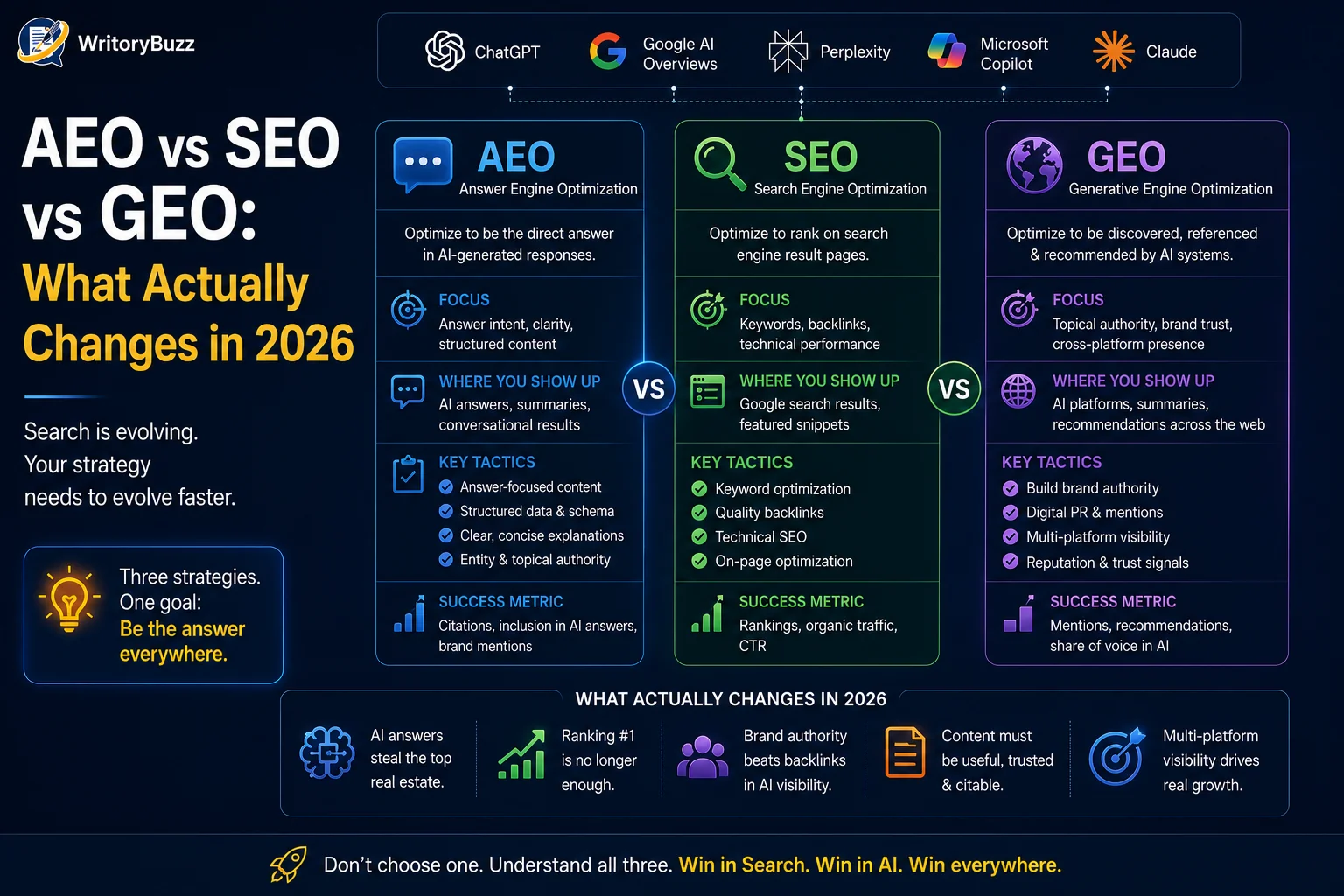
Search behavior has genuinely changed. A growing share of questions people once typed into Google now get asked directly to ChatGPT, Perplexity, or Google’s own AI Overviews, and those systems answer with a synthesized response rather than a list of blue links. Answer Engine Optimization, AEO, is the practice of structuring content specifically so these AI systems can find it, understand it, and cite it as the source behind their answer. This guide covers what AEO actually is, how it differs from traditional SEO, and where a beginner should genuinely start, including how to run your first page through a free aeo checker to see exactly where you stand today.
AEO Defined in Plain Terms
AEO means writing and structuring content so an AI answer engine, a large language model retrieving information to answer a user’s question, can easily extract a clear, accurate, directly quotable answer from your page. This differs meaningfully from writing purely to satisfy a traditional search ranking algorithm, since an AI system is not scanning for keyword frequency, it is looking for a genuinely clear, well-supported, specific answer it can confidently attribute back to your page as its source.
The practical effect is that content genuinely optimized for AEO tends to front-load direct answers, use clear heading structure, and include the kind of specific, verifiable detail an AI system can quote with confidence, rather than burying the actual answer several paragraphs deep beneath introductory throat-clearing a traditional search-ranking-only mindset might have tolerated.
Why AEO Matters Right Now
AI-powered answer surfaces increasingly intercept a search query before it ever reaches a traditional list of website links, meaning a page can rank well in traditional search yet receive meaningfully less actual traffic if AI Overviews or a chatbot answers the user’s question directly without requiring a click-through at all. For any brand or publisher depending on organic search traffic, this shift means visibility inside an AI-generated answer, or a citation link within one, has become a genuinely important new traffic and brand-visibility channel worth deliberate optimization.
This does not mean traditional SEO no longer matters, it means AEO has become a genuinely necessary complementary discipline sitting alongside traditional SEO rather than replacing it entirely, since many of the same underlying quality signals, clear structure, genuine expertise, accurate information, matter to both disciplines even as the specific optimization tactics differ in meaningful ways.
| Dimension | Traditional SEO Focus | AEO Focus |
| Primary goal | Rank in a list of search results | Get cited directly inside an AI-generated answer |
| Content structure | Keyword placement, meta tags | Direct answers, clear headings, extractable facts |
| Success signal | Ranking position, click-through rate | Citation frequency, AI answer inclusion |
| Key technical asset | XML sitemap, robots.txt | llms.txt, structured data, clean HTML hierarchy |
The Core Building Blocks of AEO
Structuring content around clear, specific questions and direct answers represents the foundational AEO building block, since an AI system extracting an answer needs a genuinely clean, unambiguous passage to quote from, rather than an answer scattered loosely across several paragraphs of surrounding context. Using genuine heading structure that mirrors how a person would actually phrase a question further helps an AI system map its own query directly onto the specific section of a page most likely to contain the answer it needs.
Beyond content structure, several technical elements support AEO specifically, structured data markup helping AI crawlers understand a page’s content type and context, and an llms.txt file specifically signaling to AI crawlers which parts of a site represent genuinely authoritative, citation-worthy content. Running a page through a free aeo checker provides a genuinely fast way to see exactly which of these specific building blocks a given page is currently missing, rather than guessing at AEO readiness without this kind of direct, structured evaluation.
How to Start Applying AEO to Existing Content
Auditing a site’s highest-traffic or highest-value existing pages first, rather than attempting to overhaul an entire site simultaneously, provides a genuinely practical starting point, since these specific pages already carry proven relevance and are the pages most likely to be pulled into an AI-generated answer if properly structured for that purpose. Running each of these priority pages through a free aeo checker specifically surfaces the concrete, page-by-page gaps worth addressing first.
Generating and publishing a genuine llms.txt file for the site overall, using a llms.txt generator rather than attempting to hand-write this file’s specific technical formatting from scratch, represents a second genuinely high-leverage early step, since this single file helps AI crawlers understand which sections of an entire site represent the most authoritative, citation-worthy content across the full domain rather than page by page.
Checking whether existing content demonstrates the genuine expertise and trustworthiness signals AI systems increasingly weigh before citing a source, using an eeat checker specifically, addresses a third foundational AEO building block, since AI systems, similar to traditional search algorithms, weigh a source’s demonstrated credibility before treating that source as reliable enough to cite directly within a generated answer.
AEO Is a Discipline, Not a One-Time Fix
Because AI answer engines continue evolving how they select and cite sources, genuinely effective AEO requires ongoing attention rather than a single audit and fix applied once and then forgotten, similar to how traditional SEO itself has always required sustained, ongoing attention rather than a one-time optimization effort. Building this evaluation into a regular content review cadence, rather than treating it as a rare, occasional project, keeps a site’s AEO readiness current as both AI systems and a site’s own content library continue to evolve.
For a full toolkit covering AEO, traditional SEO, and broader content optimization together, explore WritoryBuzz’s free SEO and AI visibility tools rather than piecing together separate, disconnected tools for each individual check.
Search is no longer limited to traditional search engines. Follow WritoryBuzz for expert insights on SEO, AEO, GEO, AI-powered search, and practical optimization strategies to help your content rank across Google, ChatGPT, Perplexity, and the next generation of AI search platforms.