
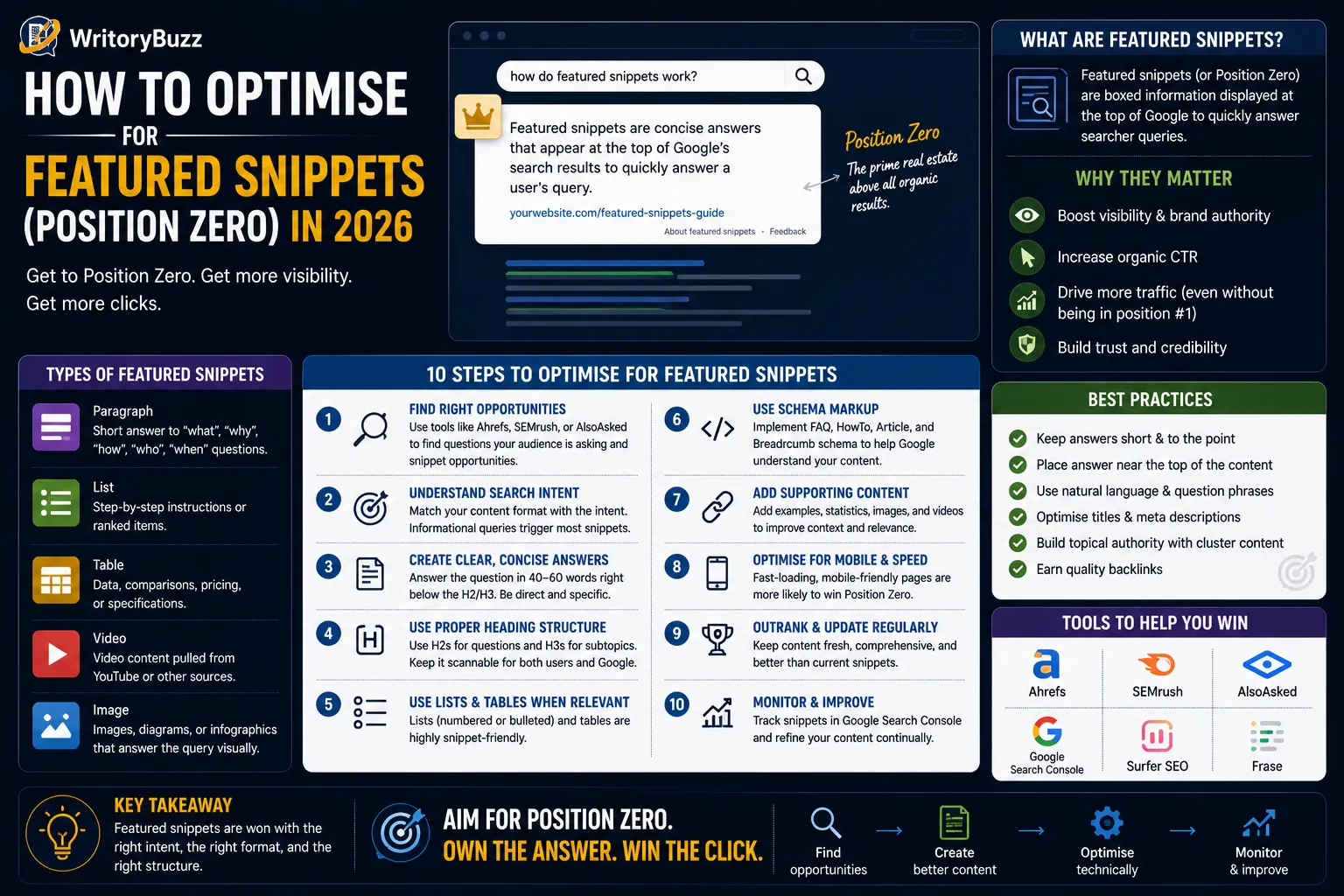
Featured snippets appear above organic results for approximately 12 to 15 percent of all Google searches. Winning a featured snippet typically doubles or triples the click-through rate for that position. In 2026, featured snippet optimisation also directly serves AI Overview ranking the same content structure that wins snippets is what Google’s AI Overview and other LLMs use to generate cited answers.
A featured snippet is a summarised answer extracted from a web page and displayed at the top of Google search results. It shows the answer text, the page title, and a link. The page providing the snippet is typically also ranking in the top 5 organic results featured snippets are won through content structure, not from outside the top 10.
The Three Types of Featured Snippets
Paragraph Snippets (Most Common)
A 40 to 60-word direct answer to a question. Google extracts this from a page that concisely and directly answers the query. Triggered by definition queries (‘what is…’), explanation queries (‘how does…’), and opinion queries (‘why is…’). Paragraph snippets appear for approximately 70 percent of all featured snippets.
How to win paragraph snippets: Write a direct 40 to 60-word answer immediately after the H2 heading that matches the query. The structure that consistently wins: H2 heading phrased as the question, then a concise paragraph directly answering it, then expanded detail. The snippet is extracted from the concise paragraph.
List Snippets
Ordered or unordered lists extracted from pages. Triggered by ‘how to…’ and ‘steps to…’ queries (ordered lists) and ‘best…’, ‘types of…’, ‘ways to…’ queries (unordered lists). Google typically shows 6 to 8 list items in the snippet, truncating longer lists.
How to win list snippets: Use proper HTML list markup (ul or ol tags, or their markdown equivalents). Keep each list item to one clear concept. Place the list immediately after the H2 heading that mirrors the query. For step-based content, number each step with a clear action verb.
Table Snippets
Tables extracted from pages for comparison queries (‘X vs Y’), price queries, and data queries. Google displays the table with its formatting. Triggered by queries expecting structured comparative data.
How to win table snippets: Use proper HTML table markup with clear headers in the first row. Keep tables to 3 to 5 columns maximum for readability. Title the table with an H2 that mirrors the query intent. Comparison tables (two subjects across multiple attributes) win table snippets most frequently.
The Formatting Principles That Win Snippets
Answer first, explain after: The snippet is extracted from the most direct answer on the page. If your answer is buried after three paragraphs of context, Google cannot extract it cleanly. Structure content as: question in heading, direct answer in first paragraph (snippet target), detailed explanation after.
Match the exact query phrasing: Use the query phrase in the H2 heading. If targeting ‘how long does sourdough starter take’, the H2 should be ‘How Long Does a Sourdough Starter Take?’ and the following paragraph should directly answer in 40 to 60 words.
Use numbers and specific data: Snippets with specific numbers, percentages, and dates are extracted more frequently than vague answers. ‘Typically 5 to 7 days’ is snippet-friendly. ‘It varies depending on conditions’ is not.
Word count for the answer paragraph: Target 40 to 60 words for the direct answer paragraph. Google’s snippet extraction prefers this length. Shorter is often too brief to provide a complete answer. Longer is less likely to be selected as a clean snippet.
Featured Snippets and AI Overviews
Google’s AI Overviews and third-party LLMs (ChatGPT, Perplexity) use the same content signals as featured snippet algorithms: concise direct answers to questions, properly structured lists, clearly marked data tables. Optimising for featured snippets simultaneously optimises for AI answer engine citation.
The GEO (Generative Engine Optimisation) insight: pages with featured snippet-optimised content are systematically more likely to be cited in AI-generated answers because the answer extraction that wins snippets is exactly what LLMs look for when selecting citation sources.
Checking Your Featured Snippet Opportunities
Identify current top 5 rankings: Featured snippets are only available to pages already ranking in the top 5 to 10 positions for the query. Use Google Search Console to identify queries where you rank position 2 to 10 with no featured snippet showing these are your highest-opportunity targets.
Tools: Ahrefs and Semrush both show featured snippet ownership and opportunity data. Filter for queries where a competitor holds the snippet for a keyword where you rank in the top 5.
What is a featured snippet and how does it work?
A featured snippet is a direct answer extracted from a web page and displayed above organic results in Google search. Google extracts content from pages already ranking in the top 5 to 10 positions, preferring clearly formatted direct answers. Winning a featured snippet typically doubles or triples click-through rate versus the same organic position without a snippet.
How do you optimise content for featured snippets?
Structure content with the query phrased in the H2 heading, followed immediately by a 40 to 60-word direct answer paragraph (the snippet target), then expanded detail. For list snippets use proper HTML list markup. For comparison snippets use proper table markup. Include specific numbers and data in the answer.
What types of queries trigger featured snippets?
Definition queries (‘what is…’), explanation queries (‘how does…’), step-based queries (‘how to…’), comparison queries (‘X vs Y’), and best-of queries (‘best ways to…’). Featured snippets appear for approximately 12 to 15 percent of all Google searches, weighted toward informational queries.
Can you win a featured snippet without ranking number 1?
Yes. Featured snippets are typically won by pages ranking positions 1 to 10. The most common source positions are 2 to 5 pages that rank near the top but are outranked by a result without a well-structured direct answer. A page ranking position 4 with excellent snippet formatting frequently wins the snippet over a position 1 page without it.
How does featured snippet optimisation help with AI answer engines?
The same content structure that wins featured snippets direct answers to questions, properly formatted lists, structured tables is what AI answer engines extract when selecting citation sources. Optimising for snippets simultaneously optimises for Google AI Overviews, ChatGPT search, Perplexity, and other AI engines that cite sources.
How many words should a featured snippet answer be?
Target 40 to 60 words for the direct answer paragraph. This length is extracted most consistently. Shorter paragraphs may not provide sufficient information for Google to consider them complete answers. Longer paragraphs are less likely to be selected cleanly as snippets.
Position Zero Is Won With Structure
Featured snippets are not won by ranking first. They are won by structured content that answers questions directly in the format Google can extract and display. The pages that consistently win snippets apply the same structure: query in heading, direct answer in 40 to 60 words, expanded detail below. Apply this to every informational page targeting a question-format query.