
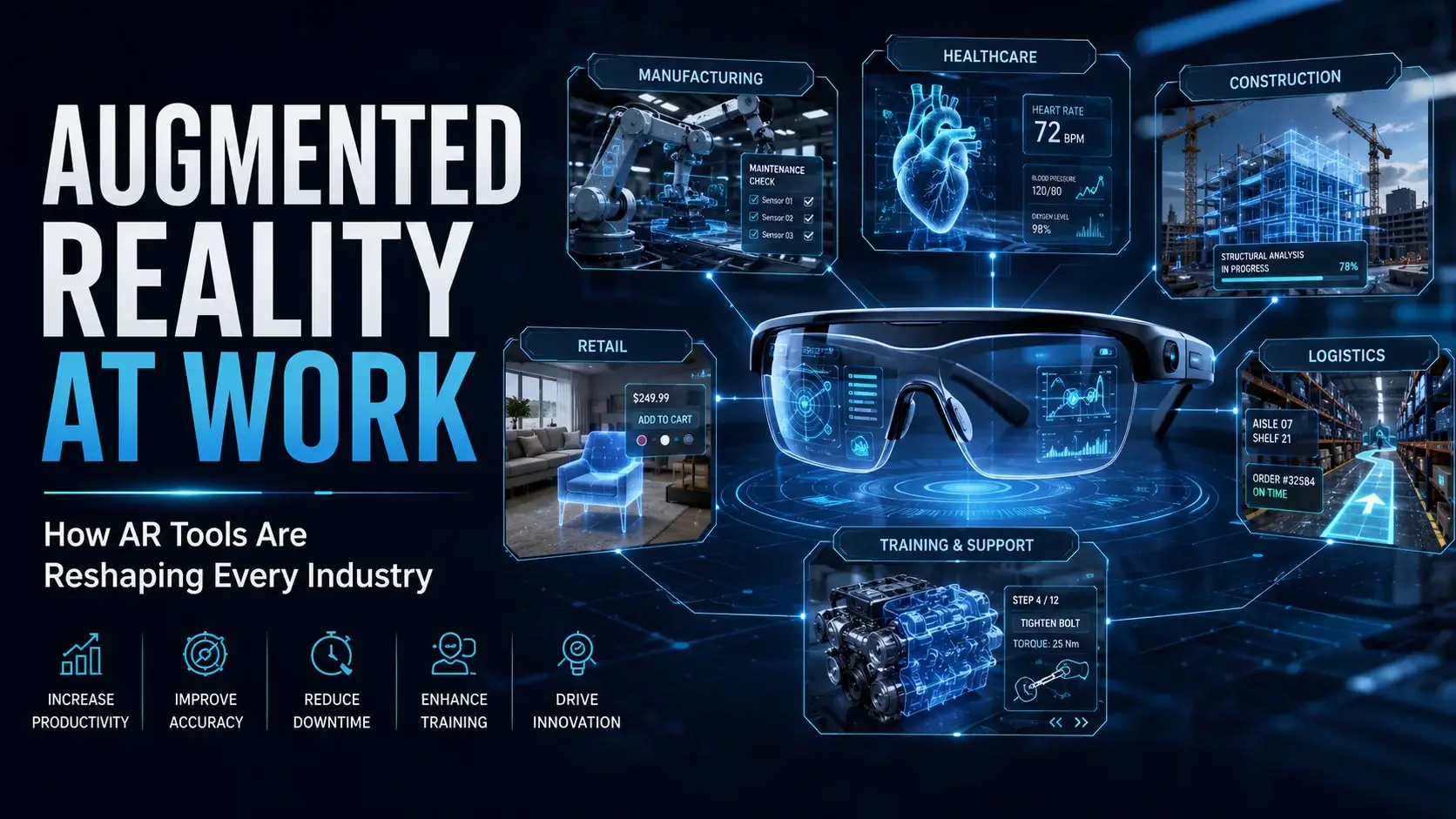
Most people still think of augmented reality as a feature in smartphone games. The actual picture in 2026 is far more practical. AR has moved from novelty into the daily operations of factories, hospitals, construction sites, and retail floors.
The shift happened faster than most analysts expected. When AR glasses became affordable and lightweight enough for full-day wear, industries that had been cautious about the technology started deploying it at scale.
This article looks at how AR tools work inside real organisations, which industries have moved furthest, and what business leaders should understand before making their first AR investment.
Why Businesses Are Adopting AR Now
AR overlays digital information onto the real world without replacing it. A technician sees a physical machine in front of them, and the AR system adds labels, warnings, step-by-step repair instructions, or live data feeds exactly where they need it.
The productivity argument is strong. Boeing reported a 25% reduction in wiring harness assembly time after deploying AR-guided work instructions. DHL saw a 15% improvement in warehouse picking accuracy with AR glasses. These are not pilot-project numbers; they are from ongoing operations.
The training argument is equally strong. Training a new surgeon or aircraft maintenance engineer used to require years of supervised practice. AR simulators compress that timeline significantly without putting patients or aircraft at risk.
Industries Leading the AR Shift
Manufacturing and Assembly
Manufacturing was the first industry to embrace AR at scale. Assembly lines use AR to guide workers through complex multi-step processes. Mistakes drop because the worker sees exactly which part goes where, in the right sequence, at the right torque.
Quality inspection has also changed. AR cameras scan components in real time and flag defects that human inspectors might miss after hours on the line. Some facilities run entirely AR-assisted inspection for critical parts.
Healthcare and Surgery
Surgeons use AR headsets to see patient scans overlaid on the actual operating area. Veins, tumours, and nerve pathways appear as transparent overlays on living tissue. The precision this allows, particularly in brain and spine surgery, has changed outcomes for complex cases.
Medical training programmes at universities in the UK, Germany, and South Korea now run full cadaver AR simulations before students touch real anatomy. Students repeat procedures dozens of times before their first supervised session on a patient.
Construction and Engineering
Construction workers use AR to see building plans projected onto actual ground or existing structures. A plumber can see exactly where pipes run inside a wall before cutting into it. An electrician sees wiring paths without pulling up panels.
Project managers use AR walkthroughs to compare the planned structure against what has actually been built. Deviations appear visually, in real time, without waiting for formal inspections. Rework rates on major construction projects using AR are down measurably across multiple studies.
Retail and Customer Experience
Retail AR splits into two areas. In-store AR helps customers see how furniture fits in their living room before buying. IKEA, Wayfair, and several Indian furniture brands have run AR try-before-buy features for several years now. Customer return rates drop when shoppers can visualise a product in their actual space.
Employee-facing AR in retail handles stock management and picking. Warehouse staff see highlighted shelves and route optimisation through their glasses, reducing average pick time and wrong-item errors.
Key AR Platforms in 2026
| Platform | Primary Sector | Hardware |
|---|---|---|
| Microsoft HoloLens 3 | Manufacturing, Healthcare | Mixed Reality Headset |
| Google Glass Enterprise 3 | Logistics, Warehousing | Lightweight Glasses |
| PTC Vuforia | Industrial Maintenance | Device-Agnostic |
| Scope AR WorkLink | Field Service | Tablet and Headset |
| Matterport AR | Construction, Architecture | Mobile and Headset |
Challenges That Still Hold AR Back
Battery life remains a real constraint. Most AR headsets last four to six hours on a single charge, which is fine for shift-based work but requires planning for longer operations. Charging infrastructure and battery swap protocols add to deployment costs.
Content creation is expensive. A well-built AR work instruction for a complex assembly procedure can take 40 to 80 hours to develop. Organisations with large product catalogues find the initial content investment significant, even when the long-term return is clear.
Connectivity requirements are strict. AR systems that pull live data need reliable, low-latency connections. On construction sites or in remote industrial facilities, network infrastructure must be upgraded before AR deployment makes operational sense.
What Business Leaders Should Check Before Investing in AR
Start with a specific problem, not with the technology. The organisations that get strong returns from AR identify one high-value process first: a training module, a complex assembly step, an inspection workflow. They build, measure, and then expand.
Measure baseline performance before deployment. Without a clear before figure, you cannot make the case for what AR actually delivered. Time per task, error rate, and training completion time are the three most useful baseline metrics.
Involve frontline workers early. The biggest AR rollouts that have struggled did so because workers felt the technology was imposed on them rather than built for them. Workers who help design the AR workflow are far more likely to use it consistently.
Common Mistakes Organisations Make With AR Rollouts
Buying expensive hardware before the content is ready. AR glasses sitting in a cupboard because no one has built the instructions they need to display is a common and expensive mistake.
Treating AR as an IT project. AR deployment that succeeds is always led by operations teams, with IT support, not the other way around. The technology must serve the workflow, not define it.
Skipping pilot validation. Running a 30-day pilot with 10 workers before a 500-person rollout catches integration problems, content gaps, and ergonomic issues that are cheap to fix at pilot scale and very expensive to fix company-wide.
FAQs
What is the difference between AR and VR for business use?
AR overlays digital content on the real world, so workers keep full awareness of their environment. VR replaces the environment entirely, making it better for training simulations where the physical setting does not matter. Manufacturing and field service typically use AR. Safety training and surgical simulation often use VR.
How much does an AR business deployment cost?
Hardware costs range from $500 to $3,500 per headset depending on capability. Content development for a single workflow module runs $10,000 to $50,000 depending on complexity. Larger deployments benefit from volume licensing and reusable content frameworks.
Which industries see the fastest ROI from AR?
Manufacturing and logistics consistently show the fastest payback, often within 12 to 18 months. Healthcare training shows strong ROI but over a longer horizon of three to five years. Construction ROI is highly project-specific.
Do AR systems work without internet connectivity?
Offline AR systems exist and are used in mining, oil and gas, and other remote settings. They cache content locally but cannot display live data feeds or collaborate in real time. Most enterprise AR platforms offer hybrid online and offline modes.
Closing Thoughts
Augmented reality has moved past the proof-of-concept stage for most major industries. The organisations that treat it as a precise operational tool rather than a technology showcase are the ones seeing genuine returns.
The best starting point is not the most advanced hardware. It is the clearest problem. Pick one process that costs you time or quality, build an AR solution for it, measure the difference, and let that data drive the next decision.
Explore the full range of AR platforms and industry applications at WritoryBuzz to stay current with how the technology is actually being deployed across sectors.