
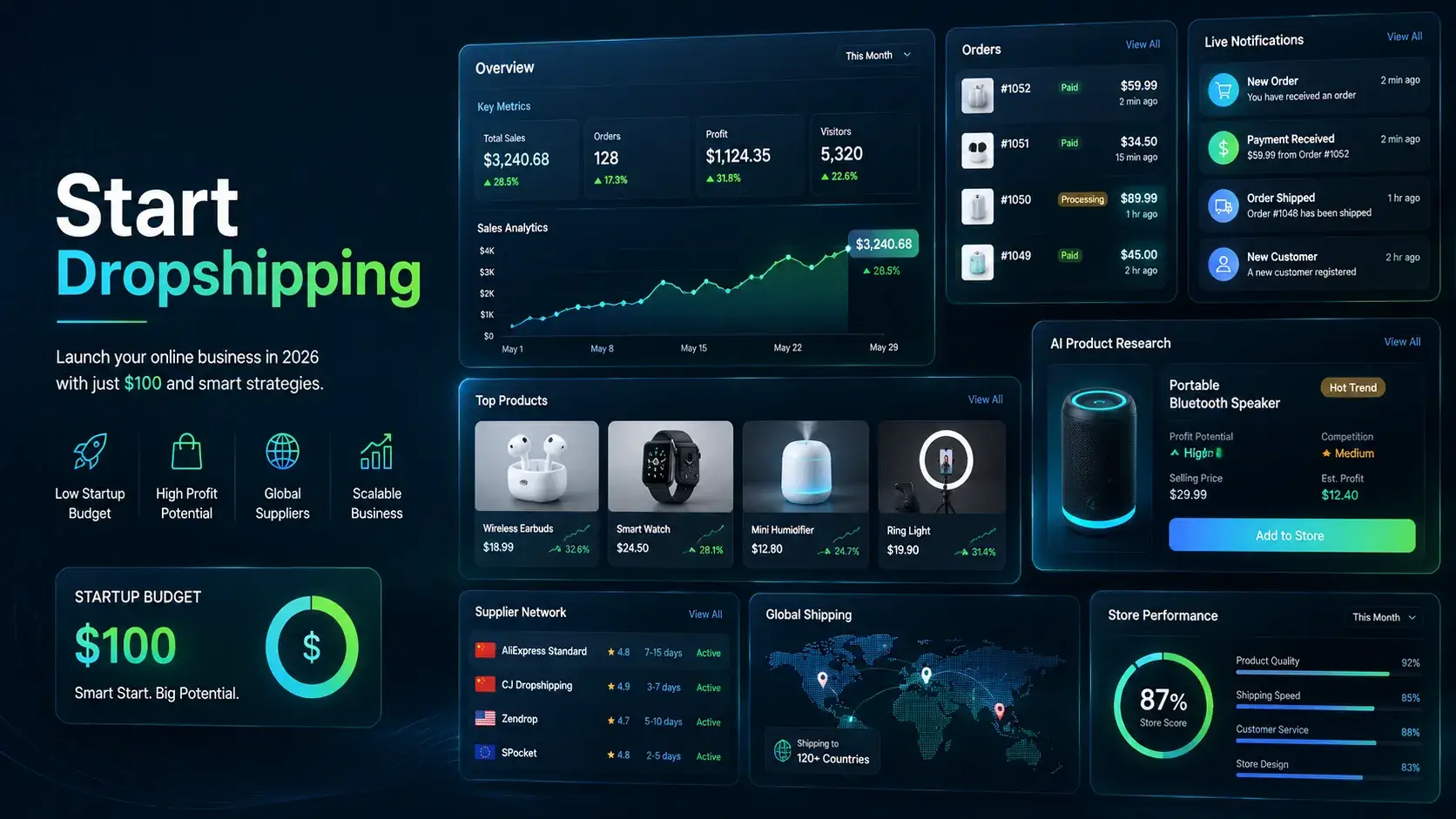
Most dropshipping guides assume you have a comfortable budget for ads, tools, and a polished Shopify store. This one does not. A hundred dollars is enough to launch a real dropshipping business in 2026, if you spend it in the right order and do not waste it on things that do not move the needle early on.
This guide covers every step from picking a niche to making your first sale, with a clear budget breakdown so you know exactly where every dollar goes.
What Is Dropshipping and Why It Still Works in 2026
Dropshipping is a retail model where you sell products online without holding any inventory. When a customer buys from your store, you forward the order to a supplier who ships directly to them. You keep the difference between what the customer paid and what the supplier charged you.
You never touch the product. You do not pay for stock upfront. Your main job is running the store and driving traffic to it.
Example: You list a kitchen organiser for $45. Your supplier charges you $18 for it. A customer orders. You pay the supplier $18, the supplier ships to the customer, and you pocket $27 minus any platform fees.
The model works in 2026 because the infrastructure has matured. Suppliers on platforms like AliExpress, CJdropshipping, and Spocket now process orders faster, offer better product photography, and integrate directly with store builders. The barrier to entry is low. What separates successful stores from failed ones is product selection, brand positioning, and consistent marketing.
How to Spend Your $100 Budget
Before touching any platform, decide where every dollar goes. Spending randomly at the start is how most beginners run out of money before they see results.
| Expense | Recommended Option | Estimated Cost |
|---|---|---|
| Domain name | Namecheap or Google Domains | $10 to $12 per year |
| E-commerce platform (first month) | Shopify Basic trial, then first paid month | $1 trial, then $29/month |
| Store theme | Free Dawn theme (Shopify) | $0 |
| Product research tool | AliExpress free browsing + Google Trends | $0 |
| Logo | Canva free plan | $0 |
| Initial paid ads budget | Meta or TikTok ads test | $50 to $58 |
| Total | ~$90 to $100 |
The strategy here is to keep fixed costs as low as possible and put the remaining budget into a small ad test. You are not trying to scale in month one. You are trying to find one product that sells.
Step 1: Pick a Niche You Can Win
Your niche determines your supplier options, your ad targeting, and how hard it is to stand out. The biggest mistake beginners make is going too broad or copying a saturated niche they saw on a YouTube thumbnail.
What Makes a Good Dropshipping Niche in 2026
- Specific enough that a buyer would search for it but not so narrow that no one is looking
- Products in the $25 to $80 range, where margins stay healthy and buyers do not over-research before purchasing
- No dominant brand loyalty (avoid anything where buyers specifically want Nike, Apple, or Sony)
- Visual products that photograph well and work in short video ads
- Repeat purchase potential or an adjacent upsell opportunity
Strong niches for 2026 include home organisation, pet accessories, posture and wellness gadgets, outdoor gear for urban buyers, and niche hobby supplies. Avoid phone cases, generic fashion, and anything in the ‘as seen on TV’ category since those are nearly impossible to differentiate.
Spend two to three hours on Google Trends before committing. A niche with flat or declining search interest over the past 12 months is a red flag, regardless of how good the products look.
Step 2: Find a Reliable Supplier
Your supplier is your silent business partner. A slow or unreliable one will destroy your store’s reviews and your refund rate before you build any momentum.
Where to Find Suppliers
AliExpress is the starting point for most beginners. It has millions of products and integrates with Shopify through apps like DSers (free plan available). The downside is shipping times from China, which can run 10 to 20 days unless you filter for suppliers with local warehouses.
CJdropshipping has faster shipping options and better quality control than AliExpress for many product categories. The platform processes orders directly and offers free product sourcing help.
Spocket focuses on suppliers from the US and Europe, which means faster delivery but higher product costs. Worth using if your target market is North America or the UK and you want sub-7-day shipping.
Whatever platform you use, check three things before listing a product: supplier rating above 4.7 stars, at least 100 orders on that specific product, and recent positive reviews mentioning shipping speed.
Step 3: Build Your Store in a Weekend
You do not need a perfect store to make your first sale. You need a clean, fast, trustworthy-looking store with clear product pages and a working checkout. That is achievable in a weekend with Shopify and a free theme.
Store Setup Checklist
- Set up Shopify with a free trial and connect your domain
- Install the free Dawn theme and customise the colours to match your niche (earthy tones for wellness, bold colours for sports, clean whites for home goods)
- Write product descriptions that focus on the outcome for the buyer, not a list of specs
- Add at least 8 to 12 products so the store looks like a real business, not a test page
- Set up a basic About page, Shipping Policy, and Return Policy (Shopify has templates for these)
- Install DSers or AutoDS to connect your supplier and automate order forwarding
- Test your checkout with a real order before going live
One thing most beginner guides skip: remove the Shopify branding from your store footer before launch. It signals to buyers that your store is new, which reduces trust. The setting is under Preferences in your Shopify admin.
Step 4: Find One Product to Test First
New dropshippers often list 50 products and wait to see what sells. That is not a strategy. It is hoping. A better approach is picking two or three products with clear evidence of demand and testing them with a small ad budget.
| Research Signal | What to Look For | Free Tool |
|---|---|---|
| Search trend | Rising or stable over 12 months | Google Trends |
| Social proof | TikTok videos with 100K+ views showing the product | TikTok search |
| Competitor pricing | Competitors selling at 2x to 3x the supplier cost | Manual search |
| Review quality | Supplier reviews mentioning fast shipping and accurate description | AliExpress |
| Ad activity | Multiple stores actively running ads for the product | Facebook Ad Library |
If a product is already being advertised by multiple stores, that is a green signal, not a red one. It means the market is proven. Your job is to enter with better creative, a cleaner store, or a slightly sharper price point.
Step 5: Get Your First Sales Without Burning Your Budget
With $50 to $58 left for marketing, you cannot run broad paid campaigns. You need focused, testable approaches that give you data quickly.
Organic Marketing First (Zero Cost)
Before spending a dollar on ads, spend three to five days on free channels. Post three to five TikTok or Instagram Reels showing the product in use. Use trending audio. Keep the video under 30 seconds. No voiceover needed. Just the product doing something visually satisfying or solving an obvious problem.
One good organic video can drive hundreds of visitors to a new store at zero cost. It also tells you whether the product has visual appeal before you put ad money behind it.
Running Your First Paid Ad Test
When you are ready to test with the remaining budget, keep it tight. Set a $10 per day budget on Meta or TikTok and run for five days. Target one interest group that closely matches your niche. Use a single video creative.
After five days, check two numbers: click-through rate (CTR) and cost per click (CPC). A CTR above 1.5% on Meta or above 2% on TikTok means the creative is working. A CPC under $1.50 on TikTok or under $2.50 on Meta means the targeting is reasonable. If both look good and you still have no sales, the issue is your store or your price, not your ad.
Mistakes That Kill Dropshipping Businesses Early
Picking a supplier without testing the product: Order the product yourself before listing it. The photos on AliExpress do not always match what the customer receives. A $15 test order saves you from 40 negative reviews.
Setting prices too low: Beginners underprice to compete, then discover that after platform fees, ad costs, and refunds there is no margin left. Price to cover a 30% refund rate and still profit.
Ignoring customer service: Dropshipping stores live and die on trust. One unanswered complaint thread on a Facebook ad can kill an entire campaign. Check messages daily in the early weeks.
Quitting after the first failed product: Most successful dropshippers tested 5 to 10 products before finding one that worked. A failed test is not a failed business. It is data.
Spending too early on premium tools: You do not need a $99/month product research tool in month one. Free tools and manual research are enough to validate a first product.
Frequently Asked Questions
Can you really start dropshipping with $100?
Yes, if you use a platform trial, a free theme, a free logo tool, and organic marketing for your first traffic. The $100 covers your domain, your first platform month, and a small ad test. It is tight but workable if you do not spend on tools you do not need yet.
How long does it take to make the first sale?
With organic content, some stores make their first sale within a week. With paid ads and a tested product, two to four weeks is realistic. Stores that go months without a sale are usually targeting the wrong niche, pricing incorrectly, or running weak ad creative.
Is dropshipping still profitable in 2026?
Yes, but margins are thinner than they were five years ago because more sellers have entered the market. Stores that succeed now differentiate through brand identity, fast shipping suppliers, or a narrowly defined niche rather than competing on price alone.
Do I need a registered business to start?
Not on day one. Many dropshippers start as sole traders and register a proper business entity once they see consistent revenue. Check the legal requirements in your country, but the store itself can go live before the paperwork is done.
What is the biggest difference between dropshipping success and failure?
Product selection and persistence. Sellers who test multiple products systematically and treat each failure as a learning iteration consistently outperform those who bet everything on one product and quit when it does not work immediately.
Which platform is best for a $100 dropshipping start?
Shopify is the most beginner-friendly option with the widest supplier integrations. The $1 trial gives you enough time to build and test your first store before committing to a monthly fee. WooCommerce on a cheap hosting plan is a lower-cost alternative if you are comfortable with WordPress.
Final Thoughts
Starting a dropshipping business with $100 in 2026 is possible, but it requires discipline about where that money goes. A domain, one month of Shopify, and a small ad test cover the essentials. Everything else in the early stage comes from organic effort and free tools.
The stores that make it are not the ones with the biggest launch budgets. They are the ones that test fast, learn from the numbers, and keep going past the first failed product.
For more practical guides on e-commerce, startups, and building an online business from scratch, browse the Business and Startups sections on WritoryBuzz.