
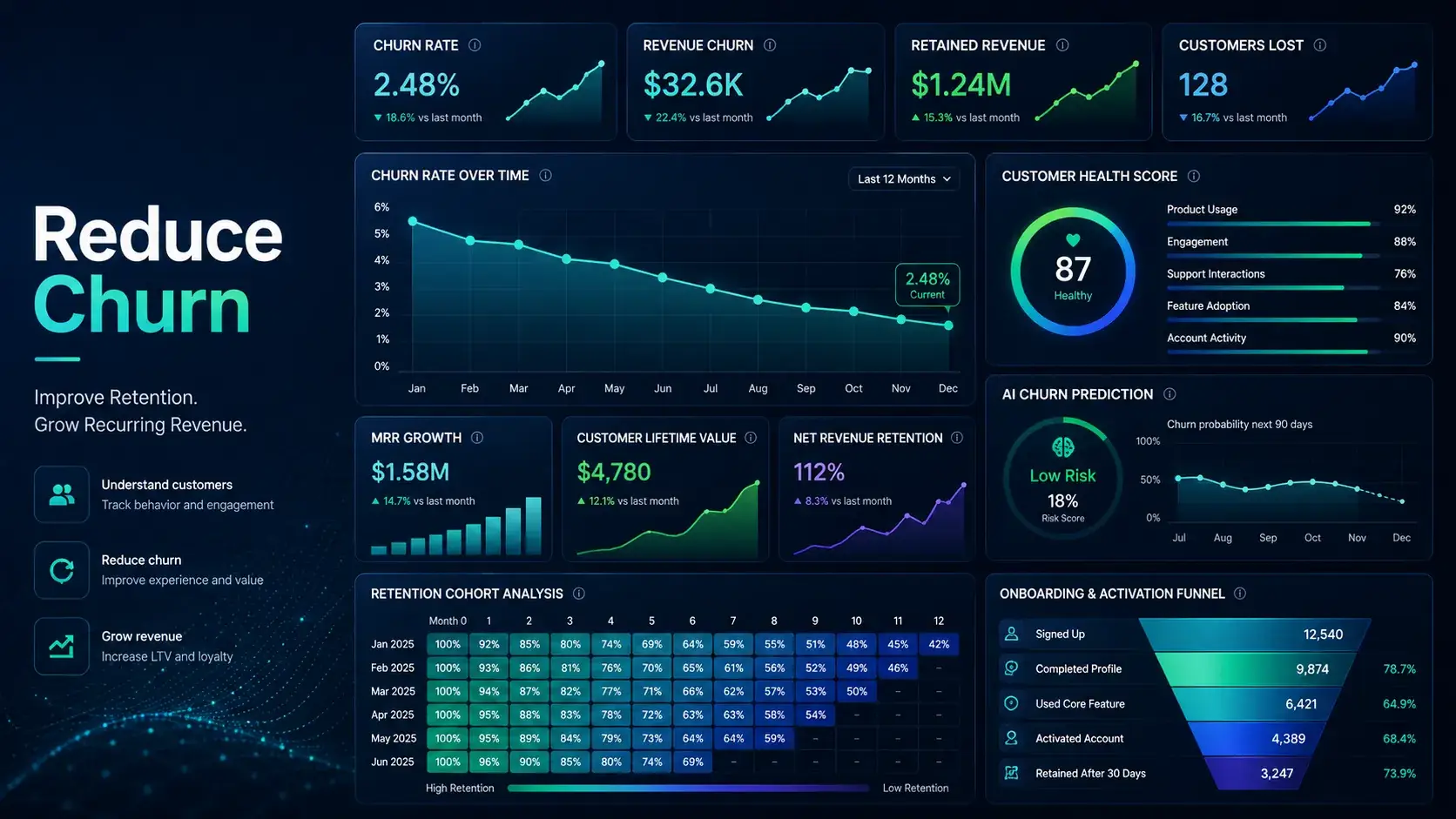
Churn is the number that tells you the truth about your SaaS business. You can grow fast, close big deals, and run sharp marketing campaigns. But if customers keep leaving, the numbers will eventually catch up with you.
This guide covers how to calculate your churn rate correctly, what the 2025 benchmarks look like across different segments, and which strategies actually work to bring churn down.
What Is SaaS Churn Rate?
Churn rate measures the percentage of customers or revenue you lose over a set period. In SaaS, it shows up in two main forms: customer churn (also called logo churn) and revenue churn.
Customer churn tracks how many subscribers cancelled. Revenue churn tracks how much recurring revenue was lost. They tell different stories, and both matter.
A company with 100 customers losing 5 mid-tier accounts has 5% customer churn. But if those 5 accounts were its biggest contracts, the revenue loss could be 30%. Revenue churn shows the financial impact more clearly.
Gross Revenue Churn vs. Net Revenue Churn
Gross revenue churn counts only the revenue lost. Net revenue churn subtracts any expansion revenue, meaning upsells, cross-sells, or seat additions from existing customers.
A company with 8% gross revenue churn but strong upsells might end up with 2% net revenue churn. Some companies achieve negative net revenue churn, where expansion revenue from existing customers actually exceeds what was lost to cancellations. That is the target worth aiming for.
How to Calculate SaaS Churn Rate
The formulas are straightforward. The tricky part is picking the right time window and being consistent about what counts as churned.
Core Formulas:
| Metric | Formula |
|---|---|
| Customer Churn Rate | (Lost Customers / Customers at Start of Period) x 100 |
| Revenue Churn Rate | (Lost MRR / MRR at Start of Period) x 100 |
| Net Revenue Churn | ((Lost MRR – Expansion MRR) / MRR at Start of Period) x 100 |
| Annual Churn from Monthly | 1 – (1 – Monthly Churn Rate)^12 |
A quick example: if you start January with 400 customers, gain 30 new ones, and end with 395, you lost 35 customers during the month. Your monthly customer churn rate is 35 / 400 = 8.75%.
One common mistake is dividing churned customers by the end-of-period count rather than the starting count. That understates churn when you are growing quickly. Always use the starting number.
2025 SaaS Churn Rate Benchmarks
Benchmarks matter because churn looks different at a $500 ARR SMB tool versus a $100K enterprise contract. Context changes what is acceptable.
| Segment | Monthly Churn (Typical) | Monthly Churn (Best-in-Class) | Annual Equivalent |
|---|---|---|---|
| SMB-focused SaaS | 3% to 5% | Below 2% | ~31% to ~46% |
| Mid-Market SaaS | 1.5% to 3% | Below 1.5% | ~17% to ~31% |
| Enterprise SaaS | 1% to 2% | Below 1% | ~11% to ~21% |
| B2B SaaS (overall) | ~3.5% median | Below 1% | ~5% annual revenue churn |
| B2C SaaS | 6.5% to 8% | Below 5% | Higher volatility |
The 2025 Recurly data puts median B2B SaaS revenue churn at 3.5%, with voluntary churn at 2.6% and involuntary churn (mostly payment failures) at 0.8%. The top performers in that dataset actually saw revenue churn go down, largely by tightening their customer targeting.
For annual contracts, churn is typically 30 to 40% lower than month-to-month plans over the same period. Longer commitments build more integration and switching friction.
What counts as ‘good’? For B2B SaaS, staying below 1% monthly (roughly 5% annually) is the widely-cited goal. Best-in-class companies hit negative net revenue retention, which means existing customers are spending more year over year than the company is losing to cancellations.
Why Customers Actually Leave
Most churn studies point to a short list of root causes. Understanding which applies to your product is the starting point for fixing it.
- Lack of perceived value: The customer did not see the outcome they expected during the trial or onboarding phase.
- Poor onboarding: 70% of churn happens within the first 90 days. Customers who take more than 7 days to reach their first meaningful result are significantly more likely to cancel.
- Pricing mismatch: The cost no longer matches the value the customer experiences, especially after budget reviews or leadership changes.
- Better alternatives: A competitor solves the problem more cheaply or with less complexity.
- Payment failures: Involuntary churn from expired cards, failed charges, and billing issues. This accounts for roughly 0.8% of B2B SaaS churn on its own.
- Product gaps: Features promised during sales were not delivered or took too long to ship.
The first 90 days deserve special attention. Onboarding quality is the single biggest controllable factor in early churn. If a customer cannot get to their first win quickly, no retention campaign will save them.
Strategies That Actually Reduce Churn
1. Fix Onboarding Before Anything Else
Map the path to first value. What is the one action that makes a new customer say ‘this is worth it’? Get them there in under 7 days. Remove friction at every step between signup and that moment.
Personalised onboarding checklists, in-app walkthroughs, and a single welcome call from a customer success manager all reduce early cancellations. The data from Optifai’s 2026 benchmark study of 939 companies shows that companies with fast time-to-first-value see 50% lower churn rates overall.
2. Identify At-Risk Accounts Early
Usage drop is the clearest early warning sign. When a customer’s activity falls below their historical average for two or more weeks, someone should reach out. Waiting for the cancellation notice is too late.
Health scoring models that combine login frequency, feature adoption, and support ticket volume give customer success teams a predictive view of which accounts need attention. AI-assisted tools for churn prediction have shown 10 to 15% churn reduction over 18 months in controlled studies.
3. Recover Failed Payments
Involuntary churn is often overlooked because it feels like a technical problem rather than a customer success problem. But at 0.8% monthly, it is a meaningful chunk of lost revenue, and much of it is recoverable.
Smart retry logic, automatic card updaters, and early dunning emails recover a large share of failed payments before the subscription actually lapses. Fixing involuntary churn alone can lift revenue by 8.6% in year one, according to Recurly’s benchmark research.
4. Use Expansion Revenue to Offset Losses
The best defence against revenue churn is strong net revenue retention. When existing customers grow their spend through seat additions, plan upgrades, or add-on features, even modest gross churn becomes manageable at the revenue level.
Identify natural expansion triggers: a team hitting usage limits, a customer reaching a milestone that unlocks new use cases, or a contract renewal where an annual commit makes sense. Build these into the customer journey rather than leaving them to chance.
5. Run Regular Business Reviews
Quarterly business reviews for enterprise accounts and check-in emails for SMB customers keep the relationship active and surface concerns before they become cancellations. Customers who feel heard rarely leave quietly.
The review itself does not need to be elaborate. Sharing three metrics the customer cares about and asking one open question about what is working or what is not covers most of the ground needed.
Common Mistakes SaaS Teams Make with Churn
Focusing only on acquisition: With net-new B2B SaaS sales down 3.3% as of Q4 2024, retention has become the primary growth engine for most companies. Treating churn as a lagging indicator rather than a leading one costs real money.
Using the wrong denominator: Dividing churned customers by the end-of-period total understates churn. Always use the starting count.
Ignoring involuntary churn: Payment failures are often treated as finance problems. They are retention problems, and they are fixable.
Confusing customer churn with revenue churn: Losing your smallest accounts while keeping your largest ones shows up as high customer churn but low revenue churn. Tracking both gives a complete picture.
Reacting too late: By the time a customer submits a cancellation request, the decision is usually already made. Proactive intervention based on usage signals is far more effective than exit interviews.
Frequently Asked Questions
1. What is a good SaaS churn rate in 2025?
For B2B SaaS, staying below 1% monthly (roughly 5% annually) is the standard target. Enterprise-focused products often achieve 1 to 2% annual churn. SMB-focused tools typically see 3 to 5% monthly. Best-in-class companies across all segments aim for negative net revenue churn.
2. What is the difference between customer churn and revenue churn?
Customer churn counts cancelled accounts. Revenue churn counts the MRR lost from those cancellations. Revenue churn gives a better picture of financial impact, especially in businesses where contract sizes vary significantly.
3. How does annual billing affect churn?
Annual contracts reduce monthly churn visibility since customers can only cancel at renewal. Over the same time period, annual contract customers show 30 to 40% lower churn rates than month-to-month customers. Offering a discount for annual payment is one of the simplest churn reduction tactics available.
4. What causes most SaaS churn?
Poor onboarding and lack of perceived value drive the majority of early churn. For established customers, pricing dissatisfaction, budget cuts, and better alternatives are the most common reasons. Involuntary payment failures account for roughly 0.8% of monthly churn but are largely preventable.
5. Can churn be negative?
Yes. Negative net revenue churn happens when expansion revenue from existing customers (upgrades, added seats, cross-sells) exceeds the revenue lost from cancellations. This is the target for growth-stage SaaS companies and signals a strong product-market fit with expanding use cases.
6. When should I measure churn: monthly or annually?
Monthly measurement gives faster feedback and is better for companies still optimising their retention. Annual measurement works better for enterprise businesses on long contract cycles. Convert between them using the compounding formula rather than simply multiplying monthly by 12, which overstates annual churn.
Final Thoughts
Churn does not fix itself. It reflects the health of your product, your onboarding, your pricing, and your customer relationships. The companies that treat churn as a metric to manage proactively rather than apologize for after the fact are the ones that compound growth over time.
Start with the fundamentals: calculate it correctly, compare it to the right benchmark for your segment, and fix the biggest driver first. For most SaaS businesses, that means onboarding and involuntary churn before anything else.
If you found this breakdown useful, explore more SaaS growth and business strategy content on WritoryBuzz for data-backed insights on running and scaling modern software businesses.