
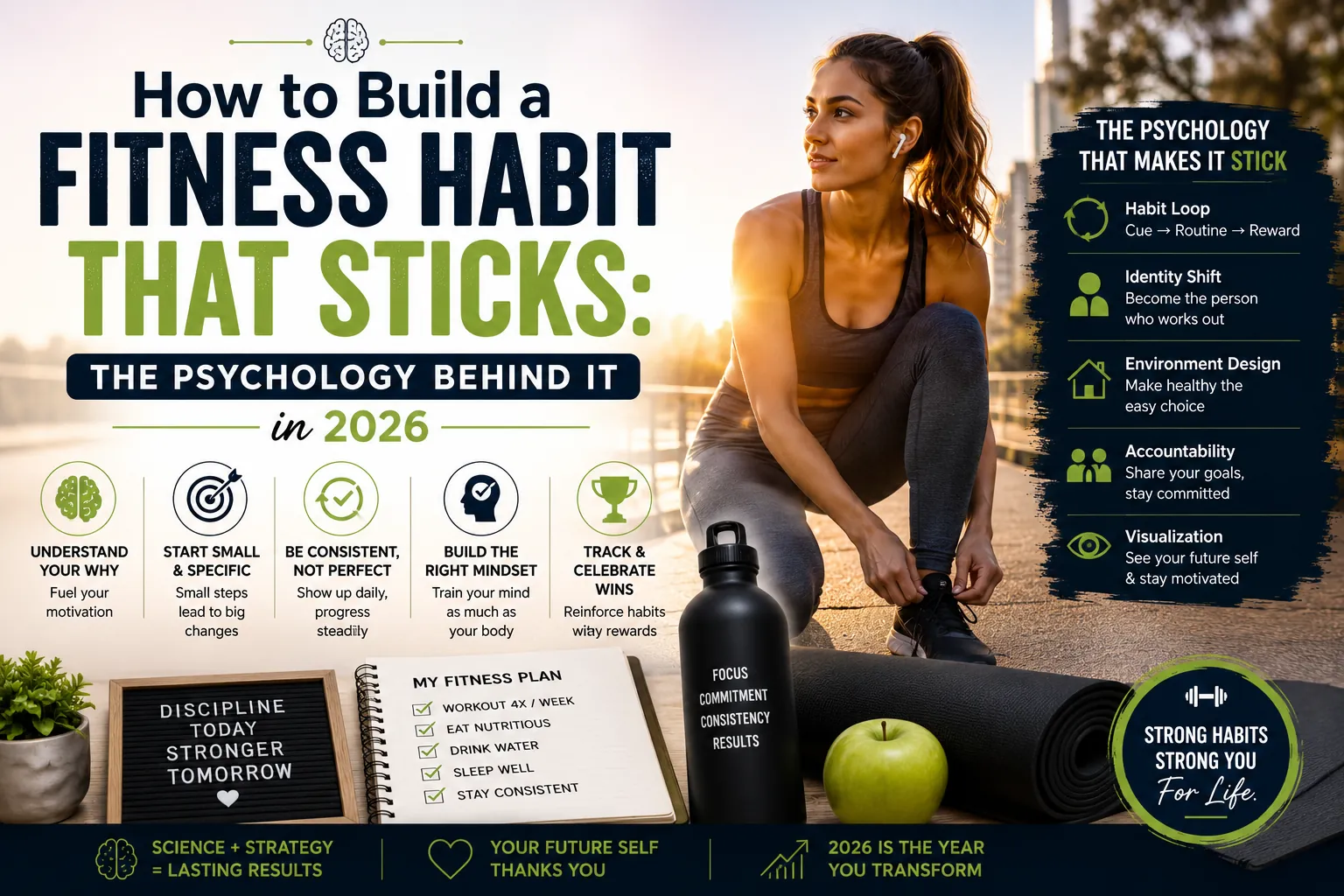
The fitness industry spends enormous effort solving the wrong problem. Most fitness content addresses what to do: the right training programme, the right nutrition protocol, the right recovery approach. The more important and less discussed question is why people who know what to do still do not do it consistently.
Exercise adherence research is clear. The majority of people who start a new exercise programme abandon it within six to eight weeks. The reasons are rarely about the exercise itself. They are about motivation, environment, identity, and the psychological architecture of habit formation.
How Habits Actually Form: The Neurological Basics
A habit is a behaviour that has been encoded in the basal ganglia through sufficient repetition that it runs with minimal conscious thought. The brain builds habits to reduce cognitive load: once a behaviour is habitual, it no longer requires deliberate decision-making, which frees up mental resources for other things.
The habit loop, described by MIT researcher Ann Graybiel and popularised by Charles Duhigg, has three components: a cue that triggers the behaviour, the routine itself, and a reward that reinforces the loop. Understanding which component is weak in your current fitness habit determines which intervention is most useful.
The Three Failure Modes in Fitness Habit Formation
| Failure Mode | What It Looks Like | The Fix |
|---|---|---|
| Motivation-dependent starts | Exercise when inspired, stop when life gets busy | Build cue-based habits that do not require motivation |
| Too much too fast | Ambitious programme abandoned after two weeks | Minimum viable exercise habit, then scale |
| Missing the reward loop | Exercise feels like obligation without positive feedback | Engineer immediate rewards, not just long-term outcomes |
| Identity mismatch | Think of yourself as someone who tries to exercise | Shift to identity: I am someone who exercises |
| Environmental friction | Gym bag not packed, gym not on the commute route | Reduce friction until the habit requires no decision |
Motivation Is Unreliable: Build Cues Instead
Motivation is an emotional state. It rises and falls based on energy levels, mood, competing priorities, and dozens of factors outside your control. Building a fitness habit on motivation is building on an unstable foundation. The people who exercise consistently do not feel more motivated than those who do not. They have built systems that make exercise happen without relying on feeling motivated.
Cue-based habits attach the exercise behaviour to something that happens consistently regardless of motivation. ‘I go for a run every morning immediately after I make coffee’ uses the coffee-making as the cue. ‘I go to the gym every Monday, Wednesday, and Friday after work before I go home’ uses the commute decision point as the cue.
The cue must be specific, already occurring in your daily routine, and immediately before the exercise behaviour. Vague intentions (‘I will exercise when I have time’) have almost zero habit-formation power because there is no consistent trigger.
The Minimum Viable Habit: Why Smaller Starts Work Better
BJ Fogg’s Tiny Habits research at Stanford showed that making a new behaviour as small as possible in the starting phase dramatically increases long-term adherence. The goal of the first two weeks is to make the cue-behaviour-reward loop reliable, not to achieve a fitness result.
A starting habit of ‘ten minutes of movement after I wake up, immediately after brushing my teeth’ is more effective than ‘one hour at the gym four times a week’ at building the neural pathway that eventually supports the larger habit. The point is to get the streak started, to experience yourself as someone who does this consistently, not to achieve maximum physical output in week one.
Once the ten-minute habit is running without friction for three weeks, scaling to twenty minutes or thirty minutes is straightforward. The habit infrastructure exists; extending it is easy. Building the infrastructure from scratch on a demanding programme is where most people fail.
Identity-Based Habit Change: James Clear’s Framework
James Clear’s Atomic Habits framework, published in 2018 and still the most practically useful popular treatment of habit formation, argues that the most durable habits are built on identity rather than outcomes. ‘I want to lose weight’ is an outcome-based goal. ‘I am someone who exercises’ is an identity-based commitment.
The difference matters because identity is self-reinforcing. Every time you exercise, you produce evidence for the belief that you are someone who exercises. That belief makes the next exercise session slightly easier. The habit and the identity strengthen each other.
Conversely, every time you skip a session, you produce evidence for the opposite belief. The first miss is not the problem. It is the interpretation of the miss. Someone with a robust exercise identity says ‘that was an exception’. Someone still building one says ‘I knew I would not stick to it’. The habit lives or dies in that interpretation.
Reducing Friction: Environmental Design for Exercise
Friction is the resistance between intention and action. Every decision required before the exercise behaviour begins is friction. Choosing what to wear, deciding where to go, packing a bag, finding headphones, figuring out what the session will involve: all of these are friction that depletes the decision-making energy available for the actual exercise.
Sleep in your running clothes if you run in the morning. Pack your gym bag the night before and put it by the door. Have a standard session structure so there is no decision about what to do once you arrive. Remove every step between the cue and the behaviour.
Environmental design works in the other direction too: increasing friction for competing behaviours. If you want to stop scrolling on your phone in the hour before bed (which competes with sleep quality that supports exercise recovery), put the phone in another room rather than relying on willpower to not pick it up.
The Role of Social Context in Exercise Adherence
Exercise accountability partners and fitness communities improve adherence rates significantly, not primarily because of external pressure but because they reinforce identity. Being part of a running group, a gym class, or a sports team makes ‘someone who exercises’ a social identity, which is considerably more durable than a private intention.
The mechanism is straightforward: when your exercise behaviour is visible to others who share it, skipping has a social cost that skipping a private commitment does not. That social cost is not punitive; it is motivational. Most people do not want to let down a group they feel part of.
What to Do When the Habit Breaks
Missing one session is not a habit failure. Missing two sessions in a row is the warning sign. The ‘never miss twice’ rule, also from Clear’s framework, acknowledges that disruptions happen and focuses on the response to the first miss rather than on perfect attendance.
When the habit does break, and it will at some point, the recovery protocol matters more than the break itself. Return at the minimum viable level, not at the full routine. Getting back to any exercise within 48 hours of a break, even ten minutes of walking, is more important for habit continuity than waiting until conditions are right for a full session.
FAQs
How long does it actually take to form an exercise habit?
The commonly cited 21-day rule is not well-supported by research. A 2010 study by Philippa Lally at UCL found that new habits took on average 66 days to become automatic, with a range from 18 to 254 days depending on the complexity of the behaviour and the individual. Simpler, shorter exercise habits form faster than complex, demanding ones.
Is morning or evening exercise better for building a habit?
The timing that produces the most consistent cue is better for habit formation, regardless of what training research says about physiological performance. If your morning routine is consistent and your evenings are variable, morning exercise will form a more reliable habit. The optimal time is the time you will actually do it.
What if I genuinely dislike exercising?
Exercise adherence is highest for activities that are intrinsically enjoyable rather than those chosen purely for fitness outcomes. Finding a form of movement you do not dread, whether that is swimming, dancing, hiking, martial arts, or team sport, is more valuable than optimising for the theoretically superior exercise programme that you reliably avoid.
Building the System
The most useful thing you can do with this information is to design one specific exercise habit for the next 30 days. One cue. One minimum viable behaviour. One immediate reward. Run it for 30 days before evaluating whether to change anything.
The evaluation question after 30 days is not ‘did I get fit?’ It is ‘did the habit run reliably?’ If yes, extend or intensify. If no, diagnose which component, the cue, the friction level, or the reward, is failing and adjust that one thing.
For psychology of behaviour change, evidence-based fitness guidance, and practical health strategies throughout 2026, WritoryBuzz covers the science of building sustainable habits without the fitness industry hype.