
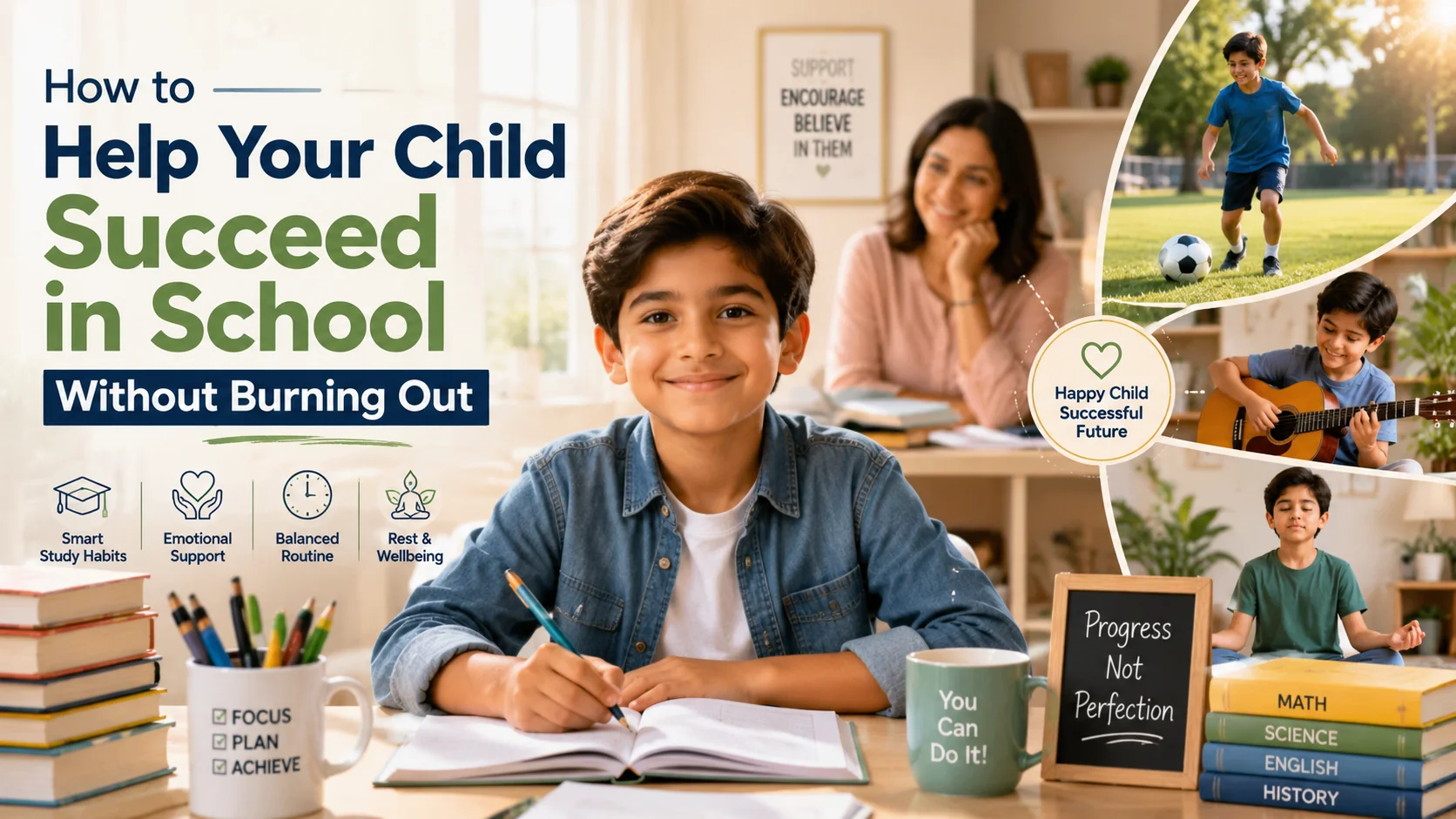
The research on what improves academic outcomes often contradicts what anxious parents instinctively do. Less hovering. More reading. And sleep always sleep.
Parent involvement is one of the strongest predictors of academic success. The type of involvement matters enormously. Parental support that builds independence consistently outperforms parental involvement that creates anxiety or learned helplessness even when well-intentioned.
The Non-Negotiable Foundation
Sleep: A 2022 study in SLEEP found each additional hour of sleep in primary school children associated with significantly higher academic performance across reading, writing, and maths — more than equivalent additional study time. Children 6 to 12 need 9 to 12 hours. Teenagers need 8 to 10. Most do not get it.
Breakfast: Consistent research links breakfast consumption to better concentration, memory, and academic performance. A child who eats before school outperforms a better-prepared child who did not on assessments requiring sustained attention.
Physical activity: Regular exercise increases BDNF (brain-derived neurotrophic factor) supporting learning and memory. Cutting physical activity to create more study time is counterproductive.
The Homework Question: How Much Help Is Too Much?
Highly involved homework support — guiding answers, checking every problem, sitting alongside throughout — tends to produce dependency and does not improve learning. The child completes work correctly but does not develop problem-solving and frustration tolerance.
The effective approach: You are present and encouraging, but the work is theirs. Respond to ‘I don’t know how to do this’ with ‘What do you think the first step might be?’ rather than showing the solution. If genuinely stuck, suggest they ask their teacher rather than you doing the work.
Reading: The Highest-Return Academic Investment
Reading volume is the most consistently correlated factor with vocabulary, writing quality, and academic performance broadly. Children who read broadly and regularly outperform non-readers on essentially every academic measure by age 10 onward.
- Keep books visible and physically accessible — proximity predicts reading frequency
- Let children choose their own books — interest drives the habit. Series, graphic novels, and ‘easy’ reads all count
- Read aloud together longer than most parents do — up to age 12, this exposes children to vocabulary above their independent reading level
- Model reading as an adult — parents who read for pleasure have children significantly more likely to do the same
Growth Mindset: Teaching Effort Over Ability
Carol Dweck’s research shows that children who believe ability develops through effort outperform peers with fixed mindsets on challenging tasks, specifically because they persist longer. The practical change is in how you praise:
Fixed mindset praise: ‘You’re so smart!’ This links success to innate ability. When children later struggle, they conclude they’re not smart enough.
Growth mindset praise: ‘You worked really hard’ or ‘That strategy worked well.’ This links success to effort and process — within the child’s control.
Responding to failure: ‘What did you learn from that?’ Normalising the learning value of difficulty builds resilience that serves children for years.
The Parent Anxiety Problem
Parental academic anxiety transmits directly to children. Studies document that when parents are highly anxious about academic performance, children’s own anxiety and performance outcomes worsen — even controlling for the child’s initial performance level.
The most useful reframe: your job is not to manage your child’s academic outcomes. Your job is to support the conditions — sleep, reading, effort encouragement, and genuine curiosity — in which they develop. The outcomes follow from those inputs over years, not weeks.
How much should parents help with homework?
Enough to ensure the child understands the task and has what they need to attempt it — but not so much that you produce the work. The goal of homework is practice and consolidation. It only achieves this when the child does it themselves.
What is the single best thing parents can do to improve academic performance?
Build a reading habit. Any books, child-selected, read frequently the improvement across vocabulary, writing, and subject knowledge compounds over years. It is also free.
The Long Game
Academic success over a school career is built through accumulated consistent habits: enough sleep, regular reading, family attitudes toward effort, and a home environment where curiosity is encouraged. The parents with the best outcomes and least burnout focus on those foundational conditions and trust they compound.