
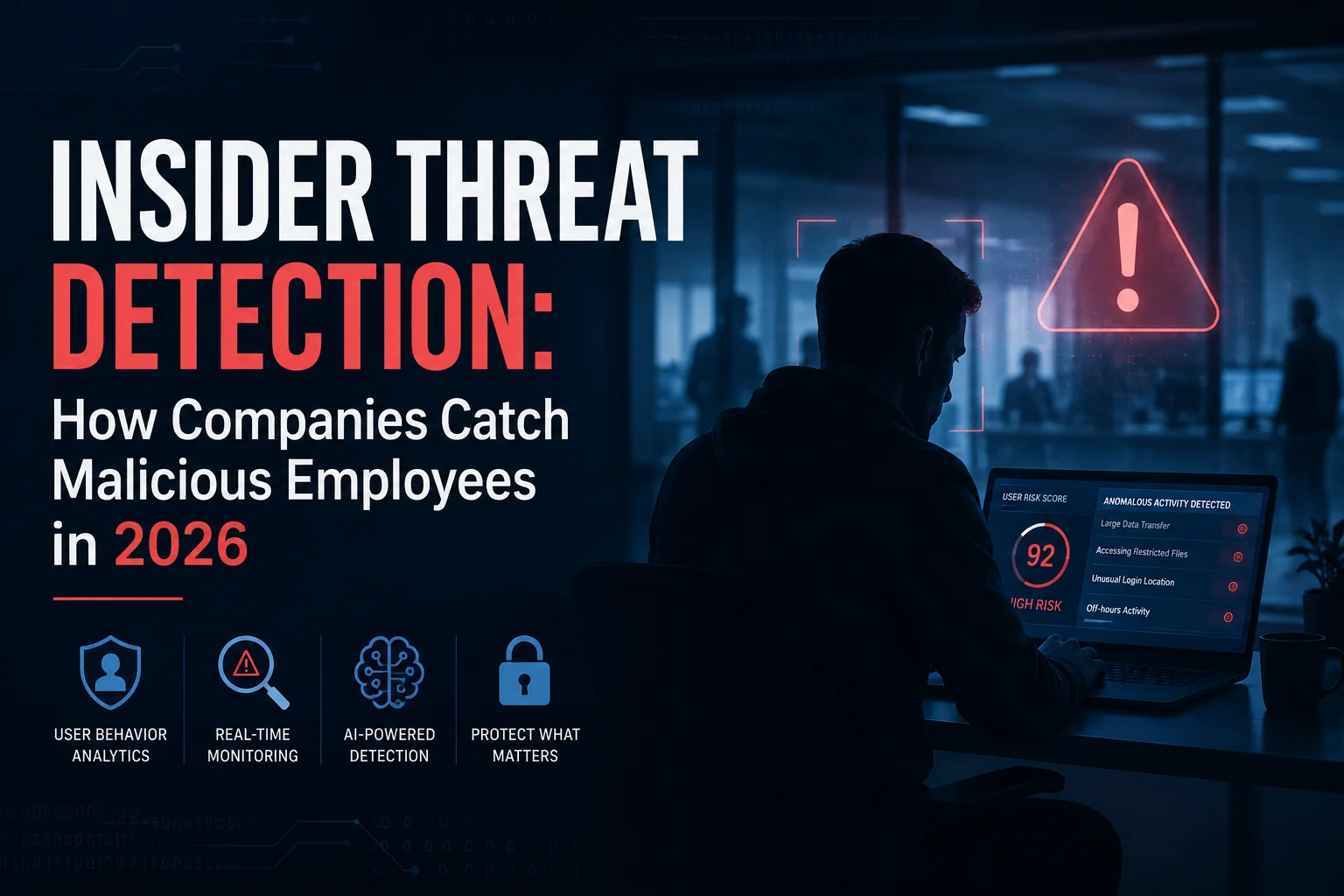
The most damaging data breaches are not always the ones that make headlines. Many of the most costly security incidents in the past five years involved people who already had legitimate access: employees, contractors, and trusted vendors who used that access to steal data, sabotage systems, or hand credentials to external attackers.
Insider threats are harder to detect than external attacks because the activity looks, at least initially, like normal work. An employee downloading thousands of customer records looks exactly like someone doing their job, until it does not.
Three Categories of Insider Threat
| Type | Motivation | Typical Behaviour |
|---|---|---|
| Malicious insider | Financial gain, revenge, ideology | Data exfiltration, sabotage, fraud |
| Negligent insider | Carelessness, lack of awareness | Phishing clicks, misconfigured storage, lost devices |
| Compromised insider | Credentials stolen by external attacker | Unusual access patterns, off-hours activity, lateral movement |
Most insider threat programmes focus on the malicious insider because the intent is deliberate. Negligent insiders cause more total incidents but typically with lower individual severity. Compromised insiders bridge the boundary between internal and external threat, making them harder to categorise in incident response.
Why Traditional Security Controls Miss Insider Threats
Firewalls, intrusion detection systems, and endpoint protection tools are designed to detect anomalous activity from outside the network perimeter. An insider already inside that perimeter, using legitimate credentials, generally does not trigger those systems.
Access controls are necessary but not sufficient. Granting the minimum necessary access (principle of least privilege) reduces the blast radius of a compromise but does not prevent an employee from misusing the access they legitimately hold.
The detection gap requires a different approach: systems that establish what normal looks like for each user, then alert on deviations from that baseline, regardless of whether the activity uses legitimate credentials.
User and Entity Behaviour Analytics (UEBA)
UEBA is the category of tool that has most significantly changed insider threat detection over the past five years. UEBA systems build behavioural profiles for every user and entity (device, application, service account) on the network. They track patterns: when a user typically logs in, from where, which files they access, how many records they query per session.
When behaviour deviates from the established profile, the system generates a risk score and flags the anomaly for review. A senior accountant who suddenly accesses HR records at 11pm on a Saturday from a new device generates a high anomaly score, even if their credentials are valid.
Platforms including Splunk UBA, Microsoft Sentinel, and Exabeam Fusion offer UEBA capabilities integrated with broader security information and event management (SIEM) systems.
Data Loss Prevention in the Modern Environment
Data Loss Prevention (DLP) tools monitor the movement of sensitive data across the organisation’s systems. They can identify when files containing defined sensitive patterns (credit card numbers, social security numbers, health records, proprietary code) are being copied, emailed, uploaded, or printed.
Modern DLP has extended beyond the traditional network perimeter. Endpoint DLP monitors activity on individual devices. Cloud DLP covers data in cloud storage, collaboration tools, and SaaS applications. The expansion matters because the historic model of data sitting inside a corporate network is now the exception, not the rule.
The challenge with DLP is false positive management. Overly sensitive DLP rules generate so many alerts that security teams become desensitised to them. Calibrating DLP rules to catch genuine exfiltration without drowning in noise requires ongoing tuning and operational experience.
The Role of Privileged Access Management
Privileged accounts, administrator credentials, database access, system configuration rights, are disproportionately represented in serious insider incidents. An employee with database administrator rights can extract far more data far more quietly than someone with standard user access.
Privileged Access Management (PAM) tools control and monitor how privileged credentials are used. They enforce session recording on privileged sessions, require justification for elevated access, and alert on privileged activity that falls outside normal patterns.
CyberArk, BeyondTrust, and Delinea are the leading PAM vendors in enterprise environments. Most major compliance frameworks including SOC 2, ISO 27001, and PCI-DSS include PAM controls as requirements.
Building an Insider Threat Programme That Respects Privacy
Effective insider threat detection requires monitoring employee activity, which creates genuine tension with employee privacy rights. This tension is not something to paper over; it requires explicit policy, legal review, and proportionate implementation.
Transparent monitoring policies, disclosed to employees at hiring and reviewed periodically, provide a legal basis for workplace monitoring in most jurisdictions. Covert monitoring without disclosure is legally problematic in the EU under GDPR and in several US states.
Proportionality matters operationally as well as legally. Monitoring everyone at the same intensity as the highest-risk roles wastes resources and creates a culture of surveillance that damages morale without improving security. Risk-based targeting focuses intensive monitoring on high-privilege users and those with known risk factors.
Common Mistakes in Insider Threat Programmes
Treating insider threat as purely a technical problem. Technology identifies anomalies; people decide what the anomalies mean and what to do about them. Programmes without trained analysts reviewing alerts consistently miss the genuine incidents buried in the noise.
Reactive-only posture. Many organisations only focus on insider threats after an incident. Baseline behavioural data must be collected and analysed before an incident occurs to be useful in investigating one.
Ignoring the offboarding window. A disproportionate share of malicious insider incidents occur in the two to four weeks before an employee’s departure, once they have decided to leave. Elevated monitoring during the notice period is standard practice in high-risk environments.
FAQs
How do you detect a malicious insider before damage is done?
Behavioural analytics looking for deviations from established user baselines, combined with DLP monitoring for unusual data movement, catch most pre-exfiltration activity. The key is establishing accurate baselines and having trained analysts reviewing high-scoring anomalies promptly.
Can employees detect that they are being monitored?
In most enterprise environments with properly disclosed monitoring policies, yes. Employees are notified in acceptable-use policies and employment contracts that company systems are subject to monitoring. Most UEBA and DLP tools are not visible at the endpoint level to standard users.
What is the most common insider threat vector?
Email remains the most common exfiltration channel, followed by cloud storage uploads and removable media. USB blocking is now standard in most regulated industries. Cloud storage monitoring is the growing challenge as personal cloud accounts are harder to monitor than corporate email.
Where Insider Threat Detection Is Heading
AI-driven behaviour analysis is becoming more granular. Next-generation systems analyse writing style, communication patterns, and sentiment alongside technical behaviour, identifying changes in emotional state that correlate with elevated risk, such as the period after a negative performance review or a failed promotion.
The ethical and legal questions around that level of monitoring are significant and not yet resolved. Several EU data protection authorities have opened investigations into employee monitoring practices that go beyond traditional IT security monitoring.
For ongoing coverage of cybersecurity practices, threat intelligence, and privacy law developments, WritoryBuzz publishes in-depth security analysis throughout 2026.