
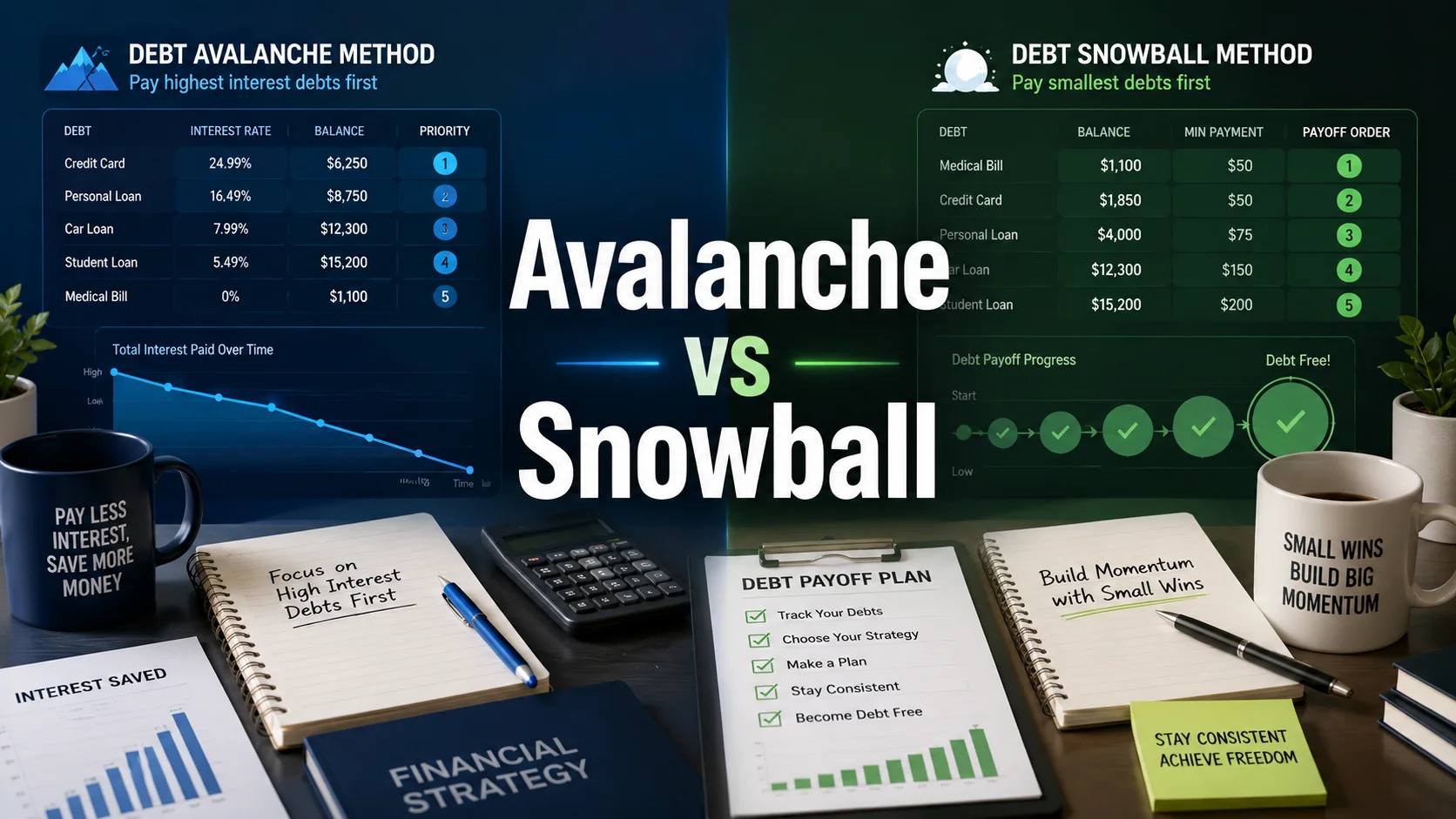
Carrying debt is expensive and stressful in ways that compound on each other. The interest compounds monthly. The stress compounds daily. Most people know they should pay down debt faster but find the practical mechanics confusing or demoralising when progress feels invisible.
Two structured approaches have been tested extensively by personal finance researchers and practitioners: the avalanche method and the snowball method. They work differently, they produce different financial outcomes, and they are more effective for different personality types. Understanding the difference lets you choose the right one rather than defaulting to whichever you happened to hear about first.
The Core Difference in One Table
| Factor | Avalanche Method | Snowball Method |
|---|---|---|
| Payoff order | Highest interest rate first | Smallest balance first |
| Total interest paid | Lower (mathematically optimal) | Higher (sometimes significantly) |
| Time to first paid-off debt | Longer (if high-rate debt is large) | Shorter (quick wins) |
| Psychological momentum | Slower to build | Builds quickly |
| Best for | Disciplined, numbers-focused people | Motivation-driven, behavioural approach |
The Avalanche Method: The Mathematically Correct Approach
The avalanche method prioritises eliminating the highest-interest debt first, regardless of balance size. You make minimum payments on all debts, then put every additional pound or dollar available toward the debt with the highest annual interest rate.
When that debt is paid off, the money you were putting toward it rolls to the debt with the next highest rate. This continues until all debts are cleared.
The financial logic is straightforward: high-interest debt is the most expensive debt to carry. Eliminating it first reduces the total interest you pay over the life of your repayment, sometimes by thousands of pounds depending on balances and rates.
Avalanche in Practice: A Worked Example
| Debt | Balance | Interest Rate | Minimum Payment |
|---|---|---|---|
| Credit card A | £4,500 | 24% APR | £90 |
| Personal loan | £8,000 | 15% APR | £160 |
| Credit card B | £1,200 | 19% APR | £30 |
| Car finance | £6,000 | 7% APR | £180 |
With the avalanche method, you attack Credit Card A (24% APR) first. Once it is cleared, the £90 minimum plus your extra payment attacks Credit Card B (19%). Then the personal loan (15%). The car finance (7%) is last.
If you have £200 extra per month to put toward debt, total interest paid using the avalanche over 36 months is meaningfully lower than the snowball for this debt profile.
The Snowball Method: The Psychologically Effective Approach
The snowball method ignores interest rates entirely. You pay off the smallest balance first, regardless of what it costs in interest. Minimum payments go to all other debts. Every extra pound goes to the smallest balance until it is gone.
Then you roll the freed-up payment to the next smallest balance. The payments compound in size as each debt is eliminated, which is where the snowball name comes from.
Dave Ramsey popularised this approach in the US. The behavioural insight behind it is real: quick wins build motivation, and motivation is what keeps people on a debt repayment plan long enough for it to work. A plan that is mathematically superior but abandoned after three months produces worse outcomes than a slightly less efficient plan that gets completed.
Snowball in Practice: Same Debts, Different Order
With the same four debts listed above, the snowball attacks Credit Card B (£1,200) first, then Credit Card A (£4,500), then the Car Finance (£6,000), then the Personal Loan (£8,000).
Credit Card B is gone in six months or so with extra payments. That quick early win is the point. The freed-up payment joins the next attack. The speed at which the snowball grows in later stages is genuinely motivating.
The extra interest cost versus the avalanche for this specific debt profile runs to a few hundred pounds over three years. For someone who would otherwise abandon the plan entirely, that cost is worth paying.
What the Research Says About Which Method Works
A 2016 study in the Journal of Consumer Research found that people who paid off their smallest accounts first were more likely to eliminate their total debt than those who mathematically optimised their payoff order. The psychological benefit of completion was a real predictor of follow-through.
A 2019 Harvard Business Review analysis of over 6,000 debt repayment accounts found that the account balance metric (what fraction of total debt has been paid off) was a stronger motivator than the total interest metric. This supports the snowball’s behavioural logic.
The practical conclusion: the best method is the one you will actually stick to. For people with strong financial discipline who can stay motivated without visible short-term wins, the avalanche saves money. For people who need to see progress to keep going, the snowball gets results.
A Hybrid Approach That Many Financial Planners Use
Some advisers recommend starting with the snowball to build momentum and then switching to the avalanche once motivation is established. Clear one or two small debts with the snowball, feel the progress, then switch the strategy to attack high-interest debts.
This works particularly well when one or two debts are small enough to clear within two to three months. Clearing those quickly, then committing to the avalanche for the remaining larger debts, captures both the psychological benefit and the interest efficiency.
Additional Tactics That Accelerate Either Method
Balance transfers can reduce the interest cost on credit card debt significantly. A 0% balance transfer for 18 to 24 months, if available, effectively pauses interest on the transferred amount. The risk is the balance transfer fee and the end-of-promotional-period rate if the balance is not cleared.
Income spikes should go to debt. A tax refund, annual bonus, freelance payment, or inheritance that gets directed entirely to debt can collapse a payoff timeline dramatically. This is harder to commit to than it sounds, which is why making the decision in advance is more effective than deciding in the moment the money arrives.
Spending cuts free up the extra payment amount. The difference between paying off debt in 36 months and 48 months is often one or two spending categories. Meal prep instead of frequent takeaways, cancelling unused subscriptions, and pausing discretionary spending temporarily are the three most consistently effective levers.
Common Mistakes in Debt Repayment
Paying off debt while carrying no emergency fund. Without any financial cushion, a single unexpected expense goes back on credit at high interest, undoing weeks of progress. A small emergency fund of £500 to £1,000 before aggressive debt payoff begins is the practical advice most debt counsellors give.
Making minimum payments and hoping for the best. Minimum payments are designed to keep you in debt as long as possible. On a £3,000 credit card balance at 24% APR, minimum payments alone can take over 15 years to clear the balance.
Opening new credit during payoff. Every new purchase that goes back on credit during a debt payoff plan extends the timeline and erodes the motivation built by paying down balances.
FAQs
Which method saves more money overall?
The avalanche method saves more money in interest in most cases. The exact difference depends on your specific debt balances and interest rates. For high-interest credit card debt carried alongside lower-rate loans, the interest savings from avalanche can be substantial.
Can I use both methods at the same time?
Not simultaneously on the same debt profile. The methods require choosing which debt to attack with extra payments. You can switch from one to the other as your situation or motivation changes.
Should I pay off debt or save for retirement?
The general rule is: pay off high-interest debt (above 8 to 10% APR) before non-matched retirement contributions. If your employer matches retirement contributions, capture the match first (it is an immediate 50 to 100% return) before aggressive debt payoff. Below 6% APR debt, the investment return from a diversified portfolio often outperforms the guaranteed return of paying off the debt.
Getting Started Today
List every debt with its balance, interest rate, and minimum payment. Pick a method: avalanche if the interest savings motivate you, snowball if you need quick wins. Calculate your current total minimum payment sum, then identify the maximum extra amount you can consistently add each month.
Automate the minimum payments. Add the extra payment manually each month to the target debt. Review progress monthly, not daily. Daily review of slow-moving balances is demoralising; monthly review shows real movement.
For more personal finance tools, debt analysis frameworks, and savings strategies for 2026, WritoryBuzz covers financial decisions in plain language without the jargon.