
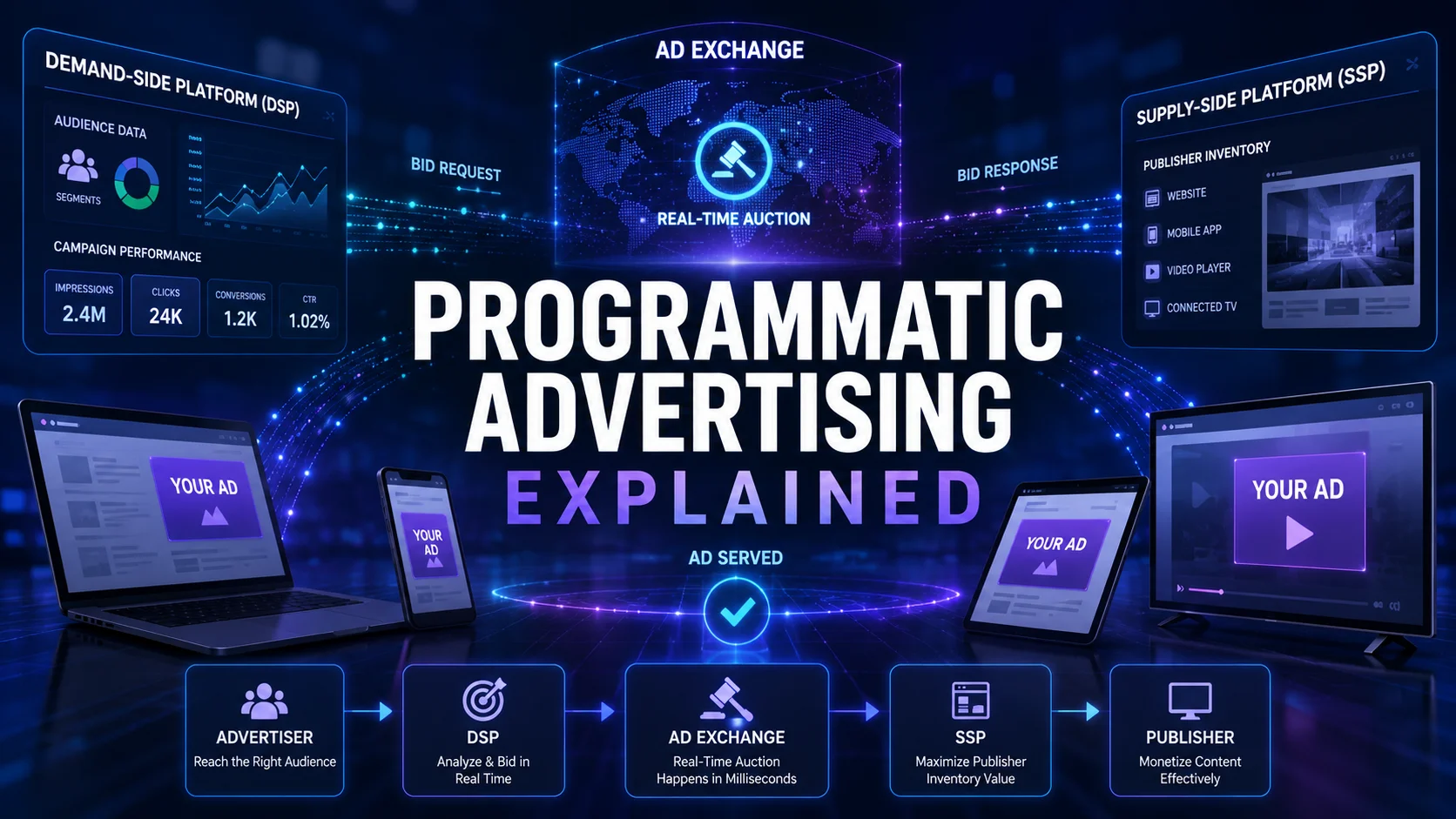
Every time a webpage loads, dozens of decisions happen in under 100 milliseconds. Advertisers bid against each other for the right to show their ad to you specifically, in that specific context, at that specific moment. You see the winning ad. The losing bids disappear without a trace.
This is programmatic advertising, and it now accounts for the overwhelming majority of digital display, video, and connected TV advertising globally. Marketers who do not understand how it works are spending significant budgets without understanding the mechanics that determine who sees their ads, at what price, and with what effect.
The Four Main Players in the Programmatic Ecosystem
| Player | Role | Examples |
|---|---|---|
| Advertiser | Pays for ad impressions, sets targeting and bids | Brand, agency, direct advertiser |
| DSP (Demand-Side Platform) | Manages advertiser bidding across multiple exchanges | The Trade Desk, DV360, Xandr |
| SSP (Supply-Side Platform) | Manages publisher inventory, connects to exchanges | Magnite, PubMatic, OpenX |
| Ad Exchange | Marketplace where DSPs and SSPs transact | Google Ad Exchange, Amazon Ads |
How a Real-Time Bid Actually Works
When a user visits a webpage with programmatic ad inventory, the publisher’s ad server sends a bid request to an ad exchange within milliseconds of the page beginning to load. That bid request contains information about the ad unit (size, format, placement), the page context (URL, category), and, in varying forms depending on privacy rules, information about the user.
The exchange broadcasts that bid request to connected DSPs. Each DSP evaluates the impression against its advertisers’ targeting criteria and bids if the impression matches. Bids are typically calculated by the DSP’s algorithm based on the advertiser’s target CPM (cost per thousand impressions), the probability that this user will convert, and the current supply-demand balance.
The auction closes in roughly 100 milliseconds. The winning DSP’s ad creative is served to the page. The user sees the ad. The entire process completes before the page finishes loading.
First-Price vs Second-Price Auctions
For most of programmatic advertising’s history, ad exchanges ran second-price auctions: the winner paid one penny more than the second-highest bid, not their actual bid. This encouraged bidders to bid their true value because overbidding did not cost them.
In 2019, most major exchanges switched to first-price auctions, where the winner pays their actual bid. This increased revenue for publishers and exchanges but required DSPs to develop bid-shading technology, algorithms that reduce bids to avoid overpaying relative to market clearing prices.
Understanding which auction type a given exchange runs is relevant for campaign managers setting bids. First-price auction environments reward tighter bid management; second-price environments reward accurate valuation.
Targeting in Programmatic: How Ads Find the Right People
Contextual targeting uses the content of the page to determine ad relevance. An ad for running shoes shown on a fitness article uses no personal data at all. It works because the content context predicts user interest with reasonable accuracy. Post-cookie, contextual targeting has gained significant renewed attention.
Audience targeting uses data about the user to bid more on impressions from people who match a defined profile: age, location, purchase history, browsing behaviour, or first-party data from the advertiser’s own customer database. This category is the one most affected by privacy legislation changes and the deprecation of third-party cookies.
Retargeting (or remarketing) shows ads to people who have previously visited an advertiser’s website or interacted with their brand. It uses first-party data and typically shows higher conversion rates than cold prospecting.
The Privacy Disruption That Is Still Playing Out
Apple’s App Tracking Transparency framework, which required explicit opt-in for tracking on iOS devices, reduced addressable mobile inventory significantly after its 2021 launch. Most iOS users opt out of tracking, which has made mobile programmatic less targetable than it was.
Google’s plan to remove third-party cookies from Chrome has been delayed multiple times, with the latest timeline suggesting a 2025 to 2026 transition. The advertising industry’s preparation for this transition, through the Privacy Sandbox initiative and alternative identity solutions, has been ongoing for three years without full resolution.
The practical result for 2026 is a fragmented identity landscape. Some programmatic environments use cookie-based targeting. Others use email hash matching (Unified ID 2.0). Others use contextual signals. Sophisticated advertisers run parallel strategies rather than depending on any single tracking method.
Programmatic for Video and Connected TV
Connected TV (CTV) is the fastest-growing programmatic channel in 2026. Smart TVs, streaming devices, and OTT platforms now sell a significant proportion of their ad inventory programmatically. The inventory is premium, the audiences are large, and the targeting options, while more limited than desktop, are growing.
Video programmatic on CTV runs primarily through private marketplace deals (PMPs), not open auction. PMPs are negotiated agreements between an advertiser and a specific publisher, executed programmatically. They offer better inventory quality controls and brand safety guarantees than open auction.
Common Programmatic Advertising Mistakes
Setting and forgetting. Programmatic campaigns require regular optimisation. Bids, creative, targeting parameters, and frequency caps all need adjusting based on performance data. A campaign left unreviewed for weeks typically develops inefficiencies that accumulate.
Prioritising impressions over outcomes. CPM optimisation can produce huge impression volumes on low-quality inventory. Optimising for cost-per-acquisition or return on ad spend produces smaller volume but measurable business results.
Ignoring brand safety settings. Without proper brand safety controls, programmatic ads can appear alongside content that damages brand reputation. Blocklists, category exclusions, and viewability standards should be configured before any campaign goes live.
FAQs
What is the difference between programmatic and display advertising?
Display advertising refers to a format: banner, rich media, and similar visual ad formats. Programmatic is a buying method: automated, auction-based purchasing of ad inventory. Most display advertising is now bought programmatically, but programmatic also covers video, audio, native, and CTV formats.
How do I know if my programmatic ads are actually being seen?
Viewability measurement (typically defined as 50% of the ad in view for one second for display, two seconds for video) is tracked by verification vendors including IAS, DoubleVerify, and MOAT. Set minimum viewability thresholds in your DSP campaign settings and use a third-party verification partner for independent measurement.
What budget do I need to run programmatic advertising?
There is no hard minimum, but programmatic campaigns need sufficient budget to generate statistically significant data for optimisation. In practice, £3,000 to £5,000 per month is typically the minimum to see meaningful performance data in most developed markets. Below that, impression volumes are too low for reliable optimisation signals.
Running Smarter Programmatic Campaigns
The difference between average and strong programmatic results usually comes down to the quality of audience definition, the rigour of creative testing, and the consistency of performance review. Technology handles execution; human judgment determines strategy.
Start with clear objectives before any campaign setup. An awareness campaign should optimise differently from a retargeting conversion campaign. Mixing objectives in a single campaign produces mediocre results on both dimensions.
WritoryBuzz covers digital marketing strategy, programmatic buying, and performance analytics throughout 2026. Follow our marketing coverage for campaign-level guidance updated with current platform changes.