
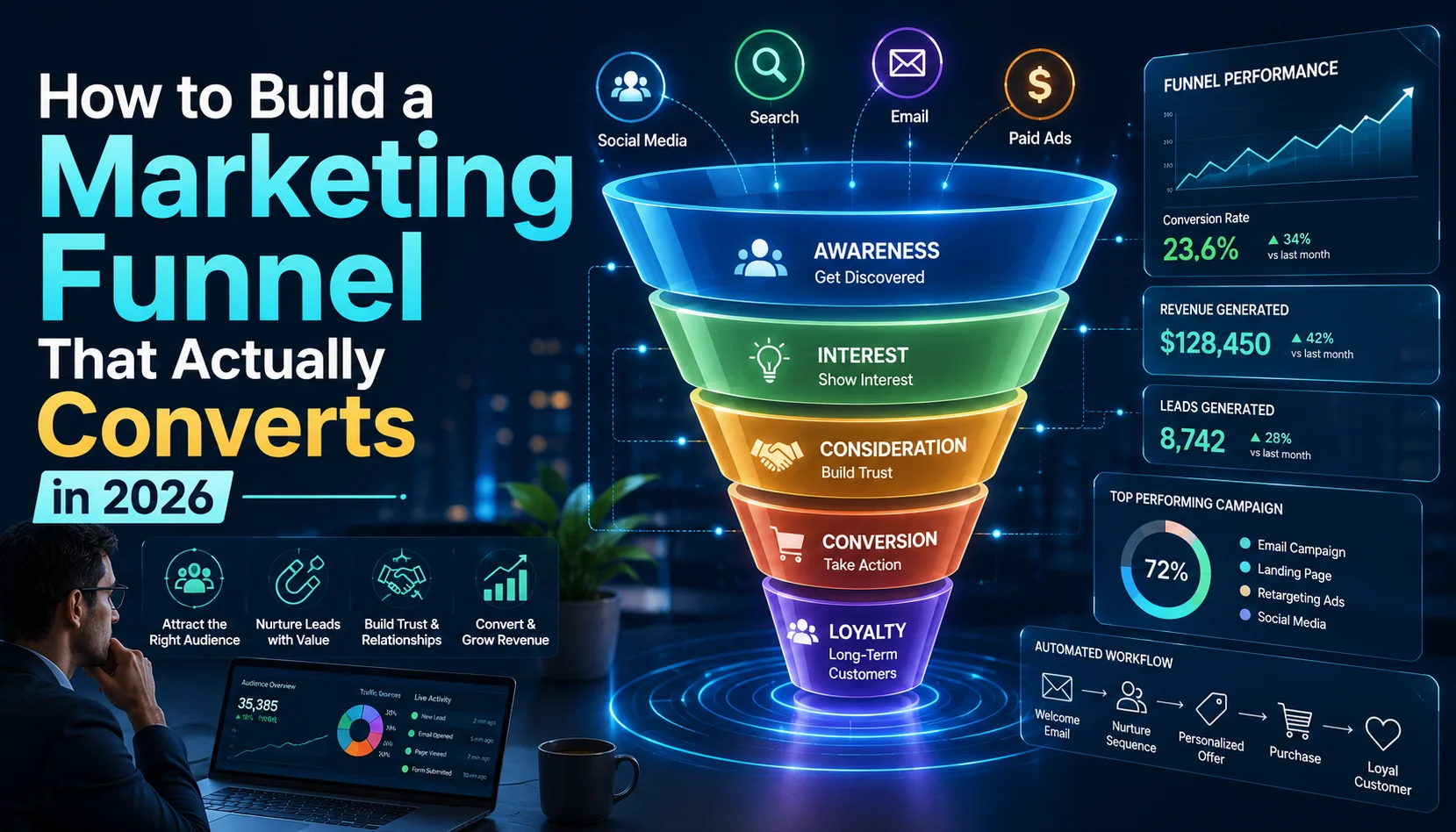
The concept of a marketing funnel is so widely understood that it has become almost meaningless. Everyone knows that prospects move from awareness to consideration to purchase. The part that is less discussed is why most funnels fail to move people effectively between those stages, and what the organisations that consistently convert actually do differently.
This guide is not about funnel theory. It is about the specific decisions at each stage that determine whether someone moves through or drops out, and how to diagnose which stage in your funnel is responsible for the results you are getting.
The Modern Funnel Is Not a Straight Line
The traditional AIDA model, Awareness, Interest, Desire, Action, describes a linear journey that few real buyers actually take. Modern buyer research shows that people move back and forth between stages, re-enter at different points, and consume content in orders that do not follow a neat sequence.
The more useful framing is jobs at each stage. What does someone need to know, feel, or believe to move closer to a decision? What content, interaction, or evidence provides that? Build around those jobs rather than around the stage labels.
Stage 1: Awareness – Being Found by the Right People
Organic Search
Topical authority in search is the most cost-efficient awareness channel for most businesses over a 12 to 24 month horizon. Building a content cluster that comprehensively covers a topic area, through a pillar page and supporting articles, signals expertise to Google and earns ranking positions that generate continuous traffic without ongoing spend.
The mistake most businesses make at this stage is writing about themselves rather than about their prospect’s questions. The awareness stage content that performs is the content that answers what someone asks before they know your company exists.
Paid Acquisition
Paid search at the awareness stage targets informational queries, questions prospects are asking rather than terms they use when ready to buy. The cost per click is lower than commercial intent keywords, and the audience is earlier in the journey, but the volume is often significantly larger.
Paid social for awareness works on interest and demographic targeting rather than search intent. Meta, LinkedIn, and TikTok reach people before they are actively searching, which makes the creative work harder (you are interrupting rather than answering) but the audience size is essentially unlimited.
What Good Awareness Measurement Looks Like
| Metric | What It Measures | Useful Benchmark |
|---|---|---|
| Branded search volume growth | Awareness building over time | YoY % increase |
| Share of voice in organic search | Presence on key informational queries | % of category queries you appear for |
| First-touch attribution | Which channels introduce new prospects | Channel mix by new visitor |
| Content engagement rate | Whether awareness content holds attention | Time on page, scroll depth |
Stage 2: Consideration – Giving Prospects What They Need to Evaluate You
The consideration stage is where most B2B funnels lose prospects unnecessarily. Someone has found you and is genuinely evaluating whether you can solve their problem. The content and experiences at this stage need to reduce uncertainty, not add to it.
Case studies are the highest-performing consideration stage content in B2B marketing by a significant margin in most studies. Not case studies that describe what you did in vague terms, but case studies that name a specific problem, quantify the result, and describe the customer’s situation in enough detail that the prospect reading it can see themselves in it.
Comparison content, including your product versus alternatives, is widely avoided by marketing teams who see it as inviting attack. It is also among the highest-converting content because it captures buyers at the exact moment they are making a decision. If you do not write that comparison, a competitor or a review site will, with less favourable framing.
Lead Capture That Does Not Annoy People
The pop-up that appears 0.5 seconds after a first-time visitor arrives on a page asking for their email address is not a consideration stage tool. It is an awareness stage interruption that damages the experience without adding value.
Lead capture that works at the consideration stage offers something genuinely valuable in exchange for contact information: a detailed guide that answers a question the prospect is actively investigating, a comparison tool, a calculator, a free assessment. The exchange is explicit and the value is immediate.
Progressive profiling, asking one or two questions at a time across multiple interactions rather than a long form upfront, consistently improves completion rates for higher-value offers without reducing lead quality.
Stage 3: Conversion – Removing the Last Barriers to Decision
By the time a prospect reaches the conversion stage, the job is not to persuade them that you are a good solution. That should already be done. The job is to remove the friction and uncertainty that stands between intent and action.
Trial or freemium models reduce conversion friction by removing financial commitment. Demo requests with fast follow-up, typically under an hour in competitive B2B markets, convert at significantly higher rates than demos scheduled days later. Pricing transparency on your website reduces the unspoken objection that often stops prospects from making contact.
The Follow-Up Sequence That Most Businesses Get Wrong
A prospect who fills in a contact form and receives a response two days later has, in most markets, already spoken to a competitor. The first response time is the single most correlated factor with conversion rates in B2B sales research. Fast first response signals operational competence before the sales conversation begins.
Follow-up sequences after initial contact should be personalised to the specific content the prospect engaged with, not generic nurture sequences. If someone downloaded a case study about cost reduction, the follow-up should reference cost-reduction context, not your full product overview.
Where Funnels Leak and How to Find Out
| Leak Location | Symptom | Likely Cause |
|---|---|---|
| Awareness to consideration | High traffic, low engagement | Wrong audience attracted or weak middle content |
| Consideration to conversion | High content engagement, few leads | Weak or poorly placed lead capture |
| Conversion to sale | Many leads, low close rate | Lead quality issues or sales process gaps |
| Post-sale retention | High churn despite good sales metrics | Product-expectation mismatch set in funnel messaging |
Cohort analysis across the funnel, tracking specific groups of prospects from first touch through conversion, reveals which stage is the primary constraint. Fixing the wrong stage, spending on more traffic when the consideration stage is the leak, is the most common and most expensive funnel mistake.
Attribution: Understanding Which Channels Actually Drive Revenue
Last-click attribution, crediting the final touchpoint before a conversion for the entire sale, systematically undervalues awareness-stage content and overvalues bottom-of-funnel paid search. A prospect who read three blog posts, downloaded a guide, attended a webinar, and then clicked a branded search ad to convert had a much more complex journey than last-click attribution records.
Data-driven attribution models, available in Google Analytics 4 and most enterprise attribution platforms, distribute credit across touchpoints based on their actual contribution to conversions. They are not perfect but they produce better optimisation decisions than last-click.
For complex B2B sales with long cycles, self-reported attribution, asking customers directly how they first heard about you and what content was most influential, remains one of the most accurate sources of attribution data available.
FAQs
How long does it take to build a converting funnel?
The awareness stage, particularly organic content, takes 6 to 18 months to generate significant traffic. Paid acquisition can drive traffic immediately but requires budget. The consideration and conversion stage mechanics, lead capture, follow-up sequences, and sales process, can be built and tested within weeks. Most businesses see meaningful funnel improvement within 90 days of focused optimisation work.
Should B2C and B2B funnels be built differently?
Yes, significantly. B2C funnels prioritise frictionless conversion, emotional resonance, and social proof. Purchase cycles are shorter and individual decision-makers are reached directly. B2B funnels must account for multiple stakeholders, longer evaluation cycles, and the need to build institutional trust, not just individual interest.
What is the biggest funnel mistake most businesses make?
Building the top and bottom of the funnel without the middle. Businesses invest in content marketing for awareness and in sales tools for conversion but leave consideration-stage content thin. The result is prospects who are aware and interested but cannot find the evidence they need to justify a decision, so they stall or choose a competitor who gave them that evidence.
Building Your Funnel Audit
Pull three months of data and map where visitors come from, what pages they visit, where they exit, and which sequences correlate with conversion. The pattern of exits tells you more than any benchmark comparison.
Run one specific experiment per funnel stage per month. A/B test headline copy on your highest-traffic awareness page. Test a different lead magnet on your consideration pages. Test response time in your conversion follow-up sequence. Systematic small experiments compound over a year into a meaningfully better funnel.
WritoryBuzz covers digital marketing strategy, conversion optimisation, and performance measurement throughout 2026. Follow our marketing content for campaign-level guidance that goes deeper than funnel diagrams.