
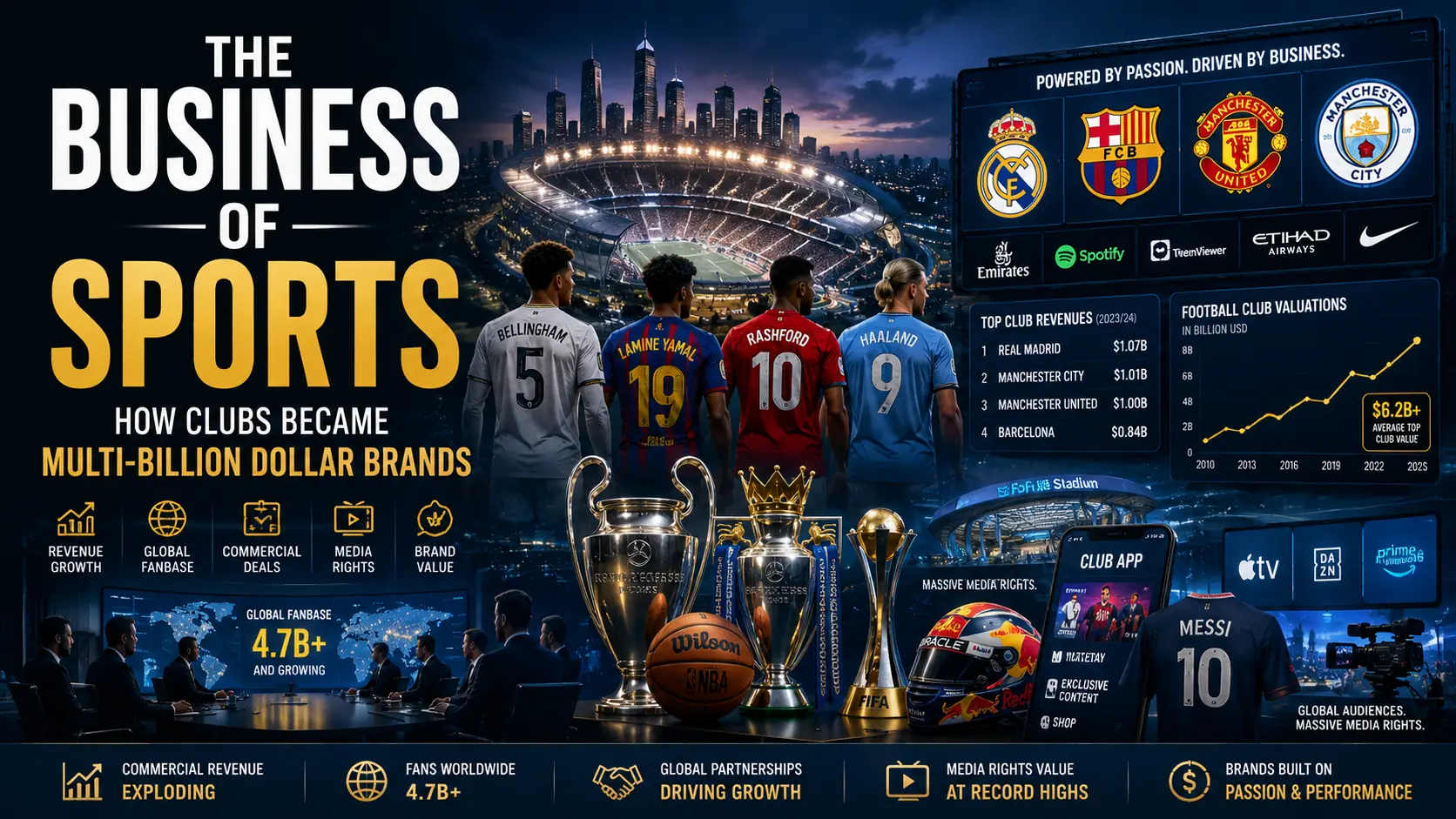
The largest sports clubs in the world are not primarily sports companies. They are media businesses, brand licensing operations, and entertainment platforms that happen to play sport at the center of everything else they do.
Manchester United generates roughly 60% of its revenue from commercial and broadcasting sources. Real Madrid’s Bernabeu redevelopment is designed as a 365-day entertainment venue, not just a football stadium. The Dallas Cowboys, valued at over $10 billion, earns more from its sponsorship portfolio and stadium operations than from the NFL revenue-sharing pool.
Understanding how this happened reveals something important about where the sports industry is going next.
The Broadcasting Revolution That Changed Everything
The modern sports business model starts with broadcast rights. Television transformed sport from a local entertainment product to a global media asset in the 1980s and 1990s. The Premier League’s decision to negotiate broadcast rights collectively, beginning with Sky Sports in 1992, set the template for every major sports league since.
Streaming has extended this model. Amazon Prime broadcasts a portion of Premier League matches in the UK. Apple TV holds the Major League Soccer rights in a deal that MLS explicitly described as a partnership rather than a licensing arrangement. The distinction matters: Apple shares data, audience insights, and marketing infrastructure with the league, not just money.
Rights fees escalate because sport delivers something increasingly rare in media: live audiences who watch in real time and cannot skip the advertising. A Champions League final draws 250 to 300 million concurrent viewers globally. No scripted television programme comes close to those numbers consistently.
Commercial Revenue: Beyond the Match Day
| Revenue Stream | Example | Scale |
|---|---|---|
| Kit manufacturing | Adidas / Real Madrid deal | $153M per year |
| Shirt sponsorship | Emirates / Arsenal deal | $50M+ per year |
| Stadium naming rights | Etihad / Manchester City | $15M per year |
| Digital content | Barcelona’s BarcaTV+ | Millions of subscribers |
| Gaming integration | EA Sports FC licensing | $150M+ annually across clubs |
The Private Equity Transformation
Private equity arrived in professional sport seriously in the early 2020s and has not left. CVC Capital Partners took stakes in La Liga, the Pro14 rugby competition, and later Formula One. Silver Lake invested in Manchester City’s parent group City Football Group. RedBird Capital owns stakes in Liverpool’s parent company Fenway Sports Group, AC Milan, and the French national football federation’s media rights.
Private equity brings capital, but more importantly it brings institutional thinking about brand value, revenue diversification, and operational efficiency. Sports clubs traditionally ran on passion and tradition. Private equity owners run on IRR calculations and exit multiples.
The tension between financial optimisation and sporting culture is real. Ticket prices have risen sharply at clubs under private equity ownership. Supporters at many European football clubs have organised against changes they see as prioritising global brand building over local community connection.
Multi-Club Ownership: The New Football Conglomerate
City Football Group, owned by Abu Dhabi interests, controls football clubs across twelve countries. Red Bull owns clubs in Germany, Austria, the United States, and Brazil. The strategy is partly sporting, partly talent pipeline management, and significantly about brand reach across multiple markets simultaneously.
For a commercial sponsor, partnering with a group that operates in twelve markets is more efficient than negotiating separate deals with twelve clubs. For a kit manufacturer, dressing a network of clubs means their products appear in multiple broadcast markets through a single relationship.
The UEFA and FIFA rules around multi-club ownership and competitive integrity are still catching up with how common the model has become.
Digital Media and Direct-to-Fan Economics
The shift that is remaking the economics of sports right now is direct-to-fan. Clubs traditionally reached fans through broadcasters, merchandise retailers, and stadium events. All three of those channels are someone else’s platform.
Clubs are building their own platforms. Real Madrid’s own digital channels reach over 500 million followers across social media. FC Barcelona launched a direct subscription service for behind-the-scenes content. Several NFL franchises have launched app-based fan engagement tools that allow personalised content delivery and direct ticket and merchandise purchase without third-party retail commission.
The data this generates, who watches what content, where fans are located, what they buy, is enormously valuable for sponsorship pricing and targeted commercial deals. A sponsor who knows a club can demonstrate a specific audience demographic buys very differently from a sponsor taking a rough broadcast reach number on faith.
Women’s Sports: The Fast-Growing Category
Women’s sport is the fastest-growing commercial category in the sports industry. The 2023 Women’s World Cup final drew 2 billion viewers globally. The NWSL in the US has seen franchise valuations rise from under $2 million to above $100 million in five years.
Rights fees for women’s football in Europe have risen sharply. The Women’s Super League broadcast deal with Sky Sports and BBC was renewed at a significant uplift. Several major brands, including Barclays, Visa, and Nike, have made high-profile commitments to women’s sport sponsorship as they follow the audience growth.
The structural advantages are significant for investors entering now: lower entry costs than equivalent men’s sport assets, large audiences that are comparatively under-monetised, and a demographic skew that many sponsors are actively seeking.
Common Misconceptions About How Sports Clubs Make Money
Thinking player wages are paid from ticket sales. At elite clubs, ticket sales make up a relatively small percentage of total revenue. The Chelsea home ground Stamford Bridge holds 40,000 seats. Selling every seat every match at premium prices covers perhaps 15 to 20% of the club’s wage bill.
Assuming that winning produces financial returns directly. The relationship is real but indirect. Winning the Champions League increases broadcast distributions, boosts commercial deal values, and supports higher ticket prices. But clubs have gone bankrupt after trophy-winning periods because the on-pitch investment exceeded the commercial returns it generated.
FAQs
Why are sports club valuations so high right now?
Several factors converge: live sport’s scarcity value in a streaming world drives rights fee escalation; private equity has brought institutional valuation discipline to an asset class previously treated as passion spending; and global brand extension means a top club’s addressable market is now genuinely global, not local.
Can smaller clubs compete financially with elite clubs?
Within their own competitions, yes. The German Bundesliga’s 50+1 ownership rule, which requires club members to hold majority control, has kept ticket prices relatively accessible and maintained competitive balance compared to the Premier League. Financial Fair Play rules attempt to set limits, but enforcement has been inconsistent.
What is the future of sports broadcasting?
Bundled subscription streaming is the direction most industry analysts point to: a package that includes multiple sports rights across one platform, with personalisation driven by viewer data. The Apple MLS deal is the most explicit current version of this model.
Where Sports Business Goes From Here
The next phase of sports commercialisation will be driven by data, direct fan relationships, and the expansion of women’s and emerging sports into commercially mature properties.
The clubs that will perform best commercially over the next decade are those that treat their fan base as an audience to serve rather than a crowd to fill seats. The difference shows up in content investment, ticket pricing structure, and how digital platforms are built.
For in-depth analysis of the sports business economy, investment trends, and club valuation data, WritoryBuzz covers the business of sport throughout 2026.