
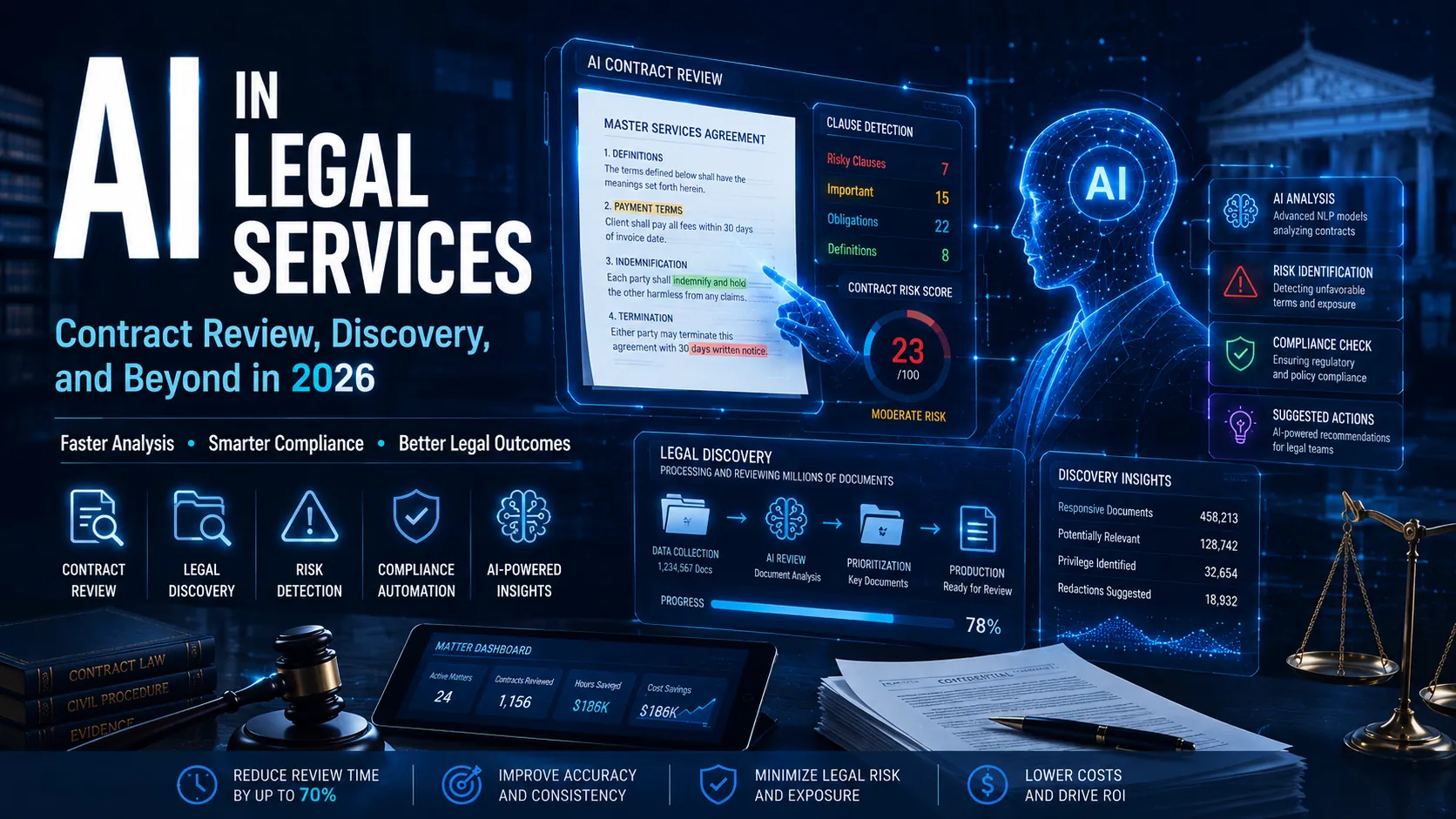
Law firms have a long-standing reputation for being the last profession to adopt new technology. That reputation is becoming harder to sustain. AI tools designed specifically for legal work are now in daily use at dozens of major firms, and the use cases that have proven themselves in practice are narrower and more specific than the broad claims made three years ago.
The honest picture in 2026 is that AI has genuinely reshaped three areas of legal work: contract review, litigation discovery, and legal research. The rest of the profession is watching those three carefully before committing further.
Why Legal Was Slower Than Other Sectors to Adopt AI
Legal work carries unusual downside risk. A factual error in a financial model costs money. A factual error in a legal brief can cost a case, damage a client relationship, and expose a firm to malpractice liability. The bar for trusting an AI output is therefore higher than in most business contexts.
The early general-purpose AI tools were also genuinely unsuitable for legal work. Hallucination rates in legal citation were a serious problem in 2022 and 2023. Multiple lawyers faced disciplinary action after submitting AI-generated briefs that cited non-existent cases. Those incidents created institutional caution that has only partially thawed.
What changed the dynamic was the arrival of legal-specific AI platforms trained on verified legal corpora: case law, statutes, regulatory filings, and contract databases. These systems have different hallucination profiles than general-purpose models, particularly in citation accuracy.
Contract Review: Where AI Has Earned Its Place
Contract review is now the strongest proof point for AI in legal services. Large-scale contract analysis, reviewing thousands of agreements for standard clause presence, deviation from templates, and specific risk language, used to require significant associate time. Most large firms now run AI-assisted review as standard practice.
The efficiency numbers are real. Kira Systems, Luminance, and Ironclad all publish case studies showing review time reductions of 60 to 80% for standard commercial contracts. The accuracy numbers are also real, though with important caveats: AI review is most accurate on standardised clause types and less reliable on unusual or highly negotiated language.
What AI Contract Review Actually Does Well
| Task | AI Performance | Human Oversight Needed? |
|---|---|---|
| Identify missing standard clauses | Very strong | Spot check only |
| Flag deviation from template | Strong | Judgment on materiality |
| Extract key dates and obligations | Strong | Cross-reference required |
| Assess negotiation risk on unusual clauses | Moderate | Full review required |
| Interpret ambiguous language | Weak | Human judgment only |
| Advise on commercial context | Not applicable | Lawyer required |
Discovery: The Billion-Dollar Efficiency Problem
Electronic discovery in complex litigation, reviewing millions of emails, documents, and communications for relevance and privilege, was one of the most expensive and time-consuming activities in large-case litigation. Document review associate time on major cases could run to millions of dollars.
AI-powered e-discovery tools, including Relativity, Nuix, and Everlaw, use predictive coding and supervised machine learning to prioritise documents for human review. The system learns from a reviewer’s decisions on a seed set of documents and then applies that learning across the full corpus.
The efficiency gain is measurable: studies across multiple jurisdictions show that AI-assisted review reduces the volume of documents requiring human review by 70 to 85%, without meaningfully changing recall rates. Courts in the US, UK, and Singapore have accepted AI-assisted discovery methodology in high-profile cases.
Legal Research: Speed Without Full Autonomy
AI legal research tools have changed how lawyers approach preliminary research significantly. Tools like Harvey AI (trained specifically on legal data), Lexis+ AI, and Westlaw Precision can return relevant case law, statutory citations, and secondary sources in minutes rather than hours.
The limitation is precision on highly specific questions. General research queries return useful results. Narrow jurisdictional questions, novel legal theories, or questions requiring interpretation of very recent case law all still require significant human researcher time.
The practical use model that has emerged is AI for breadth, human researcher for depth. Get the landscape quickly from AI, then use a qualified researcher to verify, prioritise, and go deep on the handful of cases that actually matter.
What AI Cannot Do in Legal Work
Strategic legal judgment remains entirely outside what current AI tools do reliably. Advising a client on whether to litigate or settle, how to structure a negotiation, or how a judge is likely to respond to a particular argument requires contextual judgment that AI systems consistently fail at.
Client counselling has no AI equivalent in practice. The human dimensions of legal representation, building trust with a client, reading how they are handling the stress of litigation, calibrating how much risk they can tolerate, are relational skills that AI cannot replicate.
Ethical judgment is a specific gap. Legal ethics rules vary by jurisdiction, evolve through committee decisions, and require interpretation in ambiguous factual situations. No AI system currently handles legal ethics questions reliably enough to be used without extensive human review.
Risks Firms Are Managing in 2026
Data security is the primary concern. Client confidentiality rules are among the strictest in any profession. Firms using cloud-based AI tools must ensure client data never trains external models. Most legal AI vendors now offer private deployment options, but the due diligence burden on firms is significant.
Competence standards are developing. Several state bar associations in the US and the Solicitors Regulation Authority in the UK have issued guidance on AI use, with varying positions on disclosure obligations to clients and courts.
Over-reliance risk is real. Firms that reduce associate training hours because AI handles routine review work may find themselves with less experienced lawyers when genuinely novel or difficult situations arise. This is a medium-term workforce development concern, not a current crisis.
FAQs
Will AI replace lawyers?
Not in the foreseeable future in any meaningful sense. AI is replacing specific tasks within legal work, primarily high-volume, standardised review tasks. Judgment-intensive legal work, strategy, negotiation, advocacy, and client counselling, has no credible AI replacement in current or near-term systems.
Is AI legal advice legally binding?
AI-generated legal analysis is not legal advice in any jurisdiction. Legal advice requires a qualified lawyer, a lawyer-client relationship, and professional accountability. AI outputs used without qualified review carry the same reliability risks as any unverified information.
Which firms are leading on AI adoption in legal services?
Allen & Overy, which launched an AI platform called Aira in partnership with Harvey AI, is among the most visible large-firm adopters. Several US BigLaw firms have deployed Luminance or Kira. Mid-market firms in the UK and Australia have been faster adopters than their large-firm counterparts in some areas.
Where Legal AI Goes in the Next Three Years
The most significant near-term development is AI tools that work across the full document lifecycle, from drafting, through negotiation, to execution and ongoing compliance monitoring. Ironclad and DocuSign both have product roadmaps pointing in this direction.
Regulatory AI is an emerging category: systems that monitor a company’s contracts and business activities against evolving regulatory requirements and flag potential violations before they become enforcement issues. This has obvious appeal to heavily regulated industries.
For coverage of how AI is changing professional services across law, finance, and medicine, follow WritoryBuzz’s technology and business sections throughout 2026.