
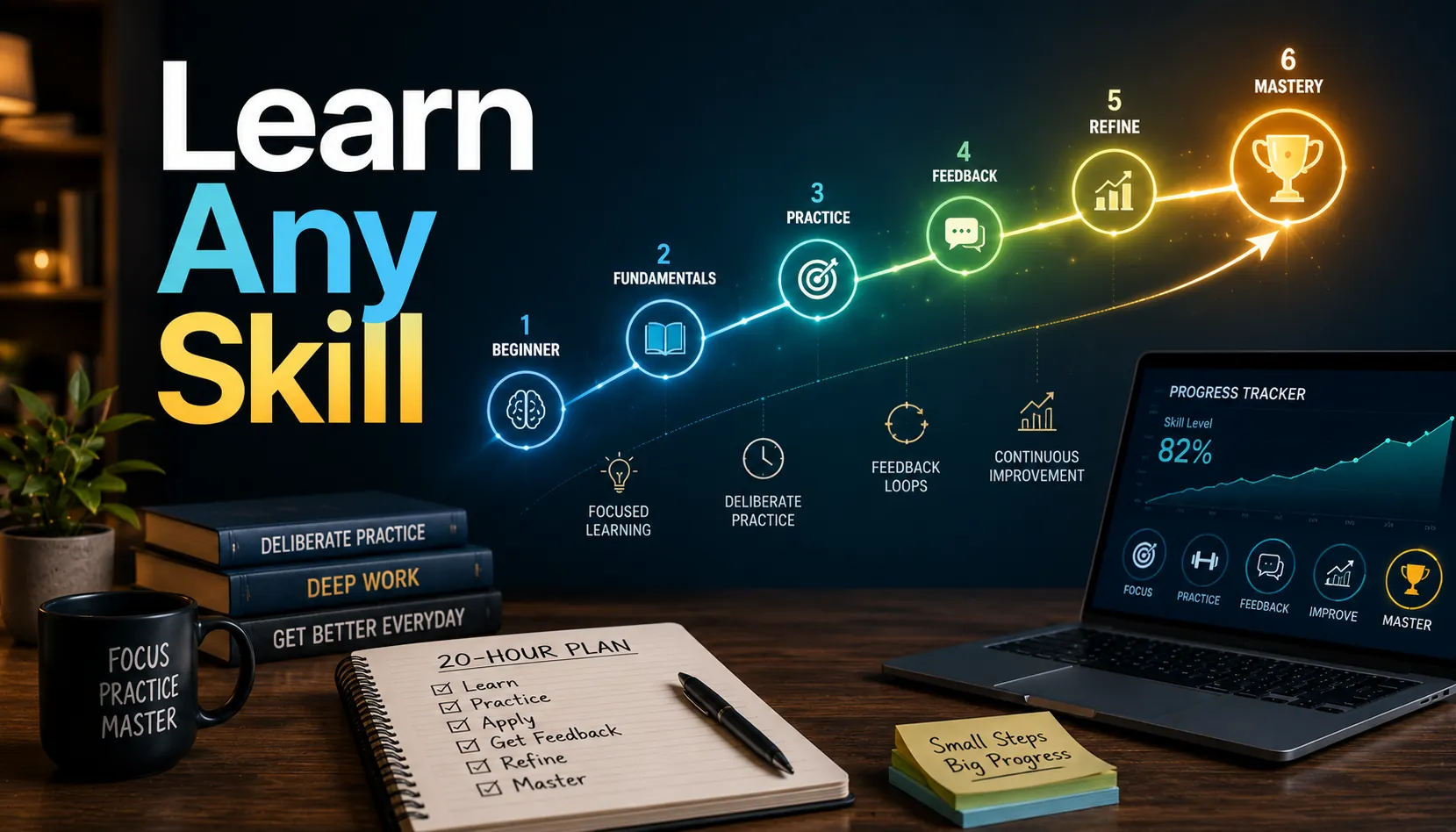
The 10,000-hour rule, popularized by Malcolm Gladwell in Outliers, is often misunderstood. It describes the hours required to reach world-class expertise in competitive domains. Most people are not trying to become world-class anything. They want to become genuinely capable, functional, and enjoying a skill they previously knew nothing about.
For that goal, 20 hours of deliberate practice is enough. This is Josh Kaufman’s core finding in The First 20 Hours, backed by practical field testing across six diverse skills, and consistent with what cognitive science says about the learning curve.
The catch: the 20 hours must be structured correctly. Random time spent with a skill is not the same as deliberate practice.
Why the First 20 Hours Are the Most Valuable
Skill learning follows a non-linear curve. The biggest performance gains happen in the very early stages. You go from knowing nothing to being functional in a relatively short time. After that initial jump, further improvement takes progressively more time per unit of gain.
This means the first 20 hours, done well, produce a disproportionate return. You go from frustrated incompetence to functional enjoyment, which is often all most people actually want. The remaining path to genuine expertise is a separate commitment.
The Four-Step Method
Step 1: Deconstruct the Skill
Most skills are actually clusters of sub-skills. ‘Learning guitar’ contains: chord fingering, strumming patterns, chord transitions, reading chord diagrams, ear training, music theory. You do not have the same level of need for all of these.
Decide what specifically you want to be able to do. ‘Play five songs by campfire’ requires different sub-skills than ‘improvise blues solos.’ Identify the sub-skills that will get you to your specific goal fastest, and focus there.
Step 2: Learn Enough to Self-Correct
Gather 3 to 5 resources (books, videos, courses) on your target skill. Do not complete them before starting to practice. Scan them quickly to identify: the most important concepts, the most common beginner mistakes, and the fastest path to your specific goal.
The purpose is not comprehensive knowledge. It is having enough understanding to recognize when you are practicing something incorrectly, so you can adjust without reinforcing bad habits.
Step 3: Remove Practice Barriers
The biggest enemy of the first 20 hours is friction: the guitar in a closet, the language app buried on your phone’s third screen, the recipe book not on the counter. Whatever you are learning, make it as easy as possible to start a practice session.
Physical proximity matters: having the tool visible and accessible increases practice frequency. Pre-committing to specific practice times removes the daily decision and associated resistance.
Step 4: Practice for At Least 20 Hours
The emotional barrier at the start is the biggest obstacle. Every new skill feels frustrating and embarrassing in the first few hours. Kaufman’s key insight: this frustration is predictable, temporary, and completely unrelated to whether you have the ability to learn the skill.
Commit to 20 hours before judging whether you can learn it. That commitment bypasses the normal point at which people quit (around hour 3 to 5, when the initial enthusiasm has worn off but meaningful competence has not arrived yet).
The Role of Deliberate Practice
20 hours of unfocused repetition is not the same as 20 hours of deliberate practice. Deliberate practice means: focused attention on a specific aspect of the skill, immediate feedback on whether you are doing it correctly, and working just outside your current comfort zone.
Playing a song you already know is not deliberate practice. Working specifically on the chord transition that trips you up, slowly, with attention, until it becomes fluent, is deliberate practice.
Research by cognitive psychologists shows that deliberate practice consistently produces faster skill acquisition than equivalent passive exposure or unfocused repetition.
What 20 Hours Looks Like in Practice
| Skill | What 20 Focused Hours Looks Like |
| Learning a language (conversational basics) | 20 minutes of focused vocabulary + sentence practice = 60 days to functional simple conversation |
| Learning guitar | 30 minutes of deliberate chord practice = 40 days to playing 5 songs recognizably |
| Learning to code (Python basics) | 45 minutes of building small projects = 27 days to writing simple scripts independently |
| Learning to cook | One recipe per day, 30 minutes active practice = 20 days to confident weeknight cooking |
The Ultralearning Layer (For Going Further)
Scott Young’s Ultralearning framework applies when 20 hours is a starting point, not a destination. His principles: metalearning (understanding how the skill is learned before learning it), directness (practicing the actual thing, not a substitute for it), and drill (isolating the hardest components for focused work).
For most skills, the 20-hour method gets you to enjoyable competence. Ultralearning principles accelerate the path to genuine proficiency beyond that.
FAQ
Is it really possible to learn a skill in 20 hours?
Functionally capable and enjoyable, yes. World-class mastery, no. The 20-hour claim is about reaching the point where you can practice independently, enjoy the skill, and make visible progress. That is achievable for most skills with 20 hours of focused deliberate practice.
What is the difference between the 10,000-hour rule and the 20-hour rule?
The 10,000-hour rule describes hours required for world-class expertise in competitive performance domains (chess grandmasters, concert musicians, elite athletes). The 20-hour rule describes hours required to go from knowing nothing to being genuinely functional and enjoying a skill.
How do I use deliberate practice to learn faster?
Focus on one specific aspect at a time. Work just outside your current ability level. Get immediate feedback on correctness. Consciously address your weakest points rather than repeating what you already do well. These four elements of deliberate practice consistently outperform equivalent time spent in unfocused repetition.
Learning becomes easier when you focus on the right methods instead of more effort. WritoryBuzz creates practical education and personal development content that helps readers learn faster, build valuable skills, and achieve meaningful growth.