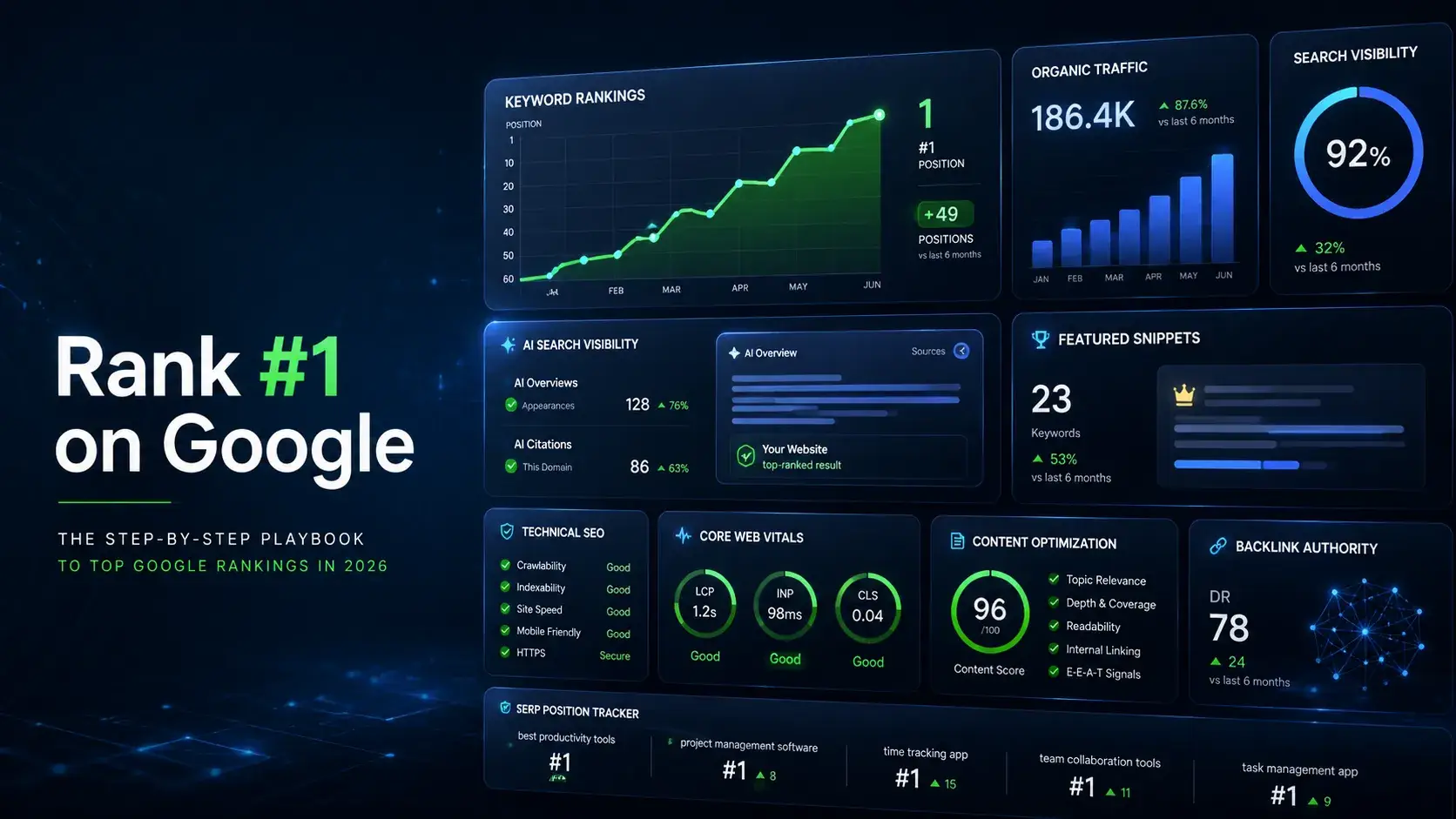
Google ranking in 2026 looks different from three years ago. The algorithm is smarter, the SERP is more crowded, and AI-generated content has flooded most niches. Simply publishing often and stuffing keywords stopped working a long time ago.
What still works is a focused system: pick the right keywords, build pages that genuinely answer the query better than anything else out there, sort out the technical foundations, and earn links that signal authority. This playbook walks through that system, step by step.
Step 1: Choose Keywords You Can Actually Win
Most websites fail at ranking because they target keywords that are out of their reach. A domain with 20 backlinks will not rank for ‘best CRM software’ against HubSpot and Salesforce on page one. The first move is picking battles worth fighting.
Start by looking at search volume alongside keyword difficulty. A keyword with 2,000 monthly searches and a difficulty score under 30 is worth more than a 50,000-search keyword where page one is owned entirely by enterprise domains.
How to Find Winnable Keywords
- Use tools like Ahrefs, Semrush, or Google Search Console to identify keywords where page one results include smaller sites (DR under 50)
- Look for informational queries where Google has not yet placed a definitive answer (thin results page, FAQ-heavy, lots of Reddit or Quora)
- Check ‘People Also Ask’ boxes for related long-tail queries your competitors have not covered deeply
- Prioritise keywords where the search intent matches content you can produce with genuine first-hand knowledge
Intent is the filter that matters most. A keyword like ‘how to export Google Analytics data’ has clear informational intent. A keyword like ‘Google Analytics consultant’ has commercial intent. Build your content to match what the person searching actually wants to do, not just what the keyword says.
Step 2: Build Pages That Satisfy Search Intent Completely
Google’s job is to show the most useful result for every query. Your job is to make that result yours. That means understanding what format the searcher expects, what questions they want answered, and what would make them stay on your page.
Match the Dominant Format
Look at the top five results for your target keyword before writing a word. If they are all listicles, write a listicle. If they are comparison tables, lead with a table. Google is already telling you what format works for that query.
This does not mean copying competitors. It means matching the structure while going deeper on the substance. Add original data, real examples, screenshots, or case studies that the other results are missing.
Cover the Topic Fully Without Padding
A page that answers the main query and every logical follow-up question in one place reduces the chance a reader will leave to search again. That return-to-search behaviour signals to Google that your page did not satisfy the intent.
The target is completeness, not length. A 900-word page that leaves no questions unanswered ranks better than a 3,000-word page stuffed with definitions and generic advice the reader already knows.
Step 3: Get E-E-A-T Right
E-E-A-T stands for Experience, Expertise, Authoritativeness, and Trust. Google uses these signals to judge whether a page deserves to rank for queries where accuracy and credibility matter.
For most content categories, this means showing proof. Not just claiming to know something, but demonstrating it through original screenshots, published results, linked credentials, or named authors with traceable expertise.
| E-E-A-T Signal | What It Looks Like in Practice |
|---|---|
| Experience | First-hand examples, original screenshots, case studies from your own work |
| Expertise | Named author with verified credentials, depth of topic coverage, cited sources |
| Authoritativeness | Backlinks from trusted publications, brand mentions, Wikipedia or press coverage |
| Trust | HTTPS, clear privacy policy, accurate contact details, transparent about who runs the site |
For YMYL (Your Money or Your Life) topics such as health, finance, or legal content, E-E-A-T carries even more weight. Pages on these topics need named authors, clear credentials, and external validation to rank consistently.
Step 4: Fix the Technical Foundations
A technically broken site will not rank, regardless of content quality. Google needs to crawl, index, and render your pages cleanly. Most sites have at least a few issues worth fixing.
Core Web Vitals
Google uses Core Web Vitals as a direct ranking signal. The three metrics that matter are Largest Contentful Paint (LCP), Interaction to Next Paint (INP), and Cumulative Layout Shift (CLS). You can check your scores through Google Search Console or PageSpeed Insights.
LCP measures how fast your main content loads. Aim for under 2.5 seconds. INP measures responsiveness to user interactions, target under 200ms. CLS measures visual stability, keep it below 0.1. Failing any of these hurts both rankings and the user experience.
Other Technical Checks to Run
- Mobile-first indexing: Google crawls the mobile version of your site first. Test with Google’s Mobile-Friendly Test and fix anything flagged
- Crawlability: Make sure your robots.txt is not accidentally blocking important pages, and submit an XML sitemap through Google Search Console
- Structured data: Add JSON-LD schema markup for Article, FAQ, and BreadcrumbList types. This improves how your pages appear in search results and can earn rich snippets
- Internal linking: Connect related pages with descriptive anchor text so Google understands the relationship between your content and distributes link equity across the site
- Canonical tags: Use canonical tags to prevent duplicate content issues, especially on e-commerce sites or blogs with pagination
Step 5: Build Topical Authority with Content Clusters
Ranking a single page is harder than ranking a site that has built genuine authority in a topic area. Content clusters are the structure that builds that authority.
The idea is straightforward. You have one pillar page that covers a broad topic at a high level, and several supporting pages that go deep on individual subtopics. The pillar page links to the supporting pages, and they link back. Google reads this as a site that knows its subject thoroughly.
Example: A pillar page on ’email marketing’ links to supporting pages on email automation, subject line writing, list segmentation, and deliverability. Each supporting page covers its subtopic in depth and links back to the pillar.
The benefit is compounding. As the supporting pages earn backlinks and traffic, they pass authority to the pillar page. The pillar page grows stronger and ranks for the broader keyword, which brings more traffic to the supporting pages.
Step 6: Earn Backlinks That Actually Move Rankings
Links remain one of the strongest ranking signals Google uses. But not all links carry the same weight. A single link from a relevant, authoritative publication moves rankings more than 50 links from low-quality directories.
Link Building Tactics That Work in 2026
- Original research and data: Publish a study or survey with findings no one else has. Other writers will link to it when referencing the numbers
- Guest posts on relevant publications: Write for sites your target audience actually reads. The link value comes from relevance and domain authority, not from volume
- Digital PR: Get your brand mentioned in news coverage, industry roundups, or expert comment pieces. Journalists linking to you carries serious authority
- Broken link building: Find broken outbound links on high-authority pages in your niche and suggest your content as a replacement
- HARO and journalist requests: Respond to journalist queries on platforms like Connectively (formerly HARO) to earn links from media publications
Avoid link schemes, paid links without disclosure, and private blog networks. Google’s manual actions team catches these patterns, and the penalty is worse than no links at all.
Step 7: Optimise for AI Overviews and Answer Boxes
In 2026, ranking at position one does not always mean the most visible spot. Google’s AI Overviews appear above organic results for many informational queries, pulling content from pages that Google trusts to answer clearly.
To get your content cited in AI Overviews, write short, self-contained answers for specific questions. A paragraph of 40 to 60 words that directly addresses a query, followed by supporting detail, is the format Google most often lifts into AI Overviews and featured snippets.
Practical tip: Add an FAQ section to every informational page. Structure each answer as a direct response to the question in the H3, with a concise first sentence that could stand alone. This format serves both featured snippets and AI Overview citations.
The 2026 SEO Ranking Playbook at a Glance
| Step | Action | Tool / Resource |
|---|---|---|
| 1 | Find winnable keywords with matching intent | Ahrefs, Semrush, Google Search Console |
| 2 | Match the dominant SERP format and cover the topic fully | Manual SERP analysis, competitor content audit |
| 3 | Add E-E-A-T signals: named authors, original proof, citations | Author bio pages, Google Search Console |
| 4 | Fix Core Web Vitals and technical SEO issues | PageSpeed Insights, Screaming Frog, GSC |
| 5 | Build content clusters around pillar pages | Site content audit, topic mapping |
| 6 | Earn backlinks through original research and digital PR | Ahrefs, Connectively, BuzzStream |
| 7 | Optimise for AI Overviews with FAQ-style short answers | GSC Search Appearance, SGE testing |
Frequently Asked Questions
1. How long does it take to rank #1 on Google in 2026?
For low-competition keywords on an established domain, 3 to 6 months is realistic. New domains targeting competitive keywords can take 12 to 24 months to reach page one. The timeline depends on domain authority, content quality, and how aggressively you build links.
2. Does publishing more content help rankings?
Publishing volume without quality actually hurts. Google penalises thin or repetitive content. A site with 20 well-researched, intent-matched pages consistently outranks a site with 200 shallow posts targeting similar keywords.
3. Do social media signals affect Google rankings?
Google has stated publicly that social signals like likes and shares are not direct ranking factors. But social content drives traffic and brand awareness, which can lead to more people linking to your content naturally. The indirect benefit is real.
4. Is keyword density still relevant?
Not in the way it was a decade ago. Google understands semantic relationships between words. Writing naturally about your topic, using related terms and phrases, matters more than hitting a specific keyword percentage. Write for the reader, not a keyword density target.
5. Can AI-generated content rank on Google?
Yes, if it is accurate, helpful, and meets E-E-A-T standards. Google’s stance is that it rewards quality content regardless of how it was produced. But AI content without human editing, original insight, or factual accuracy gets filtered quickly. Use AI to assist, not replace, the thinking.
6. What is the most important ranking factor in 2026?
No single factor dominates. The pages that rank consistently well have strong content relevance, clean technical health, credible authorship signals, and backlinks from authoritative sources. Weak performance in any one area holds the others back.
Final Thoughts
Ranking number one on Google in 2026 is not a shortcut. The shortcuts stopped working years ago. What works is building a site that genuinely serves searchers better than the competition on every dimension: the right keywords, complete content, clean technical setup, and earned authority.
The sites that compound rankings over time treat SEO as a system, not a series of one-off tasks. Each piece of content supports the others. Each link raises the floor for the whole domain.
Start with one cluster, one pillar page, and a handful of supporting posts. Do the technical audit. Build a few solid links. Measure what moves and repeat. The process is slower than most people want, but it is the one that actually holds.
For more practical guides on SEO, content strategy, and digital growth, browse the Technology and Business sections on WritoryBuzz.