
The views here represent the author’s perspective on contested research. Legitimate disagreement exists on the causal claims.
Most people have noticed it. A few minutes into reading a long article, an urge to check the phone. Reaching for a device before the previous thought has finished. The inability to sit through a film without doing something else simultaneously. The way a short clever video feels more satisfying than a paragraph requiring sustained attention.
We treat these as personal failures of focus. They are not entirely personal. They are, in significant part, designed.
The Precise Claim
I am not arguing that social media makes people biologically stupider. What I am arguing is more specific: that consistent use of short-form, algorithmically curated content platforms produces behavioural and cognitive habits that reduce capacity for the kinds of sustained, deep thinking that produce genuine intellectual growth.
Intelligence is not eroded by social media use. The practice of it sustained focus, deep reading, following complex arguments over time is.
The Research Worth Taking Seriously
A 2023 Journal of Experimental Psychology study found that the mere presence of a smartphone even face-down on a desk reduced available cognitive capacity for the task at hand. Participants performed measurably better when their phone was in another room entirely. The mechanism is not distraction from use. It is the anticipatory cognitive cost of availability.
Microsoft’s Human Factors Lab research documented a significant decline in average sustained attention between 2000 and 2015, correlated with smartphone penetration. Average attention fell from approximately 12 seconds to 8 seconds in their sample. Replication has been mixed but the directional trend is consistent across multiple independent studies.
Haidt and Twenge’s research on adolescent mental health and smartphone use documents consistent correlations between heavy social media use and reduced capacity for solitary reflection, reading for pleasure, and in-person socialisation the inputs that build thinking skills. The causal claims are contested, but the correlations are not.
The Design Element Most People Miss
Variable reward schedules — unpredictable delivery of positive stimuli — are among the most powerful reinforcement mechanisms in behavioural psychology. Slot machines use them. Social media feeds use them. The unpredictability of what the next scroll will reveal produces the same dopaminergic engagement as other compulsive behaviour loops.
The people who built these platforms understood this. The term ‘brain hacking’ appears in documents from former platform employees describing the deliberate application of behavioural psychology to maximise engagement. That engagement is not neutral with respect to cognition. Time spent in variable reward seeking is time not spent in reading, sustained conversation, focused work, and reflection.
This is not a conspiracy. It is a business model. The platform optimises for engagement. Engaged users generate advertising revenue. Downstream cognitive effects are not the platform’s problem unless they become regulatory ones.
The Self-Awareness Paradox
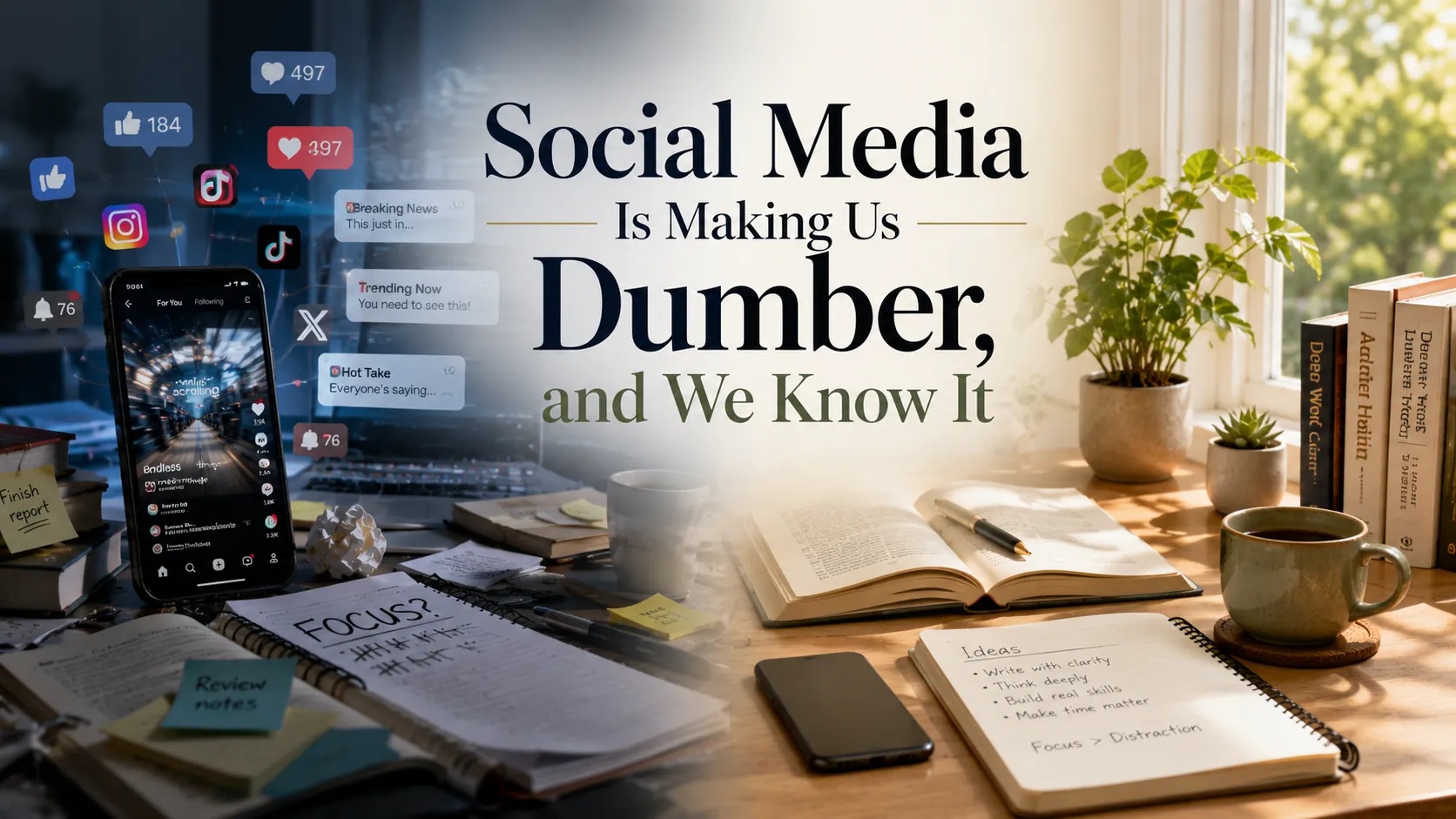
The title includes ‘and we know it.’ The majority of heavy social media users, when asked honestly, report that their use makes them feel worse, reduces focus, and takes time they would rather spend differently. They know it is happening. They continue anyway.
This is not weakness. It is the predictable outcome of interacting with a system specifically optimised to override deliberate decision-making with habitual response. The system that trained the behaviour also makes it very difficult to stop.
The Counterarguments Worth Acknowledging
I am making causal claims from correlational evidence. Proving causality rather than correlation is genuinely difficult. People with lower impulse control may be more likely to adopt heavy social media use — causality could run in either direction.
Haidt and Twenge’s conclusions have been challenged by Przybylski and Orben on methodological grounds. Effect sizes in most studies are small. And social media has genuine cognitive benefits for some users: access to information, communities of interest, and perspectives otherwise inaccessible.
What I Actually Think
The strongest version of this argument: social media platforms optimised for engagement rather than wellbeing cultivate habits hostile to the practices that build intellectual depth. The evidence that they do so is strong enough to warrant serious personal choices about usage — not just individual willpower in the face of a designed compulsion.
The most cognitively valuable activities I can engage in — sustained reading, writing that requires thinking, difficult conversations requiring genuine listening — are in direct competition for time and attention with social media feeds. When I choose the feed, I am not just spending time differently. I am strengthening a habit that makes the other activities harder.
Practical Response
- Structural changes are more effective than willpower: remove apps from phone home screens, use scheduled time windows rather than continuous availability
- Deliberate deep reading practice rebuilds attention capacity. The research on this is encouraging: attention spans improve with practice
- The useful question to ask weekly: have I done more long-form reading and thinking, or more feed-scrolling? The ratio matters
Does social media actually reduce intelligence?
The evidence is nuanced. Social media correlates with reduced capacity for sustained focus in multiple studies. Causality is contested. What is clearer is that the habits reinforced by heavy feed-use — short content cycles, passive consumption, variable reward-seeking — compete directly with the habits that build intellectual depth.
Is doom scrolling bad for your brain?
Evidence suggests extended passive scrolling activates reward-seeking behavioural loops that reduce motivation for effortful activities including reading and focused work. The effect is less about brain damage and more about which habits get reinforced with the hours available.
The Point Worth Holding
We built communication platforms of extraordinary reach and optimised them entirely for engagement. We discovered this produces side effects in human behaviour and cognition that users themselves recognise and dislike. The least useful response is deciding the problem is not real because the evidence is imperfect.