
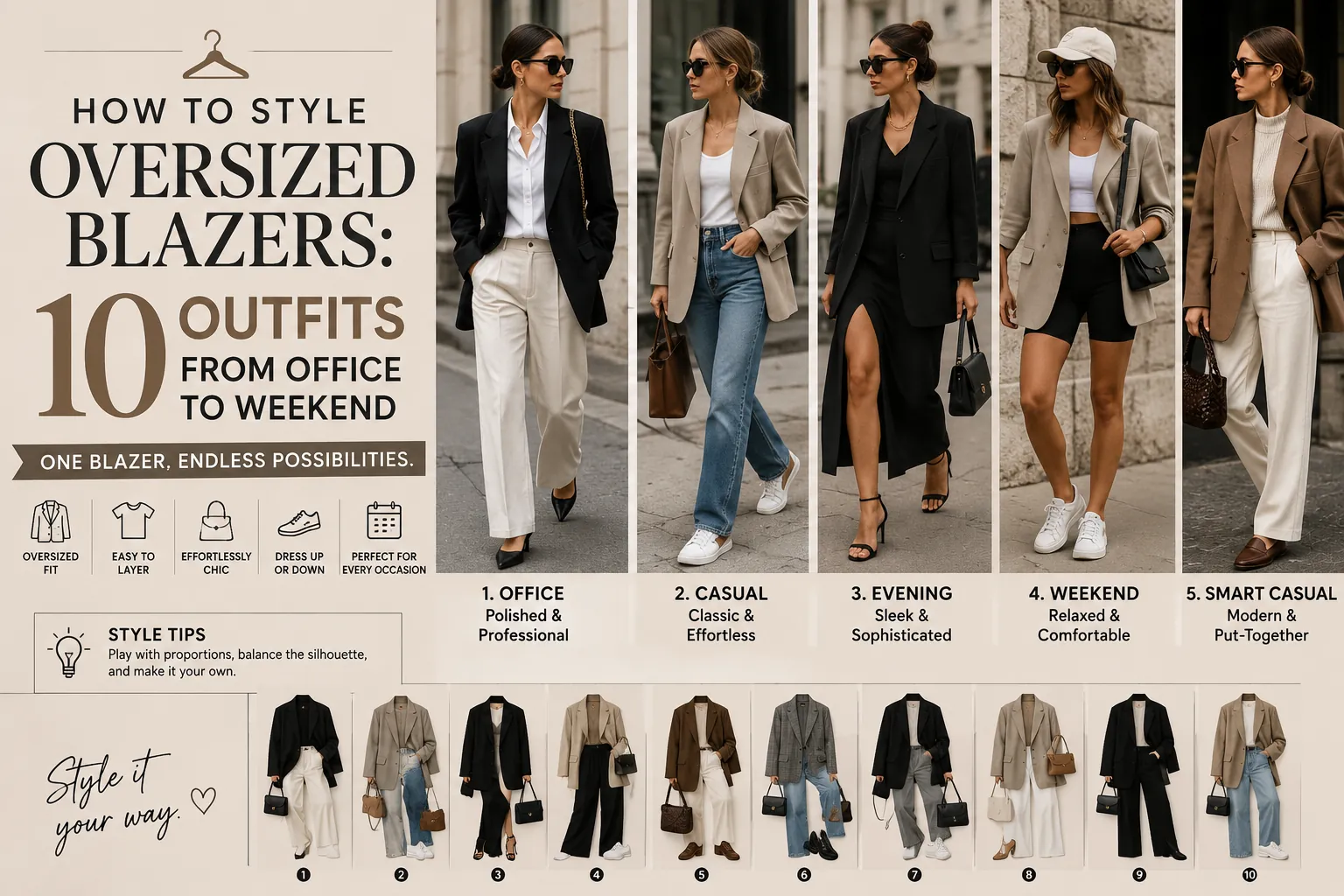
The oversized blazer is the most versatile outer layer in 2026 fashion. It works over a swimsuit at a beach club, over tailored trousers in a boardroom, and over a hoodie on a weekend. The skill is not finding one that fits. The skill is knowing which proportions to balance it with.
Oversized blazer outfit ideas have dominated search and social media through 2025 and 2026 for a simple reason: the silhouette solves the dressing problem. One blazer, worn correctly, can take an outfit from casual to polished to creative without changing anything else about your look.
These 10 outfits cover the full range of contexts where an oversized blazer excels, with specific guidance on proportions, colours, and footwear that make each one work.
The Proportion Rule That Makes Oversized Blazers Work
An oversized blazer adds volume at the top. The standard rule: balance that volume with a fitted or narrow bottom. Wide-leg trousers work only when they are fluid and high-waisted, creating a tailored visual contrast to the blazer’s width. Oversized blazer with straight-leg jeans: works. Oversized blazer with balloon-leg jeans: too much volume throughout.
The exception is the minimalist monochrome look, where matching tonal pieces can carry more volume because the unified colour creates visual cohesion that prevents shapelessness.
10 Oversized Blazer Outfits for 2026
Outfit 1: The Sharp Office Look
Pieces: Oversized blazer in charcoal or navy, fitted wide-leg trousers in a matching or tonal shade, a fitted crew-neck top (fine knit or silk), pointed-toe loafers or heeled mules.
Why it works: The blazer and trousers create a pseudo-suit effect that reads more modern and intentional than a standard suit. Pointed-toe footwear elongates the silhouette below the volume.
Outfit 2: The Saturday Errands Look
Pieces: Neutral oversized blazer (camel, stone, or cream), straight-leg white or mid-wash jeans, a simple fitted t-shirt, clean white trainers or simple mule flats.
Why it works: The jeans and trainers keep the look casual. The blazer elevates it without requiring effort. This is the most wearable everyday oversized blazer formula.
Outfit 3: Blazer as a Coat
Pieces: Longline oversized blazer worn as the outer layer over a knit midi dress or monochromatic outfit, low-heeled boots.
Why it works: A long blazer worn belted at the waist takes on coat proportions while maintaining the structured shoulder of tailoring. The belt creates a waist definition that prevents the look from reading as shapeless.
Outfit 4: The Creative Professional
Pieces: Bold or textured blazer (check, houndstooth, or velvet), slim trousers or cigarette pants in a contrasting neutral, loafers, a simple shirt or clean tee underneath.
Why it works: A statement blazer with simple foundation pieces keeps the balance right. The blazer is the look. Everything else supports it without competing.
Outfit 5: The Blazer Over Mini
Pieces: Oversized blazer, mini skirt (leather, denim, or knitwear), knee-high boots.
Why it works: The contrast between the blazer’s shoulder width and the mini skirt’s shorter hemline creates an interesting proportion play. Knee-high boots bridge the gap between hemline and shoe, creating a long leg line.
Outfit 6: Elevated Athleisure
Pieces: Sleek oversized blazer in a solid neutral, matching or contrasting bike shorts, a sports bra or fitted crop top, sleek trainers.
Why it works: The blazer elevates the athletic components to the point where the combination reads as intentional and fashion-forward rather than purely functional. This is a look that requires confidence but has strong visual impact.
Outfit 7: The Monochrome Tonal
Pieces: Oversized blazer and wide-leg trousers in the same or closely related colour (all beige, all grey, all burgundy), a simple top in the same family.
Why it works: Monochrome dressing with varying textures creates a sophisticated, fashion-literate look. The uniform colour absorbs the volume difference between the blazer and wide-leg trousers, allowing proportions that would otherwise clash.
Outfit 8: The Relaxed Denim Look
Pieces: Softly structured oversized blazer, high-waisted straight or slim jeans, tucked-in graphic tee, chunky loafers or ankle boots.
Why it works: The tucked-in tee creates waist definition that anchors the blazer’s volume. Jeans provide clean proportions below. This is one of the easiest and most reliable oversized blazer outfits for daily wear.
Outfit 9: The Layering Look
Pieces: Oversized blazer layered over a hoodie (cropped or full-length), tailored trousers or dark straight jeans, chunky trainers.
Why it works: The blazer-over-hoodie combination is one of 2026’s most referenced styling approaches. It combines structure and comfort in a way that reads deliberately styled rather than accidentally mismatched. The key is colour coordination: the hoodie should be tonal with the blazer or in a deliberate contrast.
Outfit 10: The Evening Transition
Pieces: Sophisticated oversized blazer in silk, satin, or a quality fabric with sheen, worn with wide-leg tailored trousers or a slip midi skirt, simple strappy heels.
Why it works: A quality fabric blazer transitions an outfit to evening without requiring a jacket or coat. The luxurious material does the dressing-up work that a standard wool or polyester blazer cannot.
Colour and Pattern Guidelines
Neutral oversized blazers (camel, grey, navy, black, cream) are the most versatile. One neutral blazer in each of the main tonal families gives you the most outfit combinations from the fewest wardrobe items. Bold or patterned blazers work best as the statement piece with simple foundation garments. Avoid competing patterns in the rest of the outfit.
The most wearable blazer purchase in 2026 is an oversized camel or mid-grey in a quality fabric. Both work in every context from office to weekend and with virtually every colour palette.
How do you style an oversized blazer without looking sloppy?
Balance volume at the top with fitted or narrow proportions below. Use a belt to create waist definition when wearing as a coat. Choose quality fabric that holds its shape. The key is intentional contrast: the oversized silhouette reads as styled when everything else is clean and fitted.
What shoes work best with oversized blazers?
Pointed-toe shoes elongate the silhouette and balance blazer width most effectively. Loafers provide a polished-casual balance that works with jeans or trousers. Knee-high boots work well with mini skirts under oversized blazers. Clean trainers keep the look casual without sacrificing style.
Can you wear an oversized blazer to the office?
Yes, when styled with tailored trousers or a fitted skirt and appropriate footwear. The oversized silhouette reads as polished in a work context when the fabric is quality and the proportions are balanced. Pair with pointed-toe mules or heeled loafers for the most professional version of the look.
What should you wear under an oversized blazer?
A fitted crew-neck top, a simple silk blouse, a fine-knit jumper, a sports bra for the athleisure look, or a hoodie for the layered street-style approach. The key is keeping what goes underneath clean and fitted so it does not add more volume to the already roomy blazer silhouette.
What is the difference between an oversized blazer and a boyfriend blazer?
The terms are used interchangeably in fashion content, but boyfriend blazer typically refers to a blazer styled to look borrowed from a male wardrobe with classic tailoring details. Oversized blazer is a broader category that includes fashion-forward silhouettes with deliberately exaggerated proportions beyond traditional tailoring.
How do you belt an oversized blazer correctly?
Use a thin belt for a subtle waist definition or a wide belt for a more dramatic effect. Place the belt at the natural waist, not on the hips. For single-button blazers, belt over the closed button. For open-front blazers, belt over the layers underneath. Avoid over-cinching, which distorts the blazer’s structured shoulders.
One Blazer, Multiple Lives
An oversized blazer in a quality neutral fabric is one of the highest-return wardrobe investments available. It functions as a coat, a jacket, a layering piece, and an occasion-appropriate outer layer. The 10 outfits above represent about 20 percent of the combinations a single well-chosen blazer enables.
Choose quality fabric, get the shoulder width right (it should fall just off the shoulder), and learn which proportions work below. The rest becomes intuitive.