
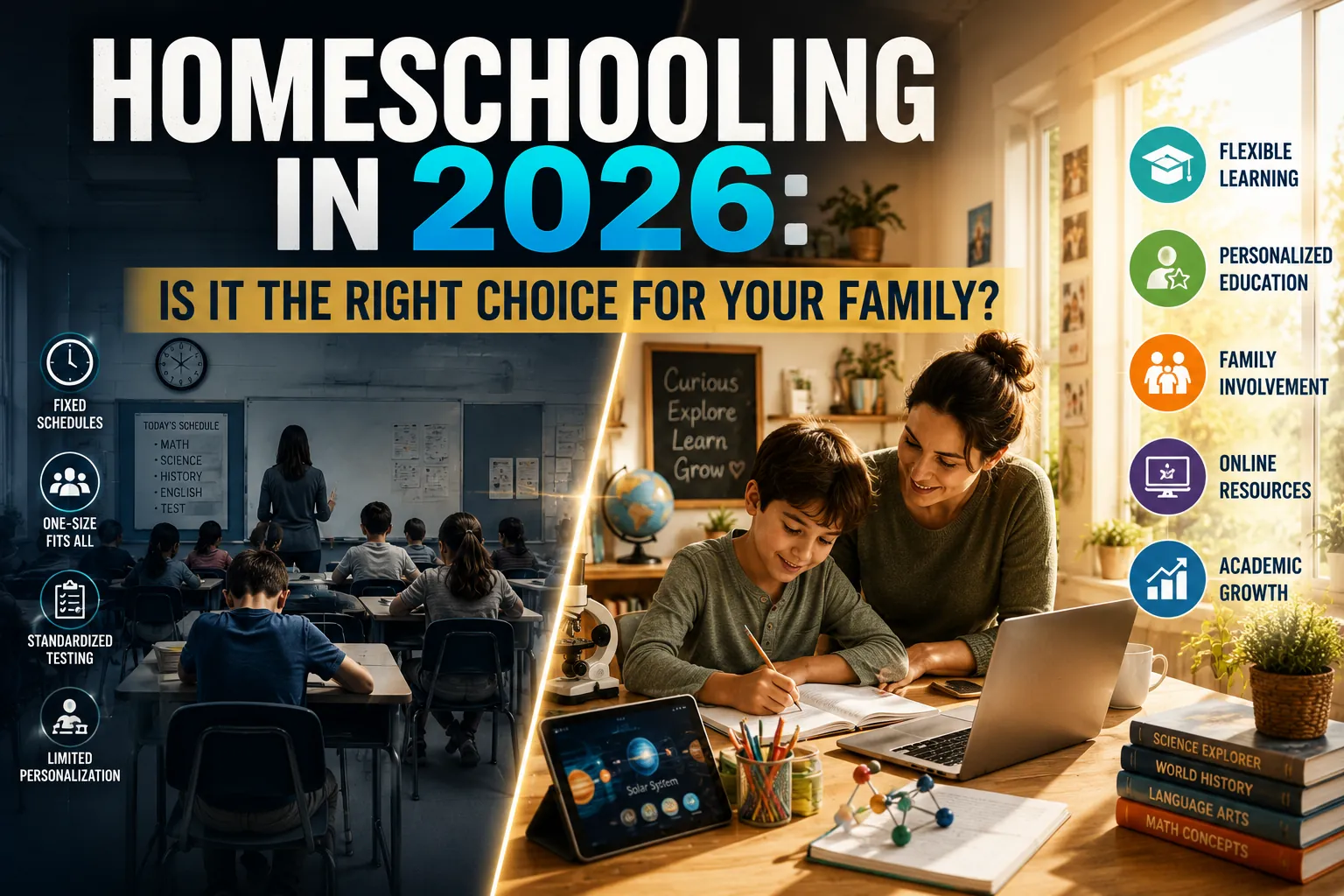
Homeschooling in the UK and US has grown substantially since 2020. In England, the number of children registered as home-educated doubled between 2019 and 2023. In the US, the National Centre for Education Statistics estimated that homeschooled children represented approximately 5.4% of school-age children by 2022, up from 3.3% in 2016.
The population of homeschooling families has also diversified significantly. Religious and ideological motivations, historically the primary driver, are now joined by families responding to specific learning needs, concerns about school environments, dissatisfaction with curriculum quality, and the discovery during pandemic years that some children learn better at home.
This guide addresses the decision as it actually is: a complex personal, educational, and practical choice with genuine advantages and genuine challenges, not a simple calculation.
The Honest Case for Homeschooling
Individualised Pace and Depth
A child who masters a concept quickly can move forward without waiting for the class. A child who needs more time with a concept can take it without social stigma or falling behind the group. This individualisation of pace is arguably the strongest educational argument for homeschooling, particularly for children who are significantly advanced or significantly behind in specific subjects.
Depth of study is also different at home. A child fascinated by medieval history can study it intensively for months. A child passionate about programming can spend hours on it daily. The breadth-over-depth compromise that classroom teaching requires for efficiency does not apply in the same way to one-to-one education.
Safety and Environment
For families whose children have experienced bullying, anxiety related to school environments, or specific social difficulties, the removal of those environmental stressors can produce significant improvements in wellbeing and learning capacity. This is not an argument that school environments are uniformly harmful; it is an acknowledgment that some children function significantly better outside them.
Values and Worldview
Families who want to integrate specific religious, philosophical, or cultural values into education can do so more fully through homeschooling than through any school setting. This remains the primary motivation for a significant portion of homeschooling families.
The Honest Challenges of Homeschooling
| Challenge | What It Actually Means | Mitigation |
|---|---|---|
| Parent time commitment | Primary educator role requires 4 to 6 hours daily | Structured co-ops, online curricula, shared teaching arrangements |
| Socialisation | Fewer incidental peer interactions than school | Deliberate co-op, sports, clubs, community activities |
| Curriculum planning | Responsibility for full educational coverage | Packaged curricula, online schools, local authority guidance |
| Financial cost | Lost parent income, curriculum costs | Two-income families carry higher costs; free resources growing |
| Assessment and progression | External qualifications require specific planning | IGCSEs, online college courses, AP exams available to home-ed students |
| Parent knowledge gaps | Parents cannot teach what they do not know | Tutors, online courses, co-op specialists for specific subjects |
Legal Requirements: UK and US
United Kingdom
In England and Wales, parents have the legal right to educate their children at home without requiring local authority approval, as long as the education is full-time and suitable for the child’s age, ability, and aptitude. Local authorities can make enquiries if they have reason to believe education is not taking place, but there is no requirement for home-educated children to follow the National Curriculum or to be assessed against its standards.
Scotland and Northern Ireland have slightly different frameworks but similar fundamental rights for parents to home educate. The Children Not in School (CNIS) register, proposed in England under the Schools Bill, would require registration of home-educated children, but as of 2026 mandatory registration is not yet in force.
United States
Homeschooling is legal in all 50 US states but requirements vary significantly. Some states require no notification to authorities. Others require annual notification. A smaller number require curriculum approval, standardised testing, or portfolio review by a local education authority. Families must research the specific requirements in their state before beginning.
Curriculum Options in 2026
The curriculum landscape for homeschooling families has expanded enormously. Structured all-in-one curricula, including Sonlight, Abeka, and Classical Conversations, provide full year plans with integrated subjects. Charlotte Mason, classical, unit study, and unschooling approaches represent distinct philosophical frameworks with supporting resources.
Online learning platforms have transformed what is available to home educators. Khan Academy provides free structured content across all major subjects. Outschool offers live online classes with qualified teachers across hundreds of specialist topics. Coursera and EdX provide university-level content for older students. The combination of free resources, subscription platforms, and specialist tutors means that gaps in parent teaching knowledge are far more manageable than a decade ago.
Home education co-operatives, where groups of families share teaching responsibilities, have grown significantly in most urban areas. One parent with science background teaches science for the group; another covers history; a third organises arts. Co-ops reduce individual parent burden and address socialisation concerns simultaneously.
Socialisation: The Most Common Concern and the Honest Answer
The socialisation question is the most common concern raised by families considering homeschooling and by professionals evaluating it. The research on homeschooled children’s social development is mixed and methodologically complex, but the consistent finding is that outcomes vary enormously based on how proactively families build social opportunities.
Homeschooled children who participate in sports teams, arts programmes, religious communities, home education groups, and community activities consistently show social competence comparable to school-educated peers. Homeschooled children who are relatively isolated at home show social deficits. The causal factor is the quantity and quality of peer interaction, not the mode of education per se.
Age-mixed socialisation is one genuine difference. Homeschooled children typically interact with people across a wider age range than school-educated children, who spend most of their social time with same-age peers. Research on whether age-mixed versus age-grouped socialisation produces better social outcomes is genuinely inconclusive.
FAQs
Do homeschooled children do well academically?
Studies consistently show homeschooled children performing at or above national averages on standardised tests and entering university at comparable rates to school-educated peers. The significant caveat is selection bias: families who choose homeschooling are not a random sample, and the resources, motivation, and educational backgrounds of home-educating parents are not representative of the general population. Comparisons with school-educated children should account for this.
What about GCSEs and A-Levels for home-educated students in the UK?
Home-educated students can sit GCSEs and A-Levels as private candidates through exam centres that accept external candidates. This requires finding an approved centre, registering for specific exams, and meeting the entry requirements for each qualification independently. Several organisations specifically support home-educated students through this process, including the Home Education Advisory Service (HEAS).
Can a single parent homeschool?
Yes, though the practical demands are harder. Single parents who homeschool typically rely heavily on structured online curricula, home education co-ops, and extended family support. Financial sustainability is a significant challenge for single-parent homeschooling families unless the parent can work during the child’s self-directed learning time.
Questions to Ask Before Deciding
Is the motivation for homeschooling addressing a specific problem (a child struggling in school, a particular educational philosophy), or is it a general preference? Specific problem-solving motivations tend to produce more focused and sustainable homeschooling approaches than general dissatisfaction.
Which parent will be the primary educator, and what does that mean for their professional and personal life? The commitment is real and long-term. Families who have not fully discussed this often find the practical reality harder than expected in the first year.
What does the child want? Older children’s preferences are relevant. A child who actively wants to be home-educated and participates in planning their education typically has better outcomes than one for whom homeschooling was decided without their input.
For education policy coverage, learning resource reviews, and family decision frameworks throughout 2026, WritoryBuzz approaches education topics with evidence and honest complexity rather than advocacy.