
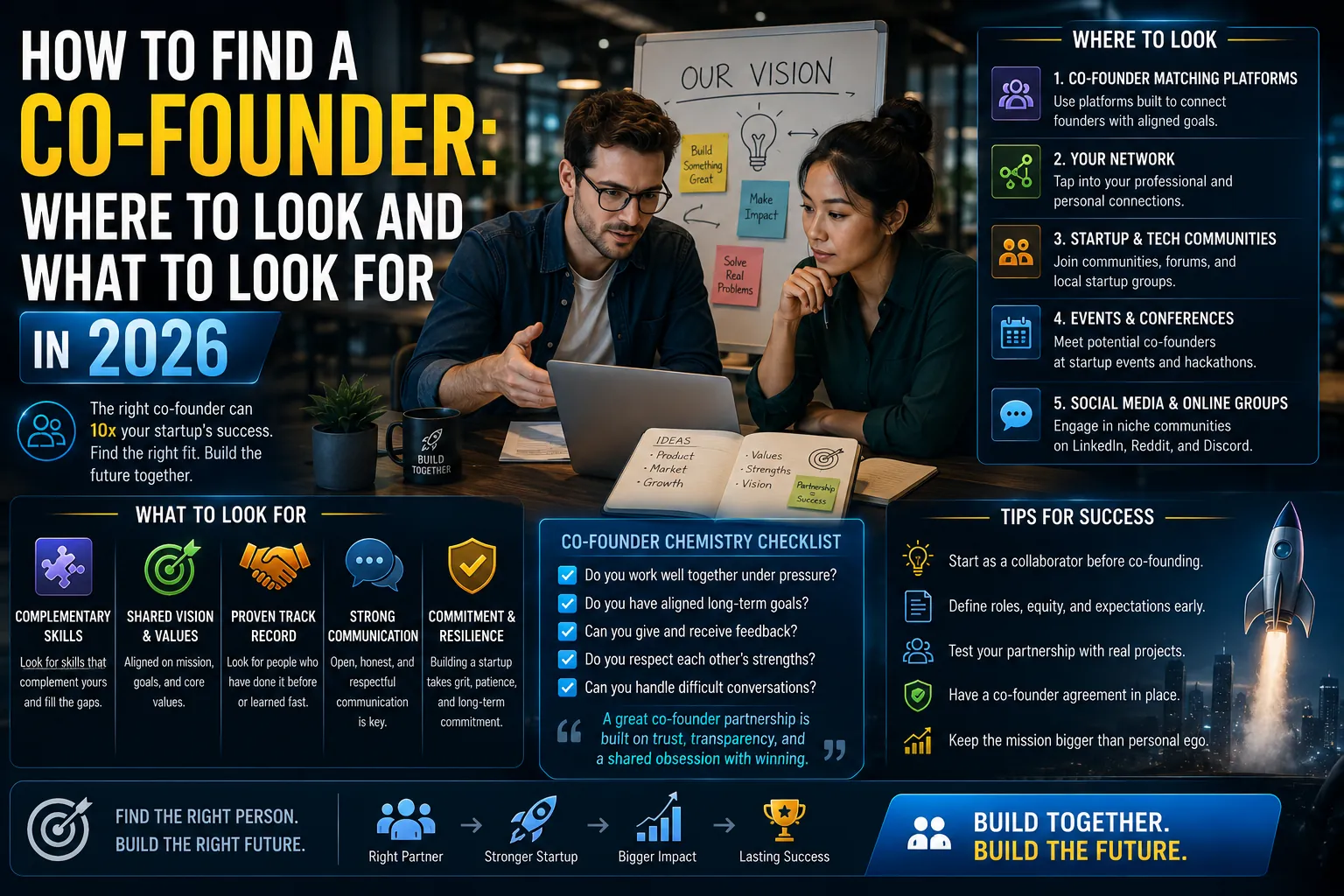
The founding team is the most scrutinised element of any early-stage startup by experienced investors. A strong solo founder with a great idea is a harder bet than two complementary co-founders with the right interpersonal dynamics. But the wrong co-founder is more damaging than no co-founder at all.
Finding the right startup co-founder is one of the most consequential decisions you will make. The relationship requires more alignment, trust, and complementary capability than most professional relationships. Unlike hiring, you cannot easily undo this decision. Unlike a romantic relationship, it involves shared financial stakes and legal obligations.
This guide covers where to find co-founders and, more importantly, how to evaluate whether someone is the right one before committing.
Why Co-Founder Fit Matters More Than Skills
The typical framing of co-founder search focuses on complementary skills: a technical founder needs a business co-founder, a designer needs an engineer. This is correct but insufficient. The skills matter. The working relationship determines whether those skills are ever fully deployed.
45 percent of startup failures cite co-founder conflict as a contributing factor. The disputes most commonly come from unaligned expectations about roles, equity splits, work ethic, and exit goals. Most of these misalignments were present before the partnership formalised and would have been visible if the right questions had been asked.
Where to Find Co-Founders in 2026
YC Co-Founder Matching
Y Combinator’s Co-Founder Matching platform is free to use and does not require being a YC applicant. It matches founders by idea stage, skills, location preference, and founder profile. The platform has facilitated thousands of co-founder introductions and has become one of the most used resources for technical and non-technical founders seeking a counterpart. The quality of profiles is generally high given the YC brand association.
Antler
Antler’s model explicitly includes co-founder matching as part of its programme. You can apply to Antler without a co-founder or even a specific idea, and the programme’s early cohort phase is designed to facilitate co-founder introductions among the admitted cohort. This produces co-founder relationships with shared initial experience and vetted-by-Antler peer quality.
Founder Communities and Accelerators
Indie Hackers, OnDeck, Entrepreneur First, and On Deck Founders all have active co-founder matching features or communities where founders connect. These skew toward specific niches (Indie Hackers toward bootstrapped SaaS, Entrepreneur First toward deep tech and research-founded companies). Matching within a relevant community produces better initial alignment than broad platforms.
Professional Networks
Former colleagues are the most common source of successful co-founder relationships. Working alongside someone gives you direct evidence of their work ethic, communication style, quality standards, and behaviour under pressure. A former colleague you admire and trust who has complementary skills is a stronger starting point than a qualified stranger from a matching platform.
Hackathons and Build Events
A weekend hackathon with someone tells you more about whether you can work together than three months of coffee meetings. You see how they handle ambiguity, how they communicate under time pressure, whether they follow through on what they say, and whether you enjoy spending extended time solving problems together. Building something small together intentionally before committing to a co-founder relationship is an underused evaluation tool.
The Evaluation Framework: Questions That Matter
What does success look like to you in 5 years? This surfaces exit goal alignment immediately. A co-founder building toward a $100M acquisition and a co-founder wanting to build a $1M lifestyle business have incompatible incentive structures at key decision points.
How much time and money are you prepared to commit? Vague commitment produces early co-founder disputes when one person’s definition of ‘full-time’ means 40 hours and another’s means 70. Be explicit before commitments are made.
What happened in the last professional relationship that didn’t work out? How someone describes a previous difficult professional relationship reveals how they process conflict, assign blame, and learn from difficulty. Look for accountability without excessive self-criticism and a genuine account of what they contributed to a difficulty.
How do you want to make decisions when we disagree? A question most founding teams cannot answer until a real disagreement arises. Asking it in advance surfaces compatibility in conflict resolution approach before the stakes are real.
What would you do if this company failed in 18 months? Calibrates risk tolerance and commitment level. Someone with significant financial obligations who needs income within 12 months is a different risk profile as a co-founder than someone with runway and flexibility.
Red Flags Worth Taking Seriously
- Cannot explain clearly why they want to solve this specific problem — motivation is vague or generic
- Describes all previous professional problems as other people’s fault with no self-reflection
- Unwilling to commit to equity vesting schedules — a signal that they want full ownership without sustained participation commitment
- Communication style that becomes evasive or defensive when direct questions are asked
- Strong ideas about what the company should do without curiosity about your perspective
- References who are reluctant to give specific positive comments about working with them
Where do you find a startup co-founder in 2026?
Y Combinator’s free Co-Founder Matching platform, Antler’s accelerator programme (co-founder matching built into the process), Entrepreneur First, OnDeck, and founder community events. Former colleagues remain the most reliable source of successful co-founder relationships because prior working experience provides direct evidence of compatibility.
What makes a good co-founder relationship?
Complementary skills, aligned exit goals and risk tolerance, compatible working styles, explicit agreement on roles and equity from the start, and the ability to disagree productively and recover quickly. Shared values about how to build a company matter as much as shared enthusiasm for the idea.
How long should you know someone before making them a co-founder?
There is no minimum time threshold but there should be a minimum evidence threshold: you should have worked on something with them, even briefly, under conditions that reveal how they behave under pressure. A weekend hackathon provides more useful information than months of casual meetings.
Should equity be split 50/50 with a co-founder?
A 50/50 split is simple but creates decision-making deadlock. Most advisors recommend a small difference (51/49 at minimum) to designate a final decision-maker. Both co-founder equity shares should vest over 4 years with a 1-year cliff, tying ownership to ongoing participation.
What questions should you ask a potential co-founder?
Ask about their 5-year definition of success, time and money commitment levels, how they handle professional disagreements, what they learned from a previous failure, and their decision-making approach when co-founders disagree. These questions surface alignment and value compatibility that skills assessment alone misses.
What are red flags in a potential co-founder?
Inability to take responsibility for past failures, resistance to vesting schedules, evasive communication when directly questioned, no curiosity about your perspective on the business, and references who cannot speak specifically and positively about working with them.
The Right Co-Founder Is a Force Multiplier
The search for a co-founder is worth taking as seriously as the search for a lead investor. The relationship will shape every major company decision for years. Rushing the process to start building faster produces a false efficiency.
Take the time to work on something together first. Ask the uncomfortable alignment questions before equity is split. The due diligence you do before committing is far less painful than the litigation you do after a co-founder relationship fails.