
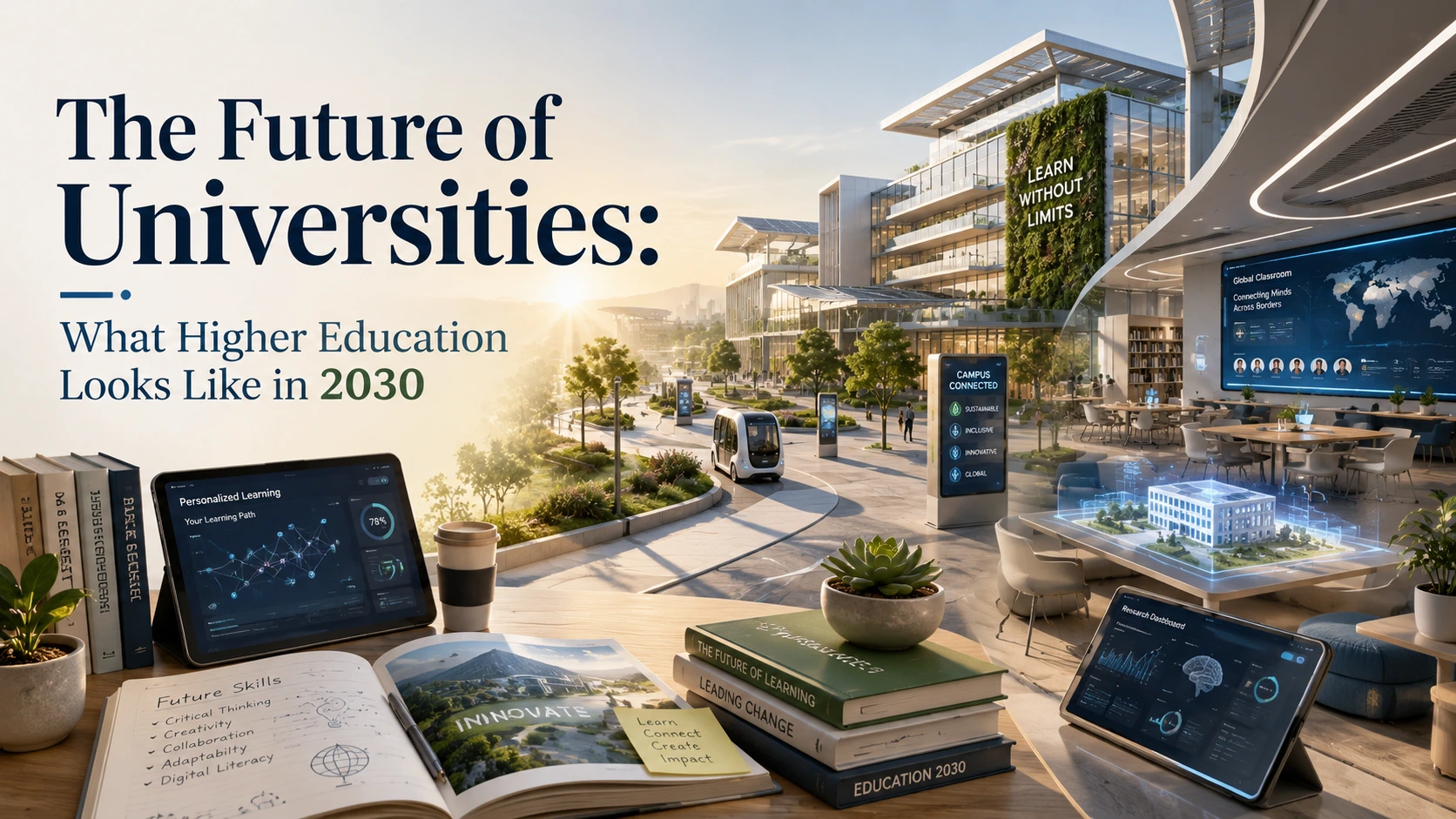
University enrolment in traditional 4-year residential degrees has declined for the fifth consecutive year in several Western countries. Online and hybrid learning now accounts for over 60 percent of higher education delivery in the US. The credential landscape is fragmenting. The university’s monopoly on legitimate credentialing is ending.
The transformation of higher education by 2030 is not hypothetical. It is already visible in enrolment trends, credential market share, employer hiring practices, and the technology being embedded into university operations. What is less certain is how traditional universities will adapt, and whether the adaptations will preserve what is genuinely valuable about the residential university experience or primarily accelerate its commodification.
The Forces Reshaping Higher Education
The Return on Investment Question Has Become Unavoidable
The average student loan debt for US graduates in 2026 exceeds $37,000. The earnings premium associated with a bachelor’s degree varies enormously by field: median lifetime earnings advantage of several hundred thousand dollars for STEM and professional fields, negative or negligible advantage for several humanities fields relative to the total cost including foregone earnings during study.
This calculation was always present but was culturally suppressed by the assumption that a degree was inherently valuable regardless of field or institution. The combination of tuition inflation, student debt visibility, and labour market data has made the ROI question explicit in ways that are driving significant enrolment changes.
Employer Credential Practices Are Changing
Google, Apple, IBM, and over 250 Fortune 500 companies have removed the 4-year degree requirement for the majority of their roles. Skills-based hiring, which evaluates demonstrated capability rather than credential, has moved from a progressive hiring practice to mainstream HR policy for technology and knowledge sector employers.
This does not mean degrees have become worthless. It means they have become one credential among several, rather than the primary filter. A portfolio of demonstrated projects, micro-credentials from recognised institutions, and verifiable skills assessment scores is now a viable alternative to a traditional degree for many career paths.
Online and Hybrid Learning Has Matured
COVID-era emergency online education produced legitimately poor outcomes in many cases. The subsequent four years of deliberate investment in online pedagogy, assessment design, and student experience have produced something fundamentally different. Institutions like the University of London, Georgia Tech, and ASU Online now deliver accredited degrees at a fraction of residential cost with outcomes data that competes with residential peers.
The completion rate problem that afflicted early MOOCs has been substantially addressed by hybrid models combining asynchronous content with synchronous support, cohort-based learning, and active employer partnerships that provide direct employment pathways.
What Universities Look Like in 2030
The Rise of Micro-Credentials and Stackable Qualifications
Modular learning, where students earn verified competency credentials that can be stacked toward a degree or valued independently, is the most significant structural change in higher education since the standardisation of the bachelor’s degree. By 2030, the majority of professional development and continuing education will take this form.
Established universities are developing micro-credential programmes both as revenue diversification and as response to employer demand. MIT, Stanford, and UK Russell Group universities all have substantial micro-credential operations. These credentials carry the institution’s brand recognition without the residential cost or time commitment of a full degree.
AI Tutoring Embedded in Learning Systems
By 2030, AI tutoring systems will be standard components of university learning management systems rather than optional add-ons. Adaptive learning platforms that identify individual student knowledge gaps, provide targeted practice, and provide instant feedback on structured exercises will handle much of the repeated-practice component of learning, freeing human faculty time for discussion, synthesis, and mentorship.
The most significant integration will be in STEM and professional fields where practice at scale is most valuable. The research on AI tutoring shows consistent benefit for procedural skill development, which suggests freeing this from human instruction time produces genuine learning efficiency gains.
The Experience Premium and the Value Split
Residential universities will increasingly justify their premium pricing through the experience, network, and identity formation they provide alongside education, rather than through the credential alone. The degree from a highly selective institution is increasingly valuable for the network and social credential it represents rather than the content learned, which is available elsewhere at lower cost.
This creates a polarisation: residential elite universities for those who can access and afford them, online and hybrid providers for the majority who want skills and employment outcomes at accessible cost. The middle tier of residential universities offering neither the elite network nor cost competitiveness faces the most significant pressure.
Will traditional universities become irrelevant by 2030?
Traditional residential universities will not become irrelevant, but their market position is narrowing. They retain strong value for their networks, the residential experience, research programmes, and professional credentialing in fields like medicine and law. The declining proposition is using a 4-year residential degree as the primary credential for general knowledge work when online alternatives offer comparable learning outcomes at lower cost.
What are micro-credentials and are they worth it?
Micro-credentials are verified certifications for specific skills or competencies, typically completed in weeks to months rather than years. They are increasingly valuable for professional development and career transitions. Their worth depends on the issuing institution’s recognition, the employer’s credential practices, and the specific skills certified. Credentials from recognised universities and industry-aligned programmes are most employable.
How is AI changing higher education?
AI is being integrated into adaptive learning systems for personalised practice and feedback, tutoring tools for out-of-hours support, assessment design and grading assistance, and research support tools. By 2030, AI tutoring components will be standard in most university learning management systems.
Is a university degree still worth it in 2026?
It depends significantly on the field, institution, and alternative paths available. STEM and professional fields show strong degree returns. Some fields have ROI that does not justify the cost when alternatives exist. Skills-based hiring by major employers has expanded the viable alternative paths. The question is no longer ‘should I get a degree?’ but ‘what credential produces the best outcome for my specific goals?’
What is the future of online education?
Online and hybrid higher education is maturing rapidly. Accredited online degrees from established universities now produce outcomes comparable to residential peers in several fields. Completion rates have improved substantially with cohort-based models and employer partnerships. By 2030, the majority of professional upskilling and credential acquisition will occur through online or hybrid channels.
What skills will employers want in 2030?
Based on current hiring trend data: AI-adjacent skills (prompt engineering, AI tool proficiency, data analysis), adaptive problem-solving with incomplete information, complex communication across disciplines and cultures, and continuous learning capacity. Employers consistently report that the ability to learn new skills quickly is valued more highly than specific current knowledge.
The Credential Is Not the Education
The most important shift in how prospective students should think about university by 2030 is separating the credential from the education. Where and how you learn, who you learn alongside, what you build and create during your studies, and the networks you form: these have genuine long-term value that is not fully replicated by online alternatives.
The credential’s value relative to its cost is a separate calculation that deserves honest analysis rather than the traditional cultural assumption that any degree from any institution automatically justifies any cost.