
HubSpot coined ‘content clusters’ in 2017 and subsequently reported significant organic traffic growth from restructuring their blog around topic clusters. The methodology has been validated widely: Google rewards topical authority, and the hub-and-spoke cluster model systematically builds it. In 2026, content clusters are not a cutting-edge strategy. They are the baseline architecture that competitive SEO requires.
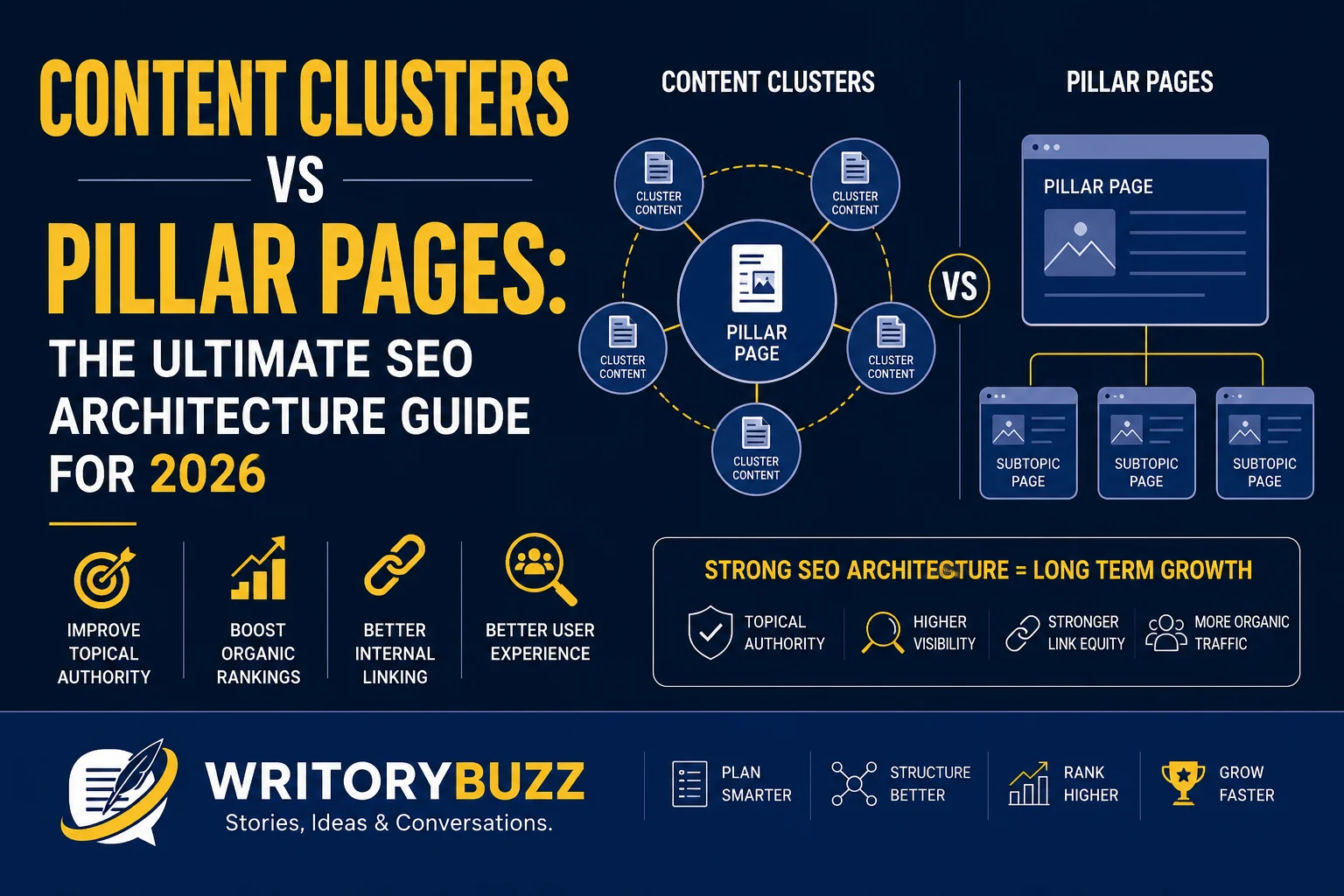
Content cluster strategy organises your content around topic hubs rather than individual keywords. A pillar page covers a broad topic comprehensively. Cluster pages cover specific sub-topics in depth. Internal links connect them bidirectionally. The result is a content architecture that signals topical authority to Google and distributes PageRank efficiently across related content.
The Architecture: How Clusters and Pillars Work Together
The Pillar Page
A pillar page is a long-form, comprehensive piece of content that covers a broad topic at the level of depth a target keyword warrants. It is typically 3,000 to 8,000 words, covers all major subtopics within the broader topic, and links to each cluster page addressing those subtopics in greater depth.
A pillar page on ’email marketing’ might be 5,000 words covering strategy, tools, metrics, list building, automation, and deliverability at a high level. Each of those subtopics becomes a cluster page with its own focused deep dive.
What a pillar page is not: A pillar page is not an introduction that links to other pages for all the real content. It should be genuinely useful as a standalone piece. A reader should be able to understand the topic from the pillar page alone, with cluster pages providing deeper exploration of components they want to explore further.
Cluster Pages
Cluster pages cover specific subtopics within the pillar’s broader topic at greater depth than the pillar treats them. Where the email marketing pillar covers ‘list building’ in 400 words, the list building cluster page covers the topic in 2,000 to 4,000 words with specific tactics, tools, and benchmarks.
Cluster page depth: The competitive depth required for cluster pages is determined by the competing content for that subtopic keyword. Run the top 3 ranking pages through a tool like Ahrefs’ Content Gap or Semrush’s SEO Content Template to identify the topics, headers, and questions they cover. Your cluster page should match or exceed that depth.
Cluster page count: A mature cluster typically has 8 to 20 cluster pages. Fewer than 6 provides insufficient topical depth to establish authority. More than 25 often means the topic is either too broad or the cluster pages are too granular.
Internal Linking: The Connective Tissue
The internal linking structure is what transforms individual pages into a cluster. Every cluster page links back to the pillar. The pillar links to every cluster page. Cluster pages link to each other where genuinely relevant (not forced).
The bidirectional requirement: A cluster page linking to the pillar without the pillar linking back provides one-way authority flow. Both directions are required for the cluster model to function as designed. PageRank flows from cluster pages to the pillar (boosting its authority for the competitive head keyword) and from the pillar to cluster pages (boosting their authority for their target terms).
Anchor text variation: Use descriptive, keyword-variant anchor text for internal links. The pillar linking to the list building cluster page with anchor ‘building your email list from scratch’ provides more topical signal than ‘click here’.
How to Build a Content Cluster: Step by Step
- Choose the pillar topic. It should be a broad keyword with meaningful search volume (1,000 to 50,000 monthly searches depending on industry) that represents a core service or product area. It should be broad enough to support 8 to 15 subtopics.
- Map the cluster. Use ‘People Also Ask’, Google’s Related Searches, Ahrefs Keyword Explorer, and Answer The Public to identify all the subtopics and questions within the broader pillar topic. Group related subtopics that belong in a single cluster page versus those warranting their own page.
- Audit existing content. Check whether you have existing content that already covers cluster subtopics. Existing content can be updated and linked into the cluster rather than replaced.
- Create or update the pillar page. Write or revise to cover all major subtopics at appropriate depth with links to cluster pages (or placeholders for ones not yet written).
- Build cluster pages. Prioritise by search volume and by pages where you already have partial content. Each cluster page must link to the pillar.
- Add cross-cluster links. After cluster pages are published, identify where relevant links between cluster pages exist and add them with descriptive anchor text.
- Monitor performance. Track pillar page rankings for the broad keyword and cluster page rankings for subtopic keywords. Use Google Search Console to monitor which queries trigger impressions for each page.
Cluster Depth vs Cluster Breadth: The Competitive Decision
When building a cluster, you face a depth-versus-breadth trade-off. Should you build fewer, deeper cluster pages or more numerous, shallower ones?
In competitive niches: Depth beats breadth. A cluster with 8 genuinely thorough cluster pages outperforms one with 20 thin pages. Google’s quality signals (time on page, bounce rate, featured snippets, backlinks) favour depth.
In less competitive niches: Breadth matters more. Comprehensive topic coverage signals authority even if individual pages are not deeply competitive. Building the most complete cluster for a niche topic establishes dominance before competition arrives.
Content Clusters for AI Answer Engines
In 2026, content cluster strategy must account for AI answer engines (Perplexity, ChatGPT search, Google AI Overviews) alongside traditional Google. AI engines identify the authoritative hub page for a topic and cite it. The pillar page in a well-structured cluster is precisely what these engines are looking for: comprehensive, authoritative, well-linked, and backed by topically related supporting content.
The GEO (Generative Engine Optimisation) implication: pillar pages in mature clusters are more likely to be cited by AI answer engines than standalone pages because the cluster structure provides the surrounding topical authority signals that AI engines use to verify the page’s credibility as a primary source.
What is a content cluster strategy in SEO?
Content cluster strategy organises website content around topic hubs: a comprehensive pillar page on a broad topic linked bidirectionally to multiple cluster pages covering specific subtopics in depth. This builds topical authority, improves internal PageRank distribution, and systematically targets both broad head keywords (pillar) and specific long-tail keywords (clusters).
What is the difference between a pillar page and a cluster page?
A pillar page covers a broad topic comprehensively (3,000 to 8,000 words) and links to cluster pages for deeper exploration of subtopics. Cluster pages cover specific subtopics within the pillar’s domain at greater depth (2,000 to 4,000 words) and link back to the pillar. Both types link bidirectionally to each other.
How many cluster pages should a content cluster have?
8 to 20 cluster pages is typical for a mature cluster. Fewer than 6 provides insufficient topical depth to establish authority. More than 25 often means the broad topic should be split into multiple clusters or cluster pages are too granular. The right number is determined by how many distinct subtopics the pillar topic genuinely contains.
How does content cluster strategy improve SEO rankings?
Clusters build topical authority by demonstrating comprehensive coverage of a subject area, which Google rewards. Internal linking distributes PageRank from cluster pages to the pillar (boosting its authority for competitive head keywords) and from the pillar to clusters (boosting their subtopic rankings). The interconnected structure is stronger than the sum of individual pages.
Do content clusters help with AI answer engines like Perplexity and ChatGPT?
Yes. AI answer engines identify authoritative hub pages for topics to cite. A pillar page in a well-structured cluster comprehensive, well-linked, backed by topically related supporting content matches exactly what AI engines look for as a primary source. Mature clusters signal topical authority to both Google and AI answer engines.
How do you choose a pillar page topic?
Choose a broad keyword representing a core service or product area with 1,000 to 50,000 monthly searches and enough subtopic depth to support 8 to 15 cluster pages. The topic should be broad enough to warrant comprehensive treatment but specific enough to be coherent. Audience-search-intent alignment is more important than raw search volume.
Architecture Before Content
The most common content strategy mistake is publishing dozens of individual keyword-targeted posts without a cluster architecture connecting them. These pages compete with each other, dilute topical authority, and fail to build the interconnected relevance that modern search algorithms reward. The architecture decision comes first. Content follows the map.