
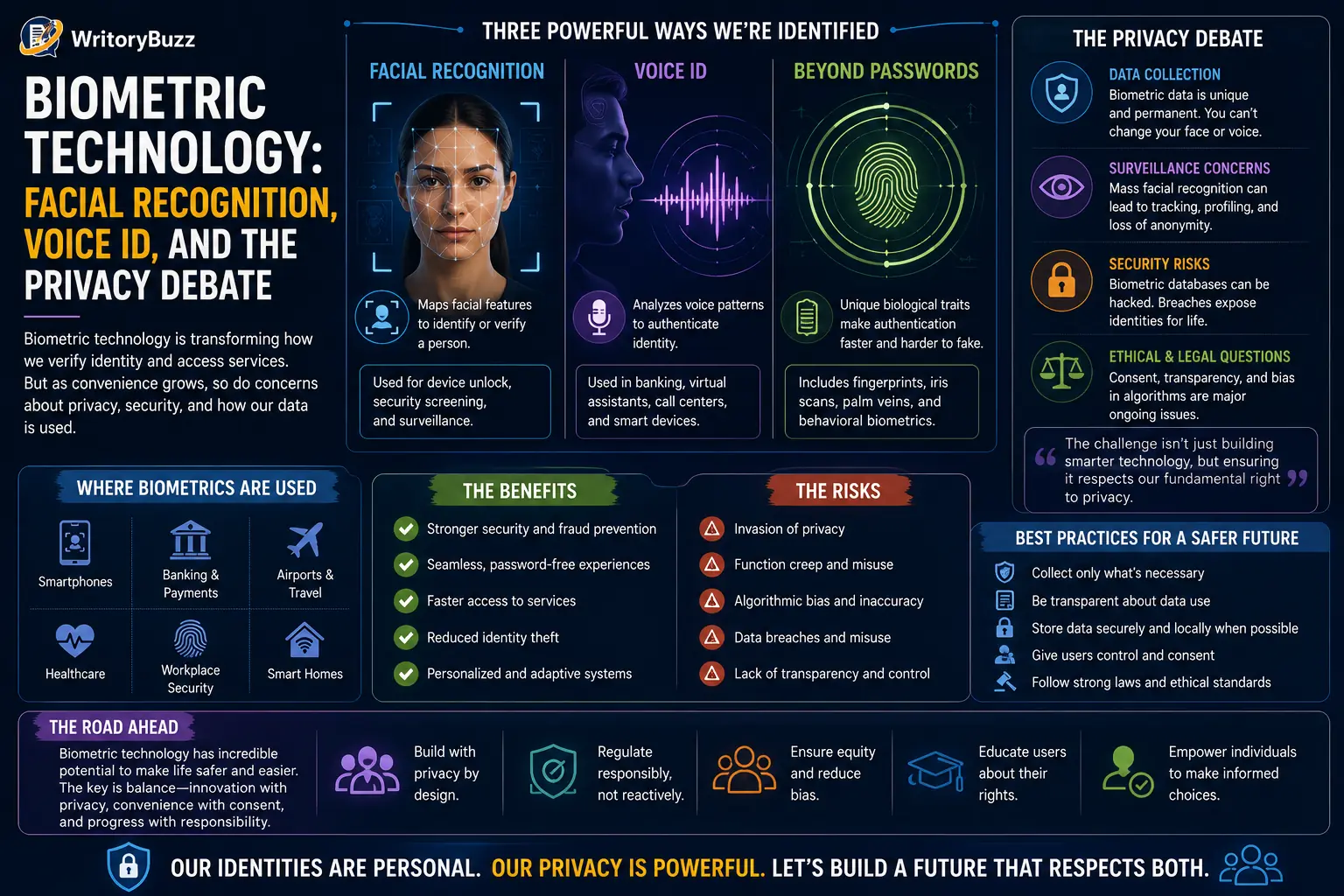
Apple’s Face ID performs face unlock in 250 milliseconds with a 1 in 1,000,000 false acceptance rate. Clearview AI has scraped more than 40 billion facial images from the internet and sells identification services to law enforcement agencies in over 30 countries. These two applications of the same underlying technology represent the full spectrum of biometric technology in 2026: seamless personal security on one end, mass surveillance infrastructure on the other.
Biometric technology uses unique biological characteristics – face geometry, voice patterns, fingerprint ridges, iris structure – to verify or identify individuals. The technology’s rapid improvement and equally rapid deployment has outpaced the legal frameworks intended to govern it, producing a contested landscape where the same capabilities serve both legitimate security functions and serious civil liberties concerns.
How Biometric Recognition Works
Facial Recognition
Modern facial recognition systems convert a face image into a mathematical feature vector — a numerical representation of facial geometry: distance between eyes, nose bridge width, jaw shape, and hundreds of other measurements. This vector is compared against a database of stored vectors using similarity scoring. The system returns a match when similarity exceeds a confidence threshold.
Accuracy in 2026: Top commercial systems achieve 99.5 percent or higher accuracy in controlled conditions on cooperative subjects. Accuracy degrades in uncontrolled conditions: poor lighting, unusual angles, partial occlusion, and demographic bias. Multiple studies have documented higher false-positive rates for darker-skinned faces, women, and older subjects across many commercial systems.
Liveness detection: Anti-spoofing measures that prevent photographs or 3D masks from fooling the system. Active liveness detection asks the user to perform actions (blink, turn head). Passive liveness detection analyses micro-texture cues, depth inconsistencies, and blood flow patterns without user interaction. Both are standard in high-security applications.
Voice Identification
Voice recognition systems analyse vocal tract characteristics — pitch, formants, speech patterns, and rhythm — that are as unique as fingerprints. Voice biometrics are used for phone-based authentication in banking and call centres, replacing knowledge-based authentication questions that are frequently compromised through data breaches.
Vulnerability to voice cloning: As documented in the cybersecurity context, voice cloning from a few seconds of audio is now trivial. This has created a significant vulnerability in voice biometric systems. Liveness detection for voice (detecting synthesised versus live speech) is an active research and deployment priority in 2026.
Beneficial Applications
Device security: Apple Face ID, Android face unlock, and fingerprint readers provide frictionless authentication that is significantly more secure than most user-chosen passwords. Biometric authentication for device unlock is among the most broadly beneficial security technologies deployed at scale.
Border control and identity verification: Automated passport control using facial recognition reduces processing time, improves fraud detection, and allows border agencies to focus human attention on genuine security concerns. The ICAO (International Civil Aviation Organisation) has standardised biometric passports globally.
Healthcare access: Patient identification using biometrics reduces medical errors from misidentification, reduces the administrative burden of identity verification at every care interaction, and supports faster emergency care delivery.
Financial authentication: Voice biometrics and facial recognition for banking authentication replace security questions that are widely compromised and have higher security than SMS OTP codes. HSBC, Santander, and most major banks deploy voice biometrics for phone banking.
The Serious Concerns
Mass surveillance: Facial recognition deployed in public spaces by governments and private actors enables tracking of individuals’ movements, associations, and activities without consent or awareness. China’s Social Credit System and police facial recognition systems in multiple Western countries have documented cases of incorrect identifications leading to wrongful arrests.
False positive consequences: A wrongful facial recognition match leading to arrest has life-altering consequences. At least six documented cases in the US involve Black men wrongfully arrested based on false facial recognition matches. The error rate asymmetry across demographic groups has significant civil rights implications.
Biometric data breach risk: Unlike a password, biometric data cannot be changed after compromise. A fingerprint or facial geometry template stolen in a data breach permanently compromises that biometric identifier. This irreversibility is a fundamental risk property distinguishing biometric from other credentials.
The Legal Landscape in 2026
The EU AI Act includes the most significant biometric regulation enacted in any jurisdiction. Real-time biometric identification in public spaces by law enforcement is prohibited with narrow exceptions (terrorism threat, specific fugitive tracking). Post-hoc biometric identification of suspects is permitted with judicial authorisation. Commercial facial recognition systems are classified as high-risk and require transparency, accuracy documentation, and fairness testing.
In the US, Illinois’ BIPA (Biometric Information Privacy Act) remains the most comprehensive state-level biometric privacy law, requiring informed consent for biometric data collection and providing a private right of action. Texas and Washington have similar laws. No federal US biometric privacy law exists despite multiple Congressional proposals.
What is biometric technology and how does it work?
Biometric technology uses unique biological characteristics — face geometry, fingerprints, voice patterns, iris structure — to verify or identify individuals. Systems convert biometric input into mathematical vectors that are compared against stored templates. Modern top-tier systems achieve over 99.5 percent accuracy in controlled conditions.
Is facial recognition accurate in 2026?
Top commercial facial recognition achieves 99.5 percent-plus accuracy in controlled conditions. Accuracy degrades with poor lighting, unusual angles, and demographic factors. Multiple studies document higher false-positive rates for darker-skinned individuals, women, and older subjects. Real-world mass deployment accuracy is significantly lower than controlled benchmark performance.
What are the privacy risks of biometric data?
Unlike passwords, biometric data cannot be changed after compromise — a stolen fingerprint or facial template permanently compromises that biometric identifier. Mass surveillance through public facial recognition enables tracking without consent. False-match consequences can include wrongful arrest. Data breach of biometric templates represents a permanent, irrevocable security failure.
What does the EU AI Act say about facial recognition?
The EU AI Act prohibits real-time biometric identification in public spaces by law enforcement with narrow exceptions (terrorism threat, specific fugitive search). Post-hoc identification requires judicial authorisation. Commercial facial recognition is classified as high-risk requiring transparency documentation, accuracy testing, and fairness assessments across demographic groups.
Can voice cloning defeat voice biometric authentication?
Sophisticated voice cloning can potentially defeat poorly-designed voice biometric systems. Leading voice authentication platforms have deployed liveness detection specifically to distinguish synthesised from live speech. The FBI has warned about voice cloning attacks on voice-authenticated systems. The robustness of liveness detection against advanced generative audio models is an active security concern.
What is BIPA and how does it protect biometric privacy?
Illinois’ Biometric Information Privacy Act (BIPA) requires informed written consent before collecting biometric data, prohibits sale or profit from biometric data, and provides a private right of action for violations ($1,000 to $5,000 per violation). It is the most protective biometric privacy law in the US and has generated significant litigation against companies collecting biometric data without consent.
The Technology Is Outpacing the Governance
Biometric technology in 2026 is simultaneously among the most beneficial and most potentially harmful technologies in widespread deployment. Device-level authentication represents genuinely positive security advancement. Mass surveillance facial recognition infrastructure represents a qualitatively different application of the same technology with profound civil liberties implications. The gap between these applications is not being adequately addressed by current legal frameworks outside the EU.
Biometric technology is transforming how we secure digital identities but it also raises important privacy questions. Follow WritoryBuzz for expert insights on cybersecurity, emerging technologies, digital privacy, and the future of authentication in 2026.