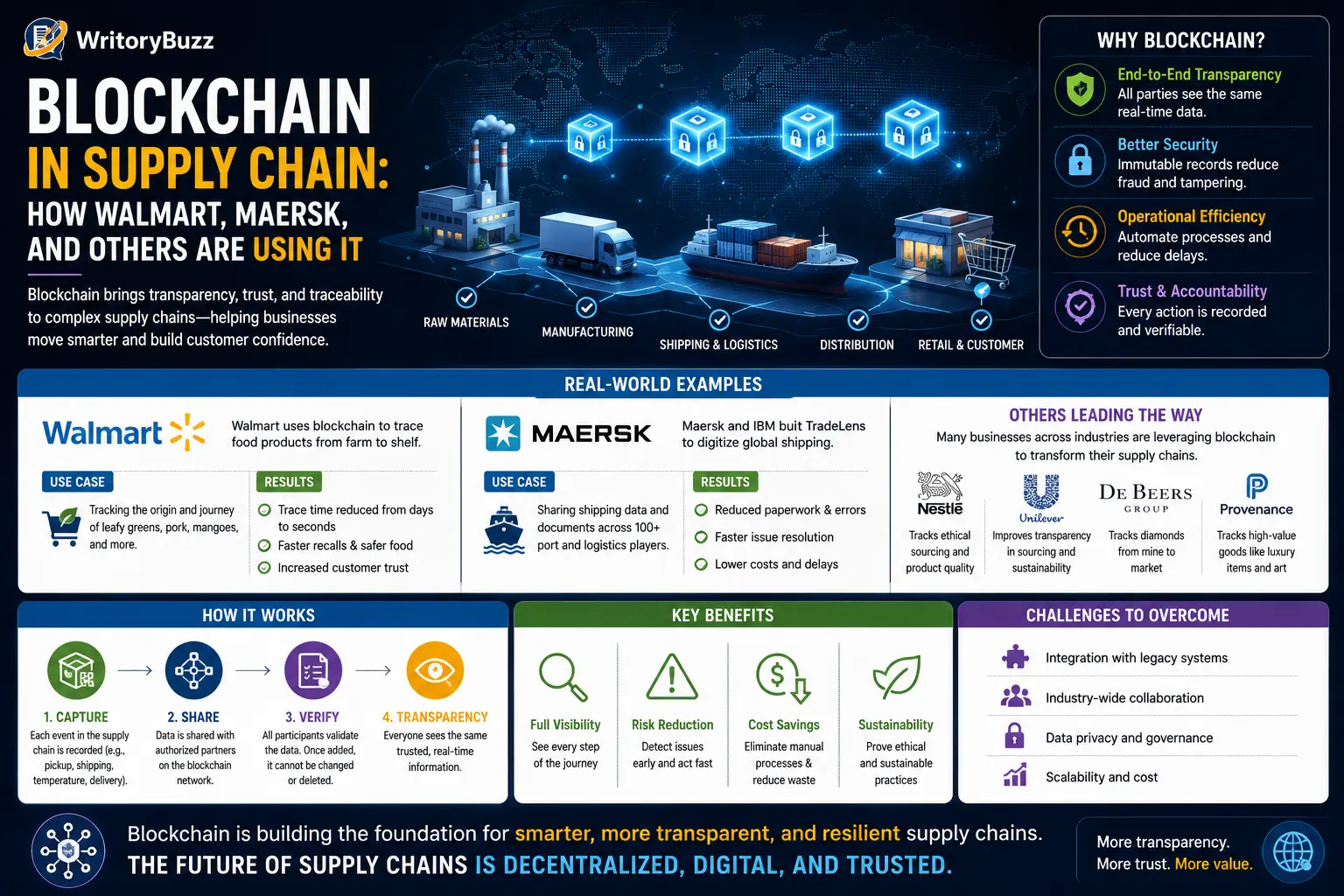
Walmart reduced the time to trace a mango’s origin from 7 days to 2.2 seconds using IBM Food Trust blockchain. Maersk and IBM built TradeLens to digitise shipping documentation for 50 percent of global container shipping volume. De Beers tracks diamonds from mine to retail on its Tracr blockchain. Real deployments exist, real outcomes are documented, and real limitations have caused some major initiatives to be restructured or discontinued.
Blockchain supply chain applications in 2026 have a documented track record. Unlike many blockchain use cases that remain in pilot phases, supply chain traceability has genuine enterprise deployments with measurable outcomes. Understanding which applications deliver value and which have been oversold requires examining both the successes and the notable failures.
Why Blockchain for Supply Chains
Traditional supply chains use fragmented, siloed data systems. A product moving from manufacturer to distributor to retailer to consumer passes through dozens of organisations, each maintaining their own records in incompatible systems. Discrepancies are common, fraud is difficult to detect, and tracing a product origin after a contamination event can take days or weeks.
Blockchain addresses this through a shared, immutable ledger that all participants write to and read from with cryptographic verification. Once data is written, it cannot be altered without detection. Every participant sees the same record. Provenance becomes auditable at every stage.
Real Deployments and Their Outcomes
Walmart and IBM Food Trust
Walmart deployed IBM Food Trust on its supply chain for leafy greens following a 2018 E. coli outbreak that killed five people and required a recall of all romaine lettuce in the US because the source could not be identified. After deployment, tracing a product origin dropped from 7 days to 2.2 seconds. Walmart subsequently mandated IBM Food Trust participation for all leafy green suppliers. The business case was demonstrated by a real food safety failure, not a theoretical efficiency argument.
Maersk and TradeLens
Maersk and IBM built TradeLens to digitise shipping documentation for global container shipping. At peak, it covered over 50 percent of global container shipping volume with 300-plus participants. In December 2022, Maersk and IBM shut down TradeLens, citing failure to achieve the commercial viability and network effect required for a neutral, industry-wide platform.
The lesson from TradeLens: Supply chain blockchain value requires all participants in a supply chain to adopt the same platform. TradeLens struggled with competitor reluctance (shipping companies did not want to use a Maersk-co-owned platform) and the governance complexity of a neutral industry utility. The technology worked. The business and governance model did not.
De Beers: Tracr
De Beers launched Tracr to track individual diamonds from mine to retail, creating a digital record of each stone’s provenance, characteristics, and chain of custody. In an industry with documented issues around conflict diamonds and synthetic diamond fraud, provenance verification has genuine commercial value. Tracr is operational and growing, serving as a differentiator for certified natural diamonds versus lab-grown alternatives.
Everledger
Everledger tracks luxury goods diamonds, wine, art on a blockchain ledger, providing provenance documentation for insurance, authentication, and resale. Over 2 million diamonds are tracked. The platform demonstrates the viability of blockchain for high-value, low-volume tracking where individual item identity matters for significant financial reasons.
Where Blockchain Supply Chain Works
The supply chain applications with the most documented success share common characteristics: food safety traceability with regulatory consequences for failures (leafy greens, seafood, pharmaceuticals), luxury goods authentication where fraud exists and provenance has significant financial value, cross-border trade documentation for high-value goods, and commodity supply chains where sustainability claims require third-party verification.
Where Blockchain Supply Chain Has Struggled
The participant adoption problem: Blockchain supply chain value is proportional to participation. A blockchain ledger with 60 percent of supply chain participants is much less useful than one with 95 percent. Achieving universal adoption across competitors, small suppliers, and international participants is the most consistent barrier to blockchain supply chain deployment.
The data quality problem: Blockchain records are only as accurate as the data entered. A fraudulent entry at the point of data capture produces a perfectly immutable false record. Counterfeit goods can be assigned authentic blockchain records. The technology cannot prevent fraud at the physical-to-digital interface without additional verification mechanisms.
Cost-benefit for standard commodities: For high-value goods and food safety applications, the cost of blockchain infrastructure is justified by the risk it mitigates. For standard commodity supply chains without regulatory drivers or fraud risk, the cost often exceeds the benefit.
How does blockchain improve supply chain management?
Blockchain creates a shared, immutable record that all supply chain participants read and write to, enabling real-time provenance tracking, fraud detection, and rapid recall response. Walmart reduced produce origin tracing from 7 days to 2.2 seconds using IBM Food Trust. The technology is most valuable where fragmented data systems cause costly supply chain failures.
What is IBM Food Trust and how does Walmart use it?
IBM Food Trust is a blockchain platform for food supply chain traceability. Walmart deployed it following a 2018 E. coli outbreak and mandated participation for all leafy green suppliers. Product origin tracing dropped from 7 days to 2.2 seconds. It connects farmers, processors, distributors, and retailers on a shared ledger with cryptographically verified records.
Why did Maersk shut down TradeLens?
TradeLens, built with IBM to digitise global container shipping documentation, was shut down in December 2022 because it failed to achieve the network effect needed as a neutral industry platform. Competing shipping companies were reluctant to use a Maersk-co-owned platform. The technical infrastructure worked but the governance model could not achieve universal industry adoption.
What is the biggest limitation of blockchain in supply chains?
The participant adoption problem: blockchain supply chain value requires all parties in a supply chain to use the same platform. Achieving adoption across competitors, small suppliers, and international participants is the most consistent barrier. The data quality problem is equally significant: fraudulent data entered at the physical collection point is immutably recorded as accurate.
Which industries use blockchain supply chain most successfully?
Food safety (Walmart IBM Food Trust for leafy greens), luxury goods authentication (De Beers Tracr for diamonds, Everledger for wine and art), pharmaceutical track-and-trace (regulatory mandate in US and EU), and high-value cross-border trade documentation where provenance verification has significant financial or regulatory consequences.
Can blockchain prevent supply chain fraud?
Partially. Blockchain prevents post-entry record alteration, making historical records tamper-evident. It does not prevent fraudulent data entry at the source. Counterfeit goods can be assigned authentic blockchain records at point of entry. Effective supply chain fraud prevention requires blockchain records combined with physical verification mechanisms (IoT sensors, third-party inspection) at the physical-to-digital interface.
Genuine Utility in Specific Applications
Blockchain supply chain has delivered real value in specific applications food safety traceability, diamond provenance, luxury authentication while struggling where participant adoption is contested and governance is complex. The technology is not universally applicable to supply chain problems but is genuinely valuable for the specific problems it was designed to solve.