
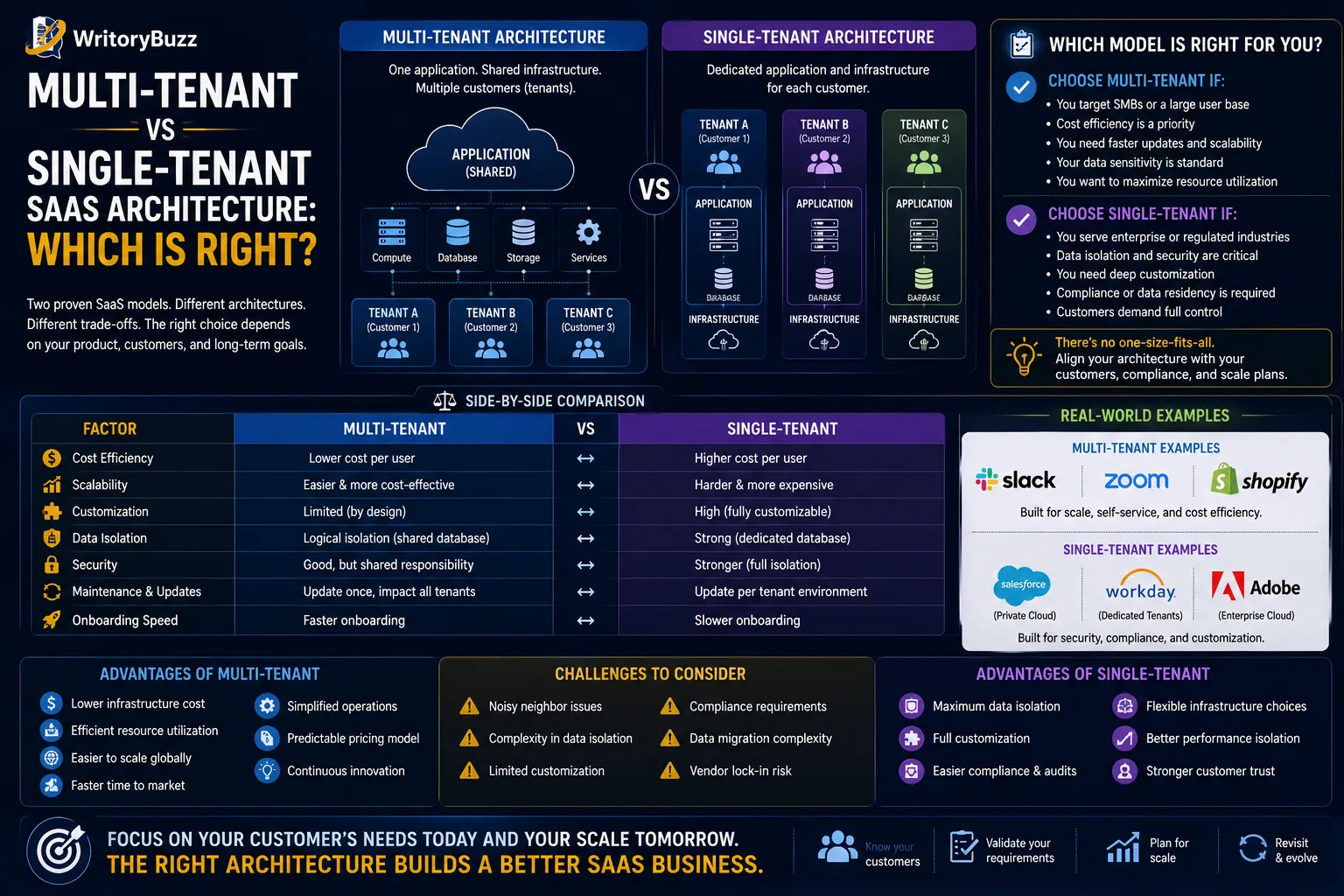
The multi-tenant vs single-tenant architecture decision shapes every dimension of a SaaS business: infrastructure cost, security posture, deployment complexity, compliance capability, and enterprise sales conversations. Getting this wrong early is expensive to correct later. Most SaaS businesses default to multi-tenancy for cost reasons without fully evaluating the compliance and enterprise implications.
Multi-tenancy means multiple customers (tenants) share the same application infrastructure the same application server, the same database (with logical isolation), the same deployment. Single-tenancy means each customer gets their own dedicated infrastructure: their own database, their own application instance, sometimes their own cloud environment.
Multi-Tenant Architecture
The dominant model for most SaaS businesses. All customers use the same application codebase, infrastructure, and (with appropriate isolation) database layer. Customers are identified by a tenant ID that scopes all data access and is validated at every query.
Cost efficiency: Multi-tenancy produces dramatically lower infrastructure costs per customer. A single application cluster serving 10,000 customers costs a fraction of 10,000 separate deployments. This is why multi-tenancy is the default for SMB-focused SaaS.
Operational simplicity: One codebase to deploy, one database schema to manage, one application to monitor. Bug fixes and feature releases apply to all customers simultaneously. Operational overhead scales sub-linearly with customer count.
The isolation imperative: Multi-tenancy’s primary security requirement is robust tenant isolation: preventing one tenant’s data from being accessible to another. This requires tenant ID validation at every data access layer, database row-level security policies, and comprehensive testing of isolation boundaries. Isolation failures in multi-tenant systems expose all customers simultaneously.
Multi-Tenant Data Models
Shared database, shared schema: All tenants’ data in the same tables with a tenant_id column. Lowest infrastructure cost. Highest isolation implementation burden. Suitable for low-sensitivity data.
Shared database, separate schemas: Each tenant has their own schema within a shared database. Better isolation than shared schema. Database connection overhead increases with tenant count.
Database per tenant: Each tenant has their own database. Strong isolation. Higher infrastructure cost. Enables per-tenant backup, compliance, and customisation. The preferred model for enterprise and compliance-sensitive multi-tenant deployments.
Single-Tenant Architecture
Each customer has their own dedicated infrastructure stack. Common in enterprise software, regulated industries, and products handling sensitive government or healthcare data.
Security and compliance advantages: Physical and logical separation of customer data simplifies compliance with regulations requiring data isolation (HIPAA, FedRAMP, EU GDPR data residency requirements). A breach of one customer’s environment cannot expose another’s. Compliance auditors can audit a single environment independently.
Customisation flexibility: Single-tenant deployments can be customised for individual enterprise customers without affecting others. Custom integrations, custom security configurations, and specific infrastructure requirements are manageable in single-tenant contexts that are impractical in shared multi-tenant environments.
The cost reality: Single-tenant deployments at scale are expensive. 500 enterprise customers each requiring their own dedicated infrastructure can cost 10 to 50 times more to operate than an equivalent multi-tenant deployment. This cost is typically passed to customers through enterprise pricing.
The Hybrid Approach
Many mature SaaS products implement a hybrid model: multi-tenant for SMB and mid-market customers (where cost efficiency is critical and compliance requirements are standard), with single-tenant ‘private cloud’ or ‘dedicated deployment’ options for enterprise customers who require it.
This approach is more complex to architect but allows a single product to serve the full market range: cost-efficient SMB delivery and compliant, customisable enterprise delivery from the same codebase.
| Factor | Multi-Tenant | Single-Tenant |
| Infrastructure cost | Low (shared) | High (dedicated per tenant) |
| Operational overhead | Low (one deployment) | High (many deployments) |
| Security isolation | Logical (enforced by code) | Physical (separate infrastructure) |
| Compliance (HIPAA, FedRAMP) | Complex; possible with DB-per-tenant | Straightforward; cleanest model |
| Enterprise customisation | Limited | High |
| Suitable market | SMB, mid-market | Enterprise, regulated industries |
| Data residency | Challenging | Straightforward (deploy per region) |
What is multi-tenant SaaS architecture?
Multi-tenancy means multiple customers share the same application infrastructure — servers, codebase, and (with logical isolation) database. Customers are separated by tenant IDs scoping all data access. It produces lower infrastructure costs and simpler operations than single-tenant but requires robust isolation enforcement to prevent cross-tenant data access.
What is the difference between multi-tenant and single-tenant SaaS?
Multi-tenant: all customers share the same infrastructure with logical data separation. Single-tenant: each customer has dedicated infrastructure, their own database and application instance. Multi-tenant is cheaper to operate; single-tenant provides stronger security isolation, easier compliance, and more customisation flexibility.
When should a SaaS company use single-tenant architecture?
When selling to enterprise customers with strict security requirements, regulated industries (healthcare, finance, government) requiring data isolation, customers with data residency requirements in specific geographies, or large contracts where customisation requirements make shared infrastructure impractical.
What is the biggest risk in multi-tenant SaaS?
Tenant isolation failure: a bug that allows one tenant’s code or queries to access another tenant’s data. This simultaneously exposes all affected tenants and represents both a security breach and a serious trust violation. Rigorous isolation testing, row-level security policies, and tenant ID validation at every data access point are the primary mitigations.
What is database per tenant and when is it appropriate?
Database per tenant gives each customer their own database instance while the application layer remains shared. It provides stronger isolation than shared schema, enables per-tenant backup and compliance, but increases infrastructure costs with tenant count. It is appropriate for enterprise-focused SaaS products handling sensitive data where compliance requirements justify the cost.
How does the multi-tenant vs single-tenant decision affect enterprise sales?
Enterprise procurement teams routinely ask about data isolation, compliance certifications, and deployment models. A single-tenant or database-per-tenant option addresses data isolation concerns that can block enterprise deals. The inability to offer dedicated deployment eliminates some enterprise opportunities in regulated industries regardless of other product quality.
Architecture Is a Business Decision, Not Just a Technical One
The multi-tenant vs single-tenant decision directly shapes which customer segments you can serve, at what price point, and with what compliance certifications. Building multi-tenant first with a clear path to database-per-tenant or single-tenant for enterprise customers is the most common successful SaaS architecture evolution path.
Choosing the right SaaS architecture can shape your application’s performance, security, and scalability for years to come. Follow WritoryBuzz for expert insights on SaaS development, cloud computing, software architecture, and emerging technology trends to build smarter, future-ready applications.