
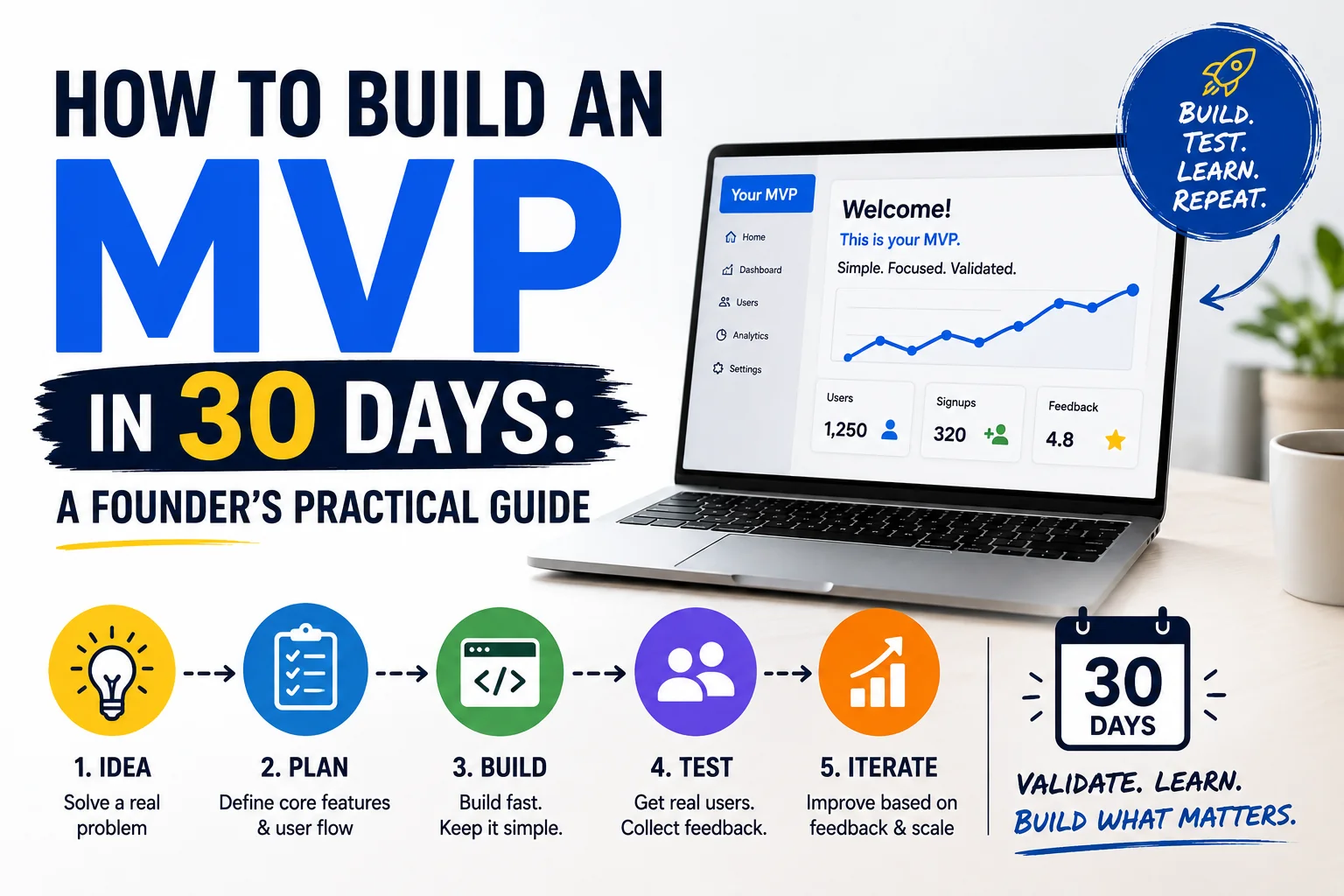
Paul Graham wrote in 2008 that startups should “launch early and iterate.” The Lean Startup methodology, popularised by Eric Ries in 2011, formalised the MVP concept as the version of a product with just enough features to gather validated learning from early customers. In 2026, the tools available to founders make a 30-day MVP timeline achievable at zero engineering cost in many categories: no-code platforms, AI coding assistants, and API-first infrastructure have reduced the technical barrier to an initial product to the point where the primary constraint is almost always scope discipline, not technical capability.
The 30-day MVP is not a full product. It is not even a good product. It is the minimum configuration of a solution that allows the founder to test whether the core assumption driving the business is correct with real users in real conditions. Building more than that before that test is complete is building on an unvalidated foundation.
What MVP Actually Means (and What It Does Not)
The most consistent mistake founders make with MVPs is building a Minimum Viable Product that is neither minimum nor particularly oriented toward viability. They build a product with all the features they originally envisioned minus a few non-essential ones, which produces a v0.1 product rather than an MVP. The correct interpretation of minimum is radical: the smallest possible set of features that allows a real user to experience the core value proposition and tell you whether it solves the problem they actually have.
Dropbox’s MVP was a demo video, not a working product. Airbnb’s MVP was a WordPress site with photos of the founders’ own apartment. Buffer’s MVP was a two-page website: one page explaining what Buffer would do, one page with a pricing form. These are not MVPs in the sense most founders mean when they use the word. They are validation experiments designed to test a specific assumption before any product is built.
A 30-day MVP that produces validated learning about the core assumption is dramatically more valuable than a three-month build that produces a better product built around the wrong assumption.
Week 1: Define the Single Assumption to Test
The 30-day MVP process begins with identifying the single most important assumption the business depends on. Not all assumptions: the single one that, if wrong, makes the entire business model invalid. This is usually a demand assumption (do enough people have this problem at a level of urgency that makes them willing to pay for a solution) rather than a solution assumption (can we build a solution that solves this problem).
The assumption should be written as a falsifiable statement: “Users with [specific problem] will pay at least [specific price] for [specific core feature].” The 30-day MVP is designed to test that specific statement with real users.
Once the assumption is defined, user interviews with five to ten people who fit the target profile (not friends or family, and ideally not people the founder knows well) validate or challenge it before any building begins. The interview is not a pitch session: it is a structured conversation about the problem, how the person currently handles it, what they have tried, and what they would pay for a better solution. Three days of interviews before building saves weeks of building the wrong thing.
Week 2: Scope the Absolute Minimum Build
The MVP scope is defined by one question: what is the smallest possible thing I can build in 14 days that lets a real user experience the core value proposition? Every feature that is not required to deliver that experience is not in the MVP. Every assumption that requires the feature to be built to test (rather than to test through interviews or mockups) is a candidate for later validation.
Tools for scoping: build a user story map with three columns. Column one: what does the user need to do to achieve their goal? Column two: what is the minimum the product needs to do for each step? Column three: what can be done manually, with existing tools, or faked for the MVP period? The third column often reveals that significant portions of the planned product can be replaced with manual processes or third-party integrations for the validation period.
For non-technical founders in 2026, the build options are:
No-code platforms (Webflow for websites, Bubble for web apps, Glide for mobile apps built on spreadsheets, Softr for portal-style apps) cover the majority of MVP use cases for SaaS, marketplace, and portal-style products. A competent Bubble builder can create a functional web application MVP in 10 to 14 days that would take a developer team 6 to 8 weeks.
AI coding assistants (GitHub Copilot, Cursor, and Claude for coding) have substantially reduced the time required for developer-founders to implement MVP features. Founders with moderate coding ability can now ship functional code at a speed that previously required senior engineering experience.
Wizard of Oz MVPs replace the technical backend with human operators. The user sees a product interface; behind the scenes, a human performs the action the software will eventually automate. This is particularly effective for AI-powered products: the founder manually performs the AI function until enough usage data exists to train and deploy an actual model.
Week 3: Build, with a Daily Scope Discipline
The primary risk during the build week is scope creep: adding features that were not in the defined scope because they seem useful, because a potential user mentions them, or because the builder encounters an elegant solution to an adjacent problem.
The discipline required is a written feature freeze list: a document that captures every feature idea that arises during the build but is not in the original scope, with a note that it will be evaluated after the MVP is validated. Writing ideas down and explicitly deferring them releases the psychological pressure to build them immediately without losing the ideas.
Daily progress should be measured against a specific milestone: by day 3 of building, the user onboarding flow should be functional. By day 7, the core value-delivering feature should be testable. By day 10, the full MVP user journey should be completable end-to-end, even with rough edges. By day 14, the MVP should be deployable to the first five test users.
Week 4: Ship to Real Users and Measure the Assumption
The MVP launches to five to ten real users in the target profile, not a public launch. The purpose is learning, not growth. The measurement is specific to the assumption defined in Week 1: if the assumption was “users will pay 49 US dollars per month for this solution,” the measurement is whether five of the ten users would pay 49 US dollars per month or actually do if an early adopter price is offered.
Qualitative feedback from user sessions (watching real users interact with the MVP, not asking them what they think of it) produces the most actionable learning. Users who are asked “what do you think?” describe what they think the founder wants to hear. Users who are observed using the product show where they get confused, where they drop off, and whether the core value proposition lands without explanation.
At the end of 30 days, the question is not “did we build a good product?” It is “did we validate or invalidate the assumption we set out to test?” Both outcomes are valuable: validation allows informed next-stage investment; invalidation prevents larger investment in the wrong direction.
| Week | Milestone | Key Decision Point |
|---|---|---|
| Week 1 | Core assumption defined; 5-10 problem interviews completed | Proceed to build or pivot assumption based on interview data |
| Week 2 | MVP scope document complete; build approach chosen | Validate that scope is genuinely minimum |
| Week 3 | Core user journey completable end-to-end | Feature freeze discipline maintained |
| Week 4 | 5-10 real users tested; assumption measured | Validated (next stage) or invalidated (pivot or stop) |
AEO FAQ: Building an MVP in 30 Days
What is an MVP and how is it different from a v1 product?
An MVP (Minimum Viable Product) is the smallest possible configuration of a product that allows a founder to test a specific core assumption about the business with real users. It is not a stripped-down version of the intended full product: it is a validation experiment designed to generate learning about whether the core demand or value assumption is correct. A v1 product is built after an MVP has validated the core assumptions; it is designed to be used and retained by customers rather than to test assumptions. Most founding teams confuse the two, building v1-scope products and calling them MVPs, which produces longer build times and later validation of assumptions.
Can you build an MVP without coding experience in 2026?
Yes. No-code platforms in 2026 cover the majority of MVP use cases for software products. Bubble builds functional web applications with databases, user authentication, payments, and complex logic without code. Webflow builds professional websites and landing pages. Glide builds mobile apps from Google Sheets. Softr builds portal-style apps with user login, content, and payments from Airtable databases. A non-technical founder with two to three weeks of learning time on any of these platforms can build and deploy a functional web application MVP. For products requiring custom behaviour beyond no-code capabilities, AI coding assistants (Cursor, GitHub Copilot) significantly accelerate development for founders with any programming background.
How do you decide what to include in an MVP?
MVP scope should be determined by one question: what is the minimum a user needs to experience the core value proposition of the product? Every feature that is not required for a user to experience that core value in a real context is not in the MVP. A useful scoping exercise is listing every feature in the planned product and asking for each one: “Can the MVP be shipped without this feature and still test the core assumption?” If yes, remove it. The remaining list is the MVP scope. A correctly scoped MVP typically covers 20 to 30 percent of the features in the originally planned product.
How many users should you test an MVP with?
An MVP should be tested with five to ten real users in the target profile before drawing conclusions. This is a qualitative research exercise: the goal is learning, not statistical significance. Five users consistently enough in their behaviour to reveal core usability problems and assumption validity signals. Testing with fewer than five users produces unreliable signals (one outlier dominates the data). Testing with more than twenty users before iteration adds time without proportionally adding insight, because qualitative learning saturates quickly. The target users should genuinely fit the problem profile and should not be close friends or family who will be overly positive.
What is the biggest mistake founders make when building an MVP?
The most consistent MVP mistake is building a Minimum Viable Product that is neither minimum nor oriented toward testing a specific assumption: founders build a stripped-down version of their intended product (removing non-essential features from a full product scope) rather than identifying the minimum needed to test the core demand assumption. The result is a longer build, a product that launches before the core assumption is validated, and customer feedback about features rather than about whether the problem being solved is real and valuable enough to pay for. The second most common mistake is building for imagined users rather than testing with real ones who genuinely have the problem.
How do you know when an MVP is validated?
An MVP is validated when real users in the target profile exhibit behaviour that confirms the core assumption defined before building. For a demand assumption (“users with this problem will pay X for a solution”), validation is when a meaningful proportion of test users express genuine willingness to pay at the specified price (or actually pay, if the MVP includes payment). For a behaviour assumption (“users will change from their current workflow to use this product”), validation is when test users adopt the product for their real workflow rather than using it once and reverting to the current solution. Validation is not “users liked it” or “the feedback was positive”: it is specific measurable behaviour that confirms or challenges the stated assumption.
The Goal Is Learning, Not Launching
The framing that most accelerates 30-day MVP progress is treating the 30 days as a research project rather than a product launch. A research project that produces the insight “our core assumption was wrong and here is what users actually need” is a successful research project. A product launch that produces the same insight after six months of building is a failed launch. The MVP accelerates the arrival at validated learning, which is the asset that allows the next stage of building to be done with confidence rather than hope.