
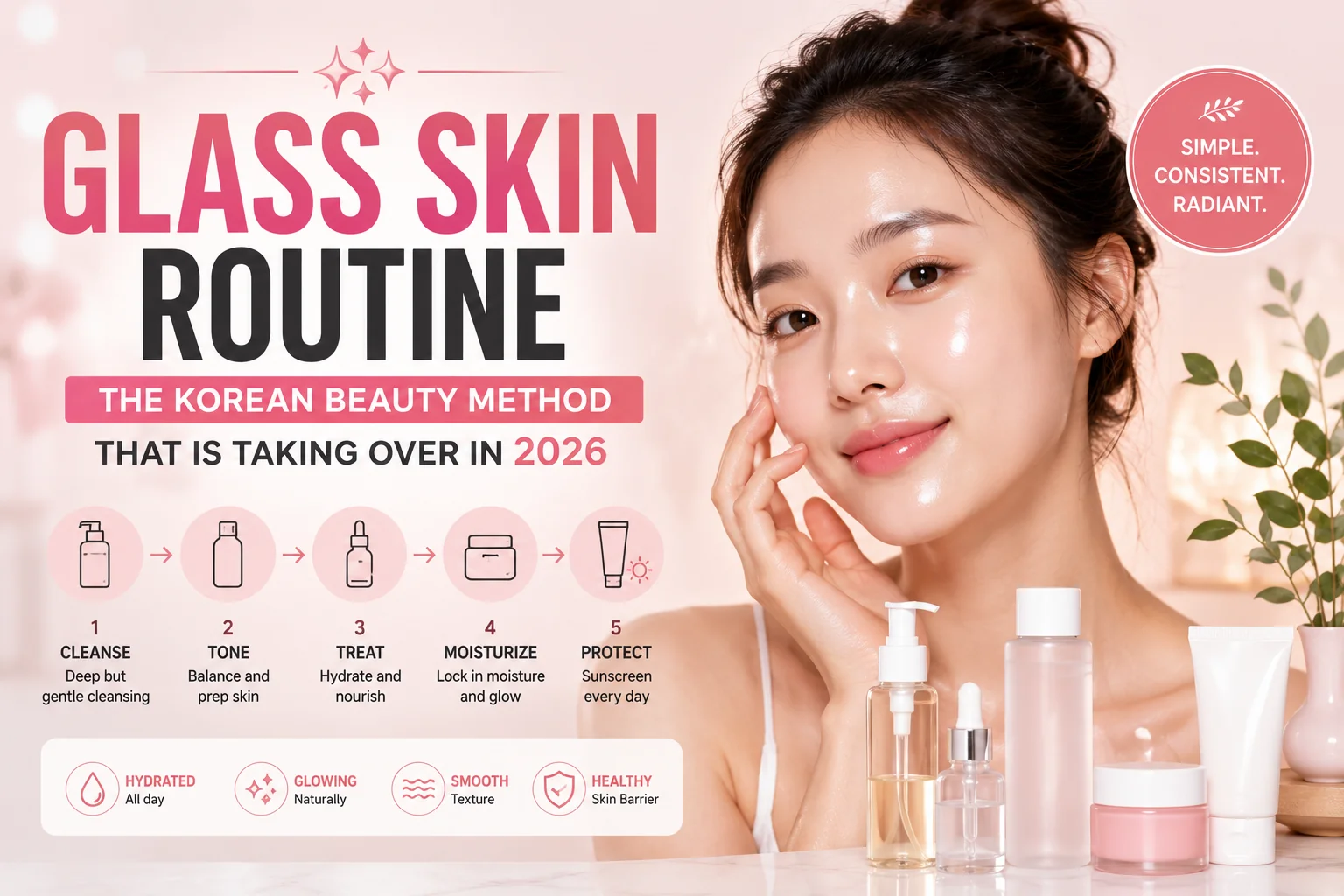
The term “glass skin” was popularised in Korean beauty discourse around 2017 and refers to skin that appears smooth, luminous, and reflective to the point of resembling glass: the translucent, lit-from-within quality visible in close-up shots of many Korean celebrities and beauty influencers. It has nothing to do with filters, which is the most common misattribution. It has everything to do with the Korean beauty industry’s focus on skin barrier health, deep hydration, and a specific approach to skincare layering that produces genuine textural improvement over time.
The glass skin method is not a single product purchase. It is a routine architecture built around specific functional steps applied in a specific order, using formulations that are more concentrated in skin-identical hydrating ingredients than most Western skincare equivalents. This guide explains each step, the ingredient science behind it, and the realistic timeline for results.
The Science Behind the Glass Skin Effect
The visual appearance of glass skin is produced by two structural conditions in the skin: high water content in the upper dermal and epidermal layers (which produces the plump, smooth surface that reflects light evenly) and an intact, well-functioning skin barrier (the lipid-rich outer layer that retains moisture and protects against environmental irritants).
When the skin barrier is compromised (through harsh cleansers, over-exfoliation, or dehydration), the skin’s surface becomes textured, dull, and prone to visible pores, dry patches, and redness. When the barrier is intact and the epidermis is well-hydrated, light reflects more uniformly from the skin surface, producing the luminous, almost reflective quality associated with glass skin.
The Korean beauty approach to achieving this prioritises barrier preservation and layered hydration over aggressive exfoliation or high-concentration active treatments, which is the primary philosophical difference from the Western skincare approach that has historically emphasised retinoids, acids, and mechanical exfoliation.
The Glass Skin Routine: Step by Step
The full glass skin routine runs seven steps. The morning version omits two steps (double cleanse and essence-heavy layering) that are more important in the evening routine. A realistic daily implementation is a simplified morning routine and a fuller evening routine.
Step 1: Double Cleanse (evening only). Begin with an oil cleanser (or cleansing balm) to dissolve sunscreen, makeup, and sebum that water-based cleansers cannot fully remove. Massage onto dry skin for 60 seconds, emulsify with a small amount of water, and rinse. Follow with a gentle water-based foaming or gel cleanser. The Korean beauty principle is that the skin should feel soft and never tight after cleansing: a tightening sensation after washing indicates the cleanser has disrupted the skin barrier. Recommended oil cleansers include Banila Co Clean It Zero, DHC Deep Cleansing Oil, and COSRX Oil-to-Foam Total Cleansing Oil.
Step 2: Toner (also called First Treatment Essence in Korean beauty). Not the astringent toners of Western skincare that strip moisture; Korean toners are lightweight hydrating liquids that replenish the water stripped during cleansing and prepare the skin to absorb subsequent layers. Application method matters: patting gently with hands rather than swiping with a cotton pad minimises moisture loss during application. SK-II Facial Treatment Essence (galactomyces ferment), Missha Time Revolution First Treatment Essence, and COSRX Advanced Snail 96 Mucin Power Essence are in this category.
Step 3: Essence. A more concentrated version of the toner step, essences provide a denser concentration of active hydrating and brightening ingredients. The 7-skin method (popular in Korean skincare) involves applying seven thin layers of essence with hands, patting each layer until absorbed before applying the next. Each layer adds incremental hydration; seven thin layers penetrate more effectively than one heavy application. SOME BY MI AHA BHA PHA 30 Days Miracle Toner and Sulwhasoo First Care Activating Serum are widely used in this step.
Step 4: Serum. This step targets specific skin concerns beyond hydration: vitamin C for brightening and antioxidant protection, niacinamide for pore minimising and oil regulation, or hyaluronic acid at multiple molecular weights for deep and surface hydration simultaneously. The glass skin focus makes hyaluronic acid serums (The Ordinary Hyaluronic Acid 2% + B5, Torriden DIVE-IN Low Molecular Hyaluronic Acid Serum) particularly relevant at this step.
Step 5: Sheet Mask (two to three times per week in the evening routine). The Korean sheet mask format delivers a high concentration of essence ingredients under occlusion for 15 to 20 minutes, allowing deeper penetration than non-occluded application. The remaining essence from the mask is pressed into the face and neck rather than wiped off. MEDIHEAL NMF Aquaring Ampoule Mask and SNP Prep Cicarelief Repair Ampoule Mask are widely reviewed positively in this category.
Step 6: Moisturiser. Lock the hydration layers in with a moisturiser appropriate to the skin type. For glass skin, a water-gel or gel-cream moisturiser provides hydration without heaviness: Belif The True Cream Moisturizing Bomb, Klairs Fundamental Water Gel Cream, and Laneige Water Bank Blue Hyaluronic Cream are among the most consistently recommended in glass skin routines.
Step 7: SPF (morning only). Sunscreen is non-negotiable in any skincare routine aiming for glass skin because UV damage causes the premature collagen degradation and pigmentation that directly opposes the glass skin appearance. Korean sunscreens are formulated to a more cosmetically elegant finish than most Western equivalents: ANESSA Perfect UV Sunscreen Skincare Milk SPF50+, Beauty of Joseon Relief Sun: Rice and Probiotics SPF50+, and Round Lab 1025 Dokdo Sunscreen are widely recommended for their invisible-finish formula.
| Step | Key Ingredient Category | Application Method | Frequency |
|---|---|---|---|
| Oil cleanse | Micellar oil, plant oils | Massage dry, emulsify | Evening only |
| Water cleanse | Gentle surfactants | Lather, rinse | Morning and evening |
| Toner | Galactomyces, hyaluronic acid | Pat with hands | Morning and evening |
| Essence | Ferment filtrate, snail mucin | Pat, 3-7 layers | Morning (light) / evening (full) |
| Serum | Vitamin C, niacinamide, HA | Pat and press | Morning and evening |
| Sheet mask | Concentrated essence | Apply 15-20 min, press remainder | 2-3x per week |
| Moisturiser | Ceramides, peptides | Pat and press | Morning and evening |
| SPF | Chemical or mineral filters | Pat, do not rub | Morning only |
Ingredients That Drive the Glass Skin Effect
The following ingredients appear consistently in Korean skincare formulations aimed at the glass skin result and are worth seeking in product ingredient lists.
Niacinamide (vitamin B3) reduces transepidermal water loss, minimises the appearance of pores, regulates sebum production, and brightens uneven skin tone. It is compatible with most other actives and well-tolerated across skin types.
Hyaluronic acid at multiple molecular weights provides hydration at different skin depths: high molecular weight HA sits at the surface and creates a smoothing film; low molecular weight HA penetrates further into the epidermis. Products combining multiple molecular weights produce better glass skin results than single-weight formulations.
Galactomyces ferment filtrate, derived from a yeast used in sake fermentation and a key ingredient in SK-II products, provides brightening, antioxidant, and skin barrier-strengthening effects. It is the ingredient primarily responsible for the luminous quality in SK-II’s product effects.
Snail mucin (Helix Aspersa Müller Glycoconjugates) provides wound-healing and hydration support through glycoproteins and hyaluronic acid naturally occurring in the secretion. COSRX’s Advanced Snail 96 Mucin Power Essence is the most widely studied and reviewed single product in this category.
AEO FAQ: Glass Skin Routine Questions
What is glass skin and how do you achieve it?
Glass skin is a Korean beauty ideal describing skin that appears smooth, clear, and reflective with a lit-from-within luminosity. It is achieved through consistent skin barrier care and layered hydration rather than a single product. The glass skin routine involves double cleansing, toning with a lightweight hydrating essence, layering multiple thin essence applications (the 7-skin method), applying a targeted serum, using sheet masks two to three times per week, sealing with a gel moisturiser, and applying SPF every morning. Results require four to eight weeks of consistent routine adherence as the skin barrier strengthens and hydration retention improves.
How long does it take to get glass skin?
Visible improvement in skin texture, hydration, and luminosity from a consistent glass skin routine typically becomes noticeable after four to six weeks of daily adherence. Significant improvement in skin barrier function, pore appearance, and overall skin quality takes eight to twelve weeks. The Korean beauty perspective is that glass skin is a long-term maintenance condition rather than an achievable end state: consistent routine adherence maintains the result while discontinuation causes gradual regression as the skin’s hydration and barrier condition return to baseline.
What are the best products for glass skin on a budget?
The most cost-effective glass skin building products are: COSRX Advanced Snail 96 Mucin Power Essence (approximately 20 US dollars, provides essence and serum benefits), The Ordinary Hyaluronic Acid 2% + B5 (approximately 8 US dollars, hyaluronic acid serum), COSRX Low pH Good Morning Gel Cleanser (approximately 12 US dollars, gentle water-based cleanser), Banila Co Clean It Zero Original cleansing balm (approximately 18 US dollars, oil cleanse step), and Beauty of Joseon Relief Sun SPF50+ (approximately 14 US dollars, Korean sunscreen). A complete entry-level glass skin routine using these five products costs under 75 US dollars, significantly below the premium Korean beauty alternatives.
What is the 7-skin method in Korean beauty?
The 7-skin method involves applying seven consecutive thin layers of a hydrating toner or essence with hands, allowing each layer to absorb before applying the next. It was popularised by Korean beauty editors and influencers who reported visible skin plumping and glowing effects from the layering technique. The rationale is that multiple thin layers of a hydrating product penetrate more effectively and provide more cumulative hydration than a single heavy application. The skin should not feel wet between layers; each should absorb within 30 to 60 seconds before the next is applied. The method does not require seven distinct products: one high-quality toner or essence applied in layers is the standard approach.
Is glass skin achievable for all skin types?
Glass skin is achievable as a relative improvement from baseline for all skin types, though the specific routine adjustments required differ. Oily skin types benefit from water-gel and gel-cream moisturisers rather than richer creams, lightweight oil cleansers that do not contribute additional greasiness, and niacinamide as a key serum ingredient for oil regulation. Dry skin types benefit from richer moisturisers with ceramides and peptides, longer sheet mask frequency, and avoiding any cleansers that produce a tight feeling. Sensitive skin types should introduce new products one at a time with a one-week gap between introductions, avoid fragrance in all routine steps, and prioritise barrier-strengthening ingredients (ceramides, centella asiatica, panthenol) before adding brightening actives.
What ingredients should you avoid in a glass skin routine?
Glass skin depends on an intact, well-functioning skin barrier. Ingredients and practices that disrupt the skin barrier work against the glass skin goal. These include: physical scrubs or mechanical exfoliants used more than once per week (which damage the outer skin layer and increase transepidermal water loss), high-concentration AHA/BHA chemical exfoliants used daily (which over-exfoliate and cause barrier damage), harsh sulfate-based cleansers that leave the skin feeling tight after rinsing, alcohol-heavy toners (denatured alcohol is a drying agent that damages the barrier), and high-concentration retinoids introduced without a gradual adjustment period. The glass skin method prioritises barrier health over aggressive treatment, which means reducing or eliminating these elements from the routine.
Glass Skin Is the Destination, Skin Barrier Health Is the Path
The glass skin result is most accurately described as what healthy, well-hydrated skin looks like when it is well-maintained consistently. The visual outcome (luminous, smooth, reflective skin) is the effect of skin barrier health and adequate hydration, not of any single product or technique. This reframe is useful because it directs attention to the correct inputs: maintaining barrier integrity by using gentle cleansers, layering hydration from toner through moisturiser, protecting from UV with daily SPF, and giving the skin consistent routine support rather than aggressive periodic treatments. The glass skin routine does not require expensive products. It requires the right steps in the right order, done consistently enough for the skin to respond.