
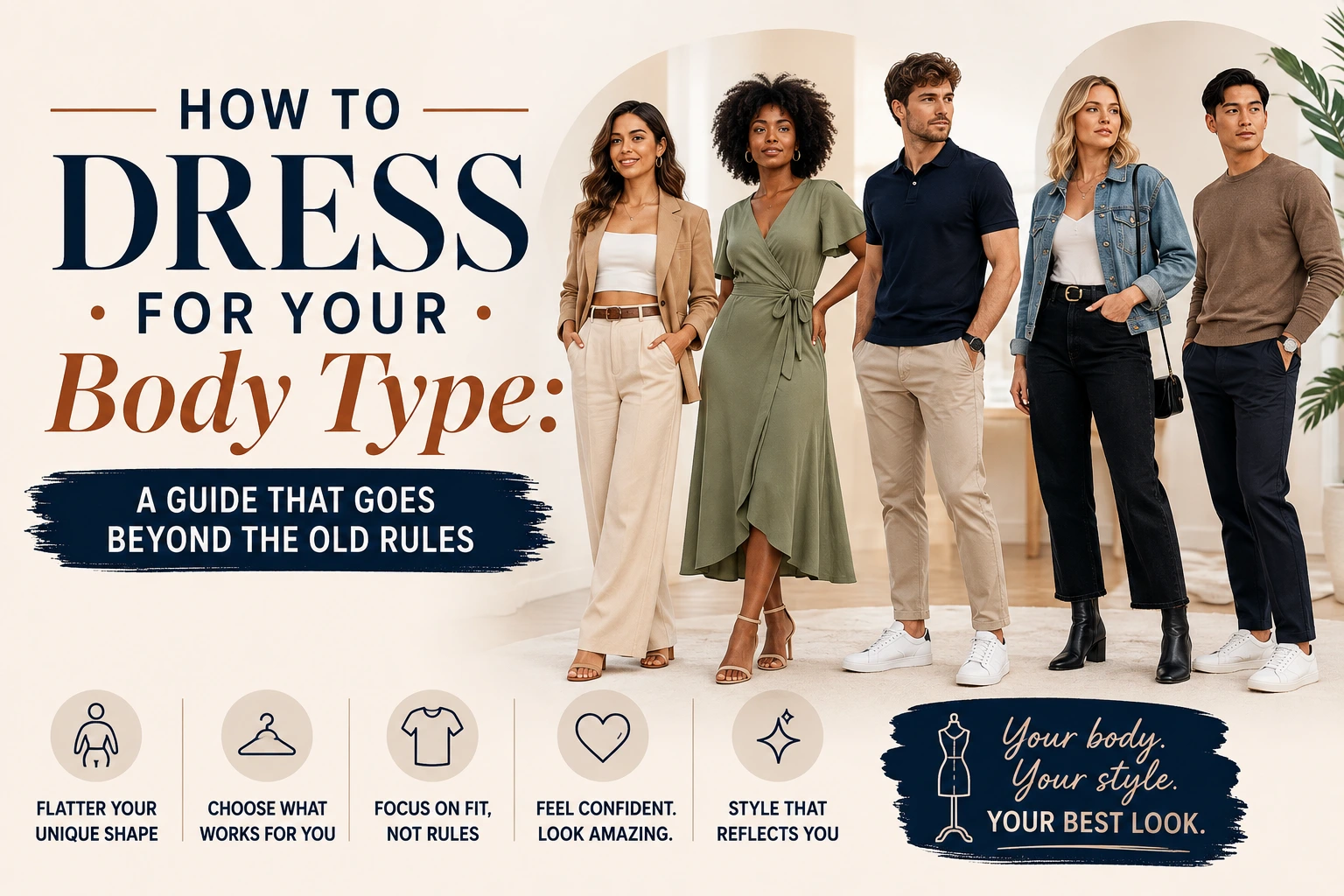
The apple-pear-hourglass-rectangle body shape classification system that has dominated fashion advice for decades was popularised by 1980s fashion journalism and has no basis in academic body science. The actual academic field of body shape research, which uses 3D scanning anthropometric data to classify human body shapes, identifies between 12 and 16 distinct shape clusters depending on the measurement methodology used. No credible researcher in body morphology uses the four-fruit system. It persists in fashion media because it is easy to remember, not because it is accurate or useful.
More practically: body type advice that begins from a categorical label and prescribes rules (“avoid horizontal stripes,” “always wear high-waisted trousers”) is less useful than advice based on the actual variables that determine how clothes fit and look on a specific person. Those variables are proportion, fit, and personal style priorities, and they vary on a continuum rather than clustering into four categories.
The Variables That Actually Matter
Three variables explain most of the difference between clothing that looks intentional and flattering on a person and clothing that looks off without clear reason.
The first is shoulder-to-hip width relationship. Clothing is designed with a default assumption about this relationship. Jackets assume a certain shoulder width relative to waist; trousers assume a hip measurement that sits in a specific proportion to the waistband. When a person’s shoulder-to-hip ratio falls outside the garment’s designed assumption, the garment looks off even in the technically correct size. This is a fit issue, not a style issue, and it is resolved by tailoring rather than by different style choices.
The second is torso length relative to leg length. Most clothing patterns assume a standard torso-to-leg proportion. A person with a proportionally longer torso and shorter legs will find that a top that fits the torso is too long to be worn untucked without creating a visual shortening effect, and that standard-rise trousers create proportions that do not reflect the actual body. A person with a proportionally shorter torso and longer legs will find that the same top hits at a hip-shortening point. Understanding your torso-to-leg proportion allows more predictive garment selection without trying everything on.
The third is the shoulder width relative to the garment’s shoulder seam. This is the most important fit point for jackets, blazers, and structured tops. A shoulder seam that falls off the actual shoulder point creates a silhouette that reads as ill-fitting regardless of how well every other dimension of the garment fits. Tailoring a shoulder seam is possible but expensive; avoiding the problem through brand selection by shoulder width measurement is more practical.
Dressing for Specific Proportion Goals
Body type advice is more useful when framed around proportion goals (what visual effect you are trying to create) than around categorical rules. The common proportion goals and the clothing choices that address them:
To create visual definition at the waist when the natural waist is not the narrowest point: high-rise bottoms that sit at the narrowest part of the torso, belted or tucked garments that define the waist visually, and avoiding garments that finish at or below the hip without any waist definition. The effect is created by where garments begin and end relative to the body’s proportional landmarks.
To balance shoulder width relative to hips: if shoulders are proportionally wider than hips, structured or wide-leg bottoms that add visual width at the hip create a more balanced proportion. If hips are wider proportionally, structured shoulders in jackets and top layers create proportion from above. These are not rules about “disguising” body features. They are choices about visual proportion balance, which is a matter of personal preference rather than correctness.
To create visual height when stature is shorter: monochromatic dressing (a single colour from top to bottom without a strong visual break at the waist) creates an uninterrupted vertical line that reads as taller. High-rise trousers worn with a top tucked at the natural waist extend the appearance of leg length. Avoid garments with strong horizontal design elements at mid-body that visually divide the silhouette.
The Fit-First Principle
The most consistent finding across professional stylists and fashion editors when asked what separates good dressing from poor dressing is fit. Not trends, not colour, not silhouette choices: fit. A mid-priced garment that fits well looks better than an expensive garment that does not. This is not a subjective principle. The reason it looks better is quantifiable: a garment that fits correctly sits at the right points on the body without pulling, bunching, or falling from where it is designed to fall, which means it creates the silhouette it was designed to create.
The practical implication is that buying for the largest dimension and tailoring to fit smaller dimensions is more reliable than hoping a garment will fit proportionally across all dimensions simultaneously. In particular: suit jackets and blazers should be bought to fit the shoulders, then tailored in the body and sleeves; trousers should be bought to fit the hips and thighs, then tailored at the waist; and fitted shirts and blouses should be bought to fit the shoulders and chest, then taken in at the waist if needed.
A wardrobe of 10 perfectly fitted garments is more functional and more consistently satisfying to wear than a wardrobe of 40 garments with inconsistent fit.
Beyond Proportion: Personal Style Authority
The proportion-based framework above is useful for people whose goal is clothes that look intentional and well-fitted without extensive thought. It is less applicable to people whose goal is a specific aesthetic, a cultural reference, or a statement that prioritises expression over conventional proportion balance.
An oversized silhouette worn deliberately and consistently reads as a style choice. An oversized silhouette worn by default because the person has not found clothes that fit reads differently. The distinguishing factor is intentionality and consistency. This is why understanding fit and proportion is useful even for people whose personal style preference is non-conventional: knowing the default rules makes intentional deviation legible as a choice rather than an accident.
| Proportion Goal | Clothing Approach | Avoid |
|---|---|---|
| Define waist | High-rise bottoms, tucked tops, belts at natural waist | Drop-waist styles, hip-length tops without definition |
| Balance wider shoulders | Wide-leg or structured bottoms | Narrow skirts or tapered trousers with minimal hip volume |
| Balance wider hips | Structured shoulders, A-line tops, bold top elements | Clingy or unstructured bottoms with no top structure |
| Create height | Monochromatic looks, high-rise, vertical lines | Strong horizontal breaks at waist, cropped tops with wide bottoms |
| Lengthen legs | High-rise trousers, pointed-toe shoes, tonal trouser-shoe combo | Ankle straps, wide hem on short legs |