

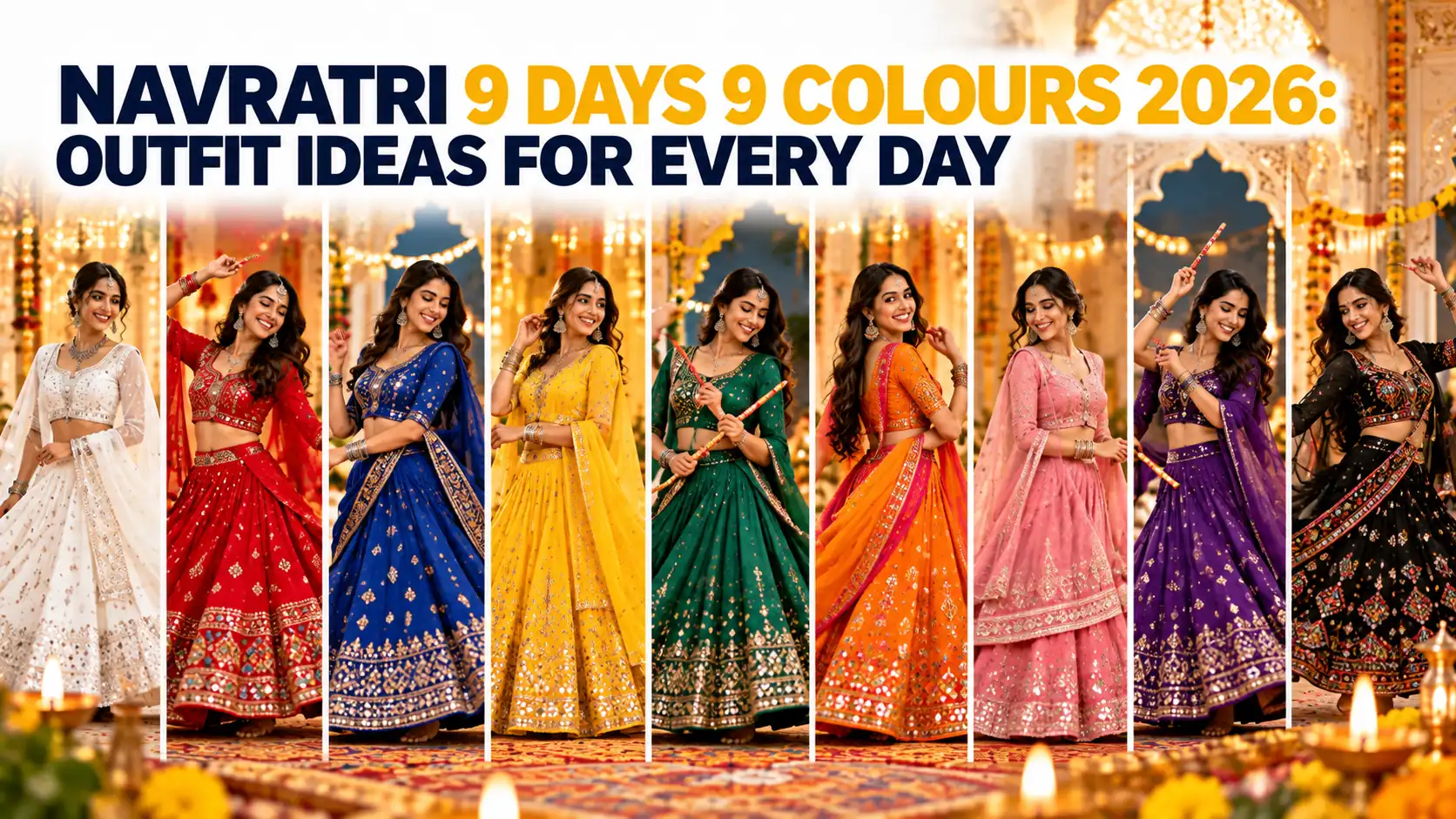
Sharad Navratri 2026 begins on Sunday, October 11 with orange and ends on Monday, October 19 with peacock green, before Vijayadashami on October 20, according to the Free Press Journal’s nine-colour list. Each of the nine nights honours a different form of Goddess Durga, and each is paired with a colour that devotees wear to mark the day. For many families, the colour is the most visible part of the festival.
This guide gives the nine Navratri colours for 2026 with dates and goddesses, explains what each means, and offers outfit ideas for women, men, and office wear. It also covers a practical question competitors tend to skip: how to cover nine days without buying nine new outfits.
Navratri 2026 Colours: Day-Wise List
The table below follows the list published by the Free Press Journal for Shardiya Navratri 2026. Different regions and publishers sometimes assign colours differently, because the sequence can follow the weekday on which Navratri begins, so confirm with your family if you follow a specific tradition.
| Day | Date | Colour | Goddess | Meaning |
|---|---|---|---|---|
| 1 | Sun, Oct 11 | Orange | Shailputri | Warmth, enthusiasm, positive energy |
| 2 | Mon, Oct 12 | White | Brahmacharini | Purity, simplicity, peace |
| 3 | Tue, Oct 13 | Red | Chandraghanta | Love, passion, strength |
| 4 | Wed, Oct 14 | Royal Blue | Kushmanda | Elegance, tranquillity, abundance |
| 5 | Thu, Oct 15 | Yellow | Skandamata | Optimism, happiness, cheer |
| 6 | Fri, Oct 16 | Green | Katyayani | Nature, growth, renewal |
| 7 | Sat, Oct 17 | Grey | Kalaratri | Balance, composure |
| 8 | Sun, Oct 18 | Purple | Mahagauri | Grandeur, nobility, richness |
| 9 | Mon, Oct 19 | Peacock Green | Siddhidatri | Freshness, individuality, compassion |
Dussehra, or Vijayadashami, follows on Tuesday, October 20, 2026, when the festival concludes. For ritual details of the first day, see our step-by-step Kalash Sthapana guide.
Outfit Ideas for Each Day
Days 1 to 3: Orange, White, Red
Start with a cotton or silk orange saree, an orange kurta set, or a lehenga in marigold shades for the Ghatasthapana puja. Day 2 is the easiest day to wear white chikankari kurtas, cotton sarees, or crisp white shirts. On day 3, red works for bridal-style lehengas, bandhani dupattas, or a red kurta with golden accents.
Days 4 to 6: Royal Blue, Yellow, Green
Royal blue pairs well with silver jewellery and works in satin or georgette. Yellow is bright and cheerful, ideal for a day-time puja with mustard sarees or yellow kurtis. Green is flexible: bottle green sarees, mint kurtas, and olive Nehru jackets all work.
Days 7 to 9: Grey, Purple, Peacock Green
Grey is subtle, so add colour through jewellery and a printed dupatta. Purple suits silks, velvet blouses, and layered dupattas. Peacock green is rich and statement-making, a natural choice for the final night, when many people attend garba and dandiya. For garba-specific styling, see our guide to garba outfit ideas.
Outfit Ideas for Men and for Office
Most colour guides focus on women’s wear, but men can follow the same palette. A kurta in the day’s colour with a neutral Nehru jacket works for evenings, and a plain shirt with a coloured stole, pocket square, or tie works at the office. For white day, a crisp white kurta or shirt is already standard. On days when the colour is hard to wear, such as grey or royal blue, a subtle accessory still marks the day. Our men’s style guide for 2026 has more on cuts and fabrics.
Women who work in an office can use the colour as an accent instead of a full outfit: a dupatta, scarf, bangles, or a bag. A neutral kurta set with a coloured dupatta is the most efficient, and the dupatta can carry through several days.
How to Cover Nine Days Without Nine New Outfits
Most colour guides list colours and outfit photos. The question readers actually face is cost and storage. A capsule approach solves it: choose a set of 5 to 6 core pieces and vary the accessories. Our guide to a capsule wardrobe explains the principle in more detail.
| Core Piece | Days It Covers | How to Restyle |
|---|---|---|
| White chikankari kurta set | Day 2, and base for days 1, 4, 6 | Change dupatta colour |
| Plain red or maroon saree | Day 3, and day 8 with a purple blouse | Swap blouse |
| Yellow cotton kurti | Day 5 | Wear with a green dupatta on day 6 |
| Neutral grey or black kurta | Day 7 | Add a purple stole on day 8 |
| Peacock green or teal lehenga | Day 9, and garba nights | Wear with different jewellery |
| Colourful dupattas (4 to 5) | All days | Rotate to match the day |
Borrowing, renting, and thrifting also help. Many cities have festive rental stores, and families often share dupattas and sarees across generations. The point of the colour is to mark the day, not to impress.
Matching Beauty, Nails, and Accessories
A quick colour-matched accessory lifts any basic outfit. Metallic oxidised jewellery works with nearly every shade, gold suits orange, red, and yellow, and silver is best with white, blue, and grey. For nails and makeup, see our guides to nail trends and 10-minute makeup routines. Comfort should win over decoration on heavy dance nights: flats or low heels, breathable fabric, and a bag that holds water and a small snack.