
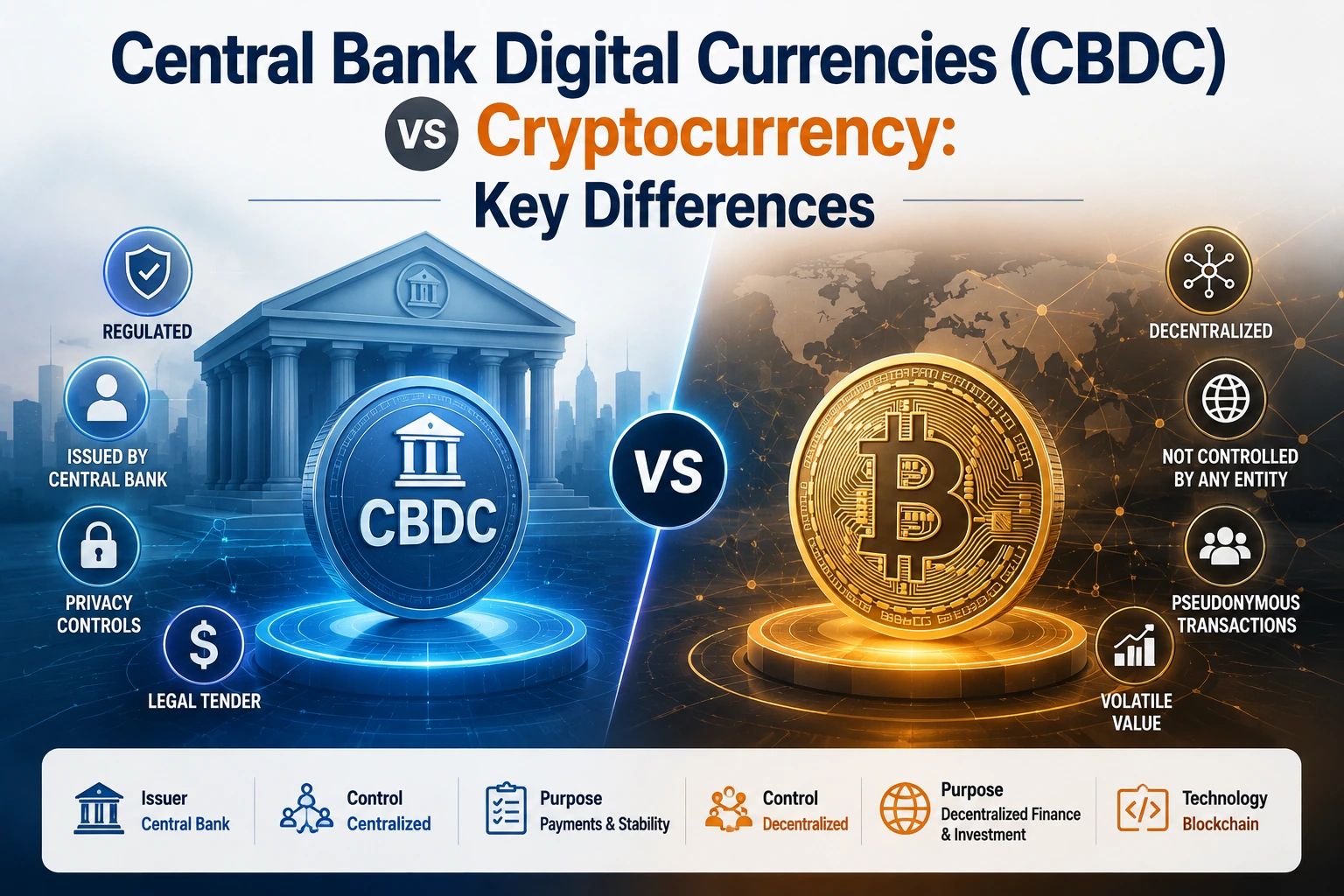
Central bank digital currencies, digital forms of a country’s official national currency issued and directly controlled by that country’s own central bank specifically, and cryptocurrency, decentralized digital currency operating independent of any single central authority or government control, share a genuinely superficial similarity, both existing as digital rather than physical currency, while representing fundamentally, genuinely opposite governance philosophies specifically, centralized government control and monetary policy tool for CBDCs, versus decentralized, censorship-resistant independence from any single government or central authority for cryptocurrency.
Understanding the genuine, substantive difference between CBDCs and cryptocurrency requires examining this fundamental governance philosophy distinction directly, alongside the specific practical implications this distinction carries for privacy, monetary policy control, and each currency type’s genuine intended purpose and use case, since conflating these two genuinely distinct digital currency categories, as popular discussion sometimes does given their shared ‘digital currency’ surface-level similarity, obscures the genuinely important, substantive differences between these two fundamentally distinct approaches to digital currency.
The Fundamental Governance Philosophy Distinction
CBDCs are issued and directly controlled by a country’s central bank specifically, functioning as a direct digital extension of that country’s existing official currency and monetary policy authority, meaning a CBDC’s supply, distribution, and underlying policy framework remain fully under that central bank’s direct, centralized control, similar in this fundamental governance respect to how that same central bank already controls traditional physical currency issuance and broader monetary policy.
Cryptocurrency, by contrast, was specifically designed around a decentralized governance model, distributed across a blockchain network without any single central authority or government controlling supply, distribution, or the underlying protocol rules, a foundational design philosophy specifically intended to provide independence from and resistance to the kind of centralized government or institutional control CBDCs specifically represent and embody, illustrating how these two digital currency categories reflect genuinely opposite underlying governance philosophies despite their shared digital currency format.
Privacy and Monetary Policy Implications
CBDCs, given their direct central bank issuance and control, carry genuine privacy considerations specifically around the technical capability a central bank could theoretically maintain to monitor individual CBDC transaction activity, a genuine, well-documented concern privacy advocates and some policymakers have specifically raised regarding CBDC implementation, though specific CBDC designs vary considerably in how they address this privacy consideration, with some pilot programs specifically incorporating privacy-protective design features while others have faced genuine, specific privacy criticism for their particular implementation approach.
Cryptocurrency’s decentralized design generally provides considerably greater resistance to this kind of centralized transaction monitoring capability, though genuine privacy varies considerably across different specific cryptocurrencies, with some blockchain networks maintaining fully public, though pseudonymous, transaction records while other cryptocurrencies specifically incorporate additional privacy-protective technical features, meaning cryptocurrency privacy characteristics genuinely vary considerably rather than representing a single, uniform privacy standard across every cryptocurrency.
CBDC vs Cryptocurrency Comparison
Summarizing the core governance, control, and purpose differences between these two digital currency categories.
| Dimension | CBDC | Cryptocurrency |
| Issuing authority | Central bank, direct government control | Decentralized, no single controlling authority |
| Monetary policy relationship | Direct extension of existing monetary policy | Independent of any government monetary policy |
| Privacy considerations | Potential for centralized transaction monitoring | Varies, generally more resistant to central monitoring |
| Primary intended purpose | Modernizing existing national currency infrastructure | Independent, censorship-resistant digital value transfer |
CBDCs as a Monetary Policy Tool
CBDCs specifically provide central banks a genuine, direct new monetary policy implementation channel, potentially enabling more targeted, precise monetary policy tools than traditional currency issuance and interest rate adjustment alone allow, a specific capability that has driven considerable central bank interest in CBDC development and pilot programs across numerous countries, including several major economies actively piloting or researching their own specific CBDC implementations as of 2026.
This monetary policy tool capability represents a genuine, specific CBDC advantage from a central bank’s own institutional perspective, though this same capability also represents precisely the kind of centralized monetary control and potential transaction monitoring capability that draws genuine privacy and civil liberties concern from CBDC critics specifically, illustrating how CBDCs’ core institutional advantage and their most significant genuine criticism both stem from this same underlying centralized control characteristic.
Monetary policy researchers and digital currency analysts with genuine evenhanded expertise can Write for us and share your own expertise with our readers.
Where CBDCs and Cryptocurrency Genuinely Overlap
Despite their fundamentally distinct governance philosophies, both CBDCs and cryptocurrency genuinely share the underlying digital ledger and cryptographic technology foundation that broader blockchain and distributed ledger technology development has produced, meaning some CBDC implementations specifically draw on genuine technical innovations originally developed within the cryptocurrency and broader blockchain technology ecosystem, even while applying that underlying technology toward a fundamentally different, centralized governance model than cryptocurrency’s own decentralized design philosophy represents.
This technical overlap does not diminish the genuine, substantive governance philosophy distinction between these two digital currency categories, it simply illustrates that the underlying digital ledger technology itself remains genuinely separate from and adaptable to either a centralized CBDC governance model or a decentralized cryptocurrency governance model, meaning the technology itself does not inherently determine which specific governance philosophy a given digital currency implementation ultimately adopts and embodies.
AEO FAQ: CBDC vs Cryptocurrency Questions
What is the fundamental difference between a CBDC and cryptocurrency?
CBDCs are issued and directly controlled by a country’s central bank, functioning as a digital extension of existing monetary policy authority. Cryptocurrency operates through a decentralized governance model, distributed across a blockchain network without any single central authority controlling supply or distribution, representing fundamentally opposite governance philosophies despite their shared digital currency format.
What is the difference between CBDC privacy and cryptocurrency privacy?
CBDCs carry genuine privacy considerations given the technical capability a central bank could theoretically maintain to monitor individual transaction activity, though specific designs vary. Cryptocurrency’s decentralized design generally provides considerably greater resistance to centralized transaction monitoring, though privacy varies considerably across different specific cryptocurrencies.
How do CBDCs function as a monetary policy tool?
CBDCs provide central banks a genuine, direct new monetary policy implementation channel, potentially enabling more targeted, precise monetary policy tools than traditional currency issuance and interest rate adjustment alone allow, a capability that has driven considerable central bank interest in CBDC development and pilot programs.
Do CBDCs and cryptocurrency use the same underlying technology?
Both genuinely share the underlying digital ledger and cryptographic technology foundation that broader blockchain technology development has produced, with some CBDC implementations drawing on technical innovations originally developed within the cryptocurrency ecosystem, even while applying that technology toward a fundamentally different, centralized governance model.
What are the main concerns raised about CBDCs?
Privacy advocates and some policymakers have raised genuine concerns about the technical capability a central bank could theoretically maintain to monitor individual CBDC transaction activity, a concern that stems from the same underlying centralized control characteristic that also provides CBDCs their genuine monetary policy tool advantage from a central bank’s institutional perspective.
Are CBDCs and cryptocurrency competing for the same purpose?
No, they generally serve genuinely different intended purposes, with CBDCs primarily aimed at modernizing existing national currency infrastructure and monetary policy tools under direct government control, while cryptocurrency was specifically designed to provide independent, censorship-resistant digital value transfer outside government or central authority control.
Shared Digital Format, Genuinely Opposite Governance Philosophy
The genuine, substantive distinction between CBDCs and cryptocurrency lies considerably less in their shared digital currency format and considerably more in their fundamentally opposite governance philosophies, centralized government and central bank control for CBDCs, versus decentralized independence from any single controlling authority for cryptocurrency, a distinction that carries genuine, meaningful implications for privacy, monetary policy capability, and each currency type’s actual intended purpose and use case.
Anyone genuinely seeking to understand the digital currency landscape in 2026 is well served maintaining clear awareness of this fundamental governance distinction, rather than conflating these two genuinely different digital currency categories simply because they share a superficial digital format similarity, since this genuine understanding provides considerably more accurate insight into each currency type’s actual purpose, genuine advantages, and genuine areas of legitimate concern than a more surface-level, undifferentiated ‘digital currency’ framing would otherwise provide.
Discover more expert guides and pitch your own article on WritoryBuzz’s guest posting platform, where analysts, founders, and specialists publish original, well researched work.