
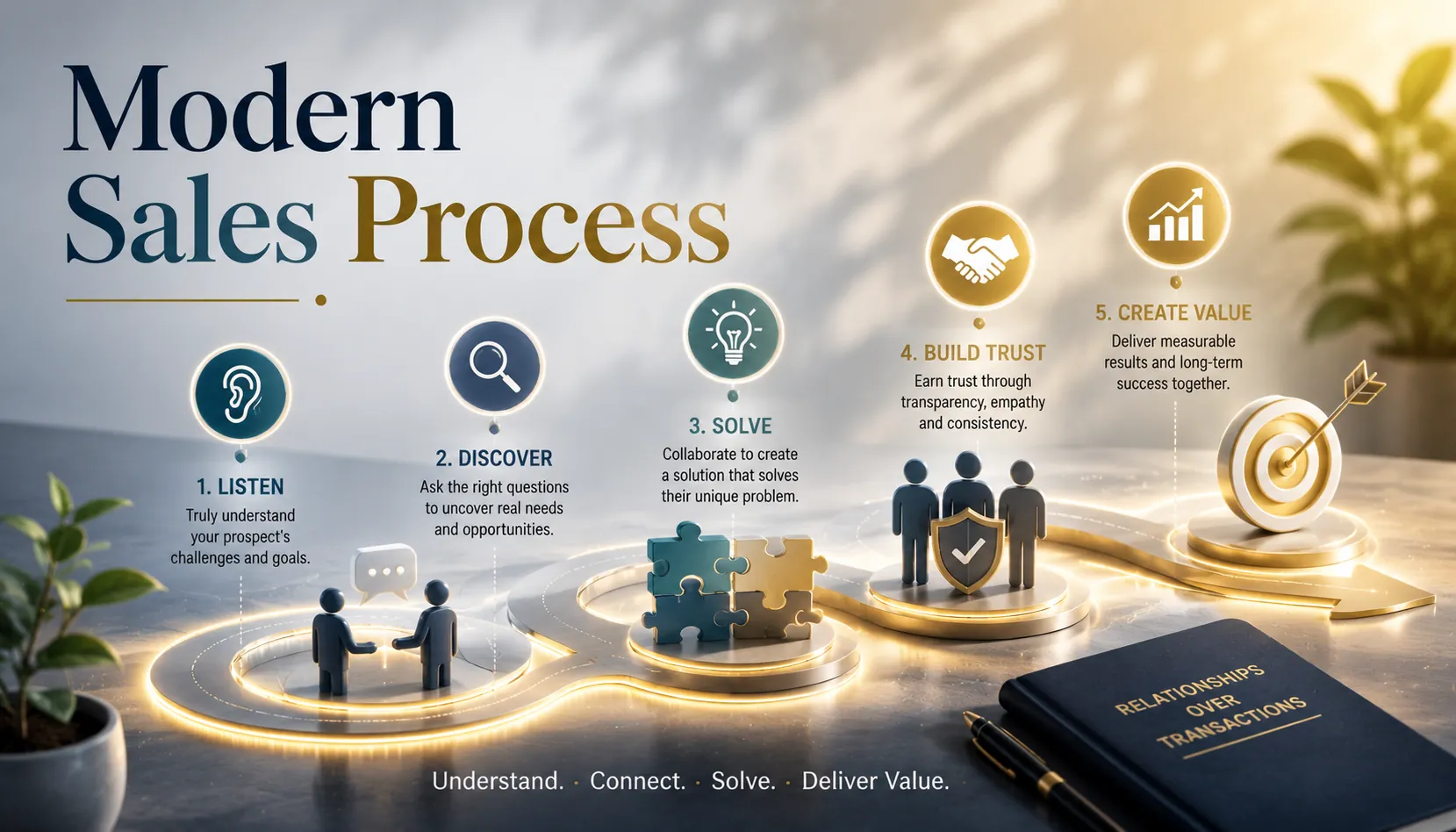
The single biggest shift in B2B sales over the past decade is that buyers no longer need salespeople to access product information. They arrive at a sales conversation already researched, already aware of alternatives, and acutely sensitive to being sold at.
In 2026, 84% of buyers want salespeople to act as advisors. Not closers. Not presenters. Advisors. This does not mean being soft or avoiding the close. It means the close happens as a natural consequence of the conversation rather than as a pressure tactic at the end.
Here is the framework that consistently produces this outcome.
The Foundation: Stop Pitching, Start Diagnosing
Traditional sales: lead with product, explain features and benefits, handle objections, push for close.
Consultative sales: lead with questions, understand the specific problem, demonstrate how your solution addresses that specific problem, close when the fit is clear.
The difference is not style. It is what drives the conversation. In consultative selling, the buyer discovers the value of your solution through the conversation rather than being told it. Research on 35,000 sales calls analyzed by Huthwaite International found that salespeople trained in consultative approaches increase sales volume by 20% on enterprise deals.
SPIN Selling: The Framework Behind the Questions
Developed by Neil Rackham from analysis of over 35,000 sales calls across 23 countries, SPIN selling organizes the discovery process into four question types that move the prospect through awareness toward decision:
| Question Type | Purpose | Example | Why It Works |
| Situation | Gather context about current state | ‘How is your current process structured?’ | Understand before diagnosing |
| Problem | Uncover pain points | ‘Where does that create difficulty?’ | Get to the actual problem |
| Implication | Explore consequences | ‘What does that cost you when it happens?’ | Magnify the pain’s significance |
| Need-Payoff | Highlight value of solving it | ‘If that were resolved, what would change?’ | Let them describe the value to you |
The genius of SPIN is that the Need-Payoff questions make the buyer articulate the value of your solution in their own words. You are not telling them what it is worth. They are telling you. This eliminates the objection that price is too high because the buyer has already described the value themselves.
The Discovery Call Structure
Most deals are won or lost in the discovery call, not the closing call. Here is the structure that produces the most useful outcome:
- Open with agenda and time check: ‘I have 45 minutes. I want to understand your situation well enough to know if we can genuinely help. If it turns out we are not the right fit, I will tell you that directly.’
- Ask Situation questions to build context: understand their current process, team, technology stack, and timelines
- Probe Problem questions until you understand the actual pain, not the surface-level description
- Implication questions: help them connect the problem to its business cost (time, revenue, risk, resource waste)
- Need-Payoff questions: what would their world look like if this was solved? Let them describe it.
- Only then present: connect your solution directly to what they just described. Not a product demo. A tailored response.
- Close with a clear next step, not pressure: ‘Does what I’ve described address what you told me earlier? What would make sense as a next step from here?’
Handling Objections Without Pressure
Most objections are not rejection. They are requests for more information or expressions of uncertainty. The response to an objection should be a question, not a counter-argument.
‘The price is too high.’ Correct response: ‘That’s helpful to know. Can you help me understand what you are comparing it to, or what budget you had in mind?’ This opens a dialogue. A counter-argument (‘But here is why the price is justified’) confirms their sense that they are being sold at.
The Close That Feels Natural
If the discovery was done well and the presentation was genuinely tailored, the close is a question, not a push:
‘Based on everything we have discussed, does this address what you described at the beginning of the call? What would you need to feel confident moving forward?’
This question surfaces remaining concerns and makes the next step a joint decision rather than a salesperson pushing past resistance.
Common Mistakes
- Asking Situation questions before building any rapport; people share problems with people they trust
- Skipping Implication questions and jumping to the demo; without magnifying the pain, the solution lacks urgency
- Using the summary close (‘So in summary, you said X, Y, Z, shall we proceed?’) when concerns have not actually been addressed
- Confusing ‘persistent follow-up’ with pressure; following up twice is professional, five times in three days is not
FAQ
What is consultative selling?
A sales approach that prioritizes understanding the buyer’s specific problems before presenting any solution. The salesperson acts as a trusted advisor, diagnosing the problem and demonstrating relevance rather than pitching a product. Closings happen when genuine fit is established, not pushed.
What is SPIN selling and does it still work?
SPIN is a question-based framework (Situation, Problem, Implication, Need-Payoff) developed from analysis of 35,000 sales calls. It structures discovery to uncover problems and their consequences before presenting solutions. Research shows a 20% sales volume increase in enterprise deals. It remains one of the most effective structured approaches in complex B2B sales.
How do I close without pressure tactics?
Close with a question that checks genuine fit rather than one that pushes a decision. ‘Based on what you told me, does this address your situation? What would you need to feel confident moving forward?’ surfaces remaining concerns and makes the decision feel collaborative rather than coerced.
The most successful sales professionals focus on understanding problems before presenting solutions. WritoryBuzz creates practical business content that helps teams improve communication, build trust, and drive sustainable growth.