
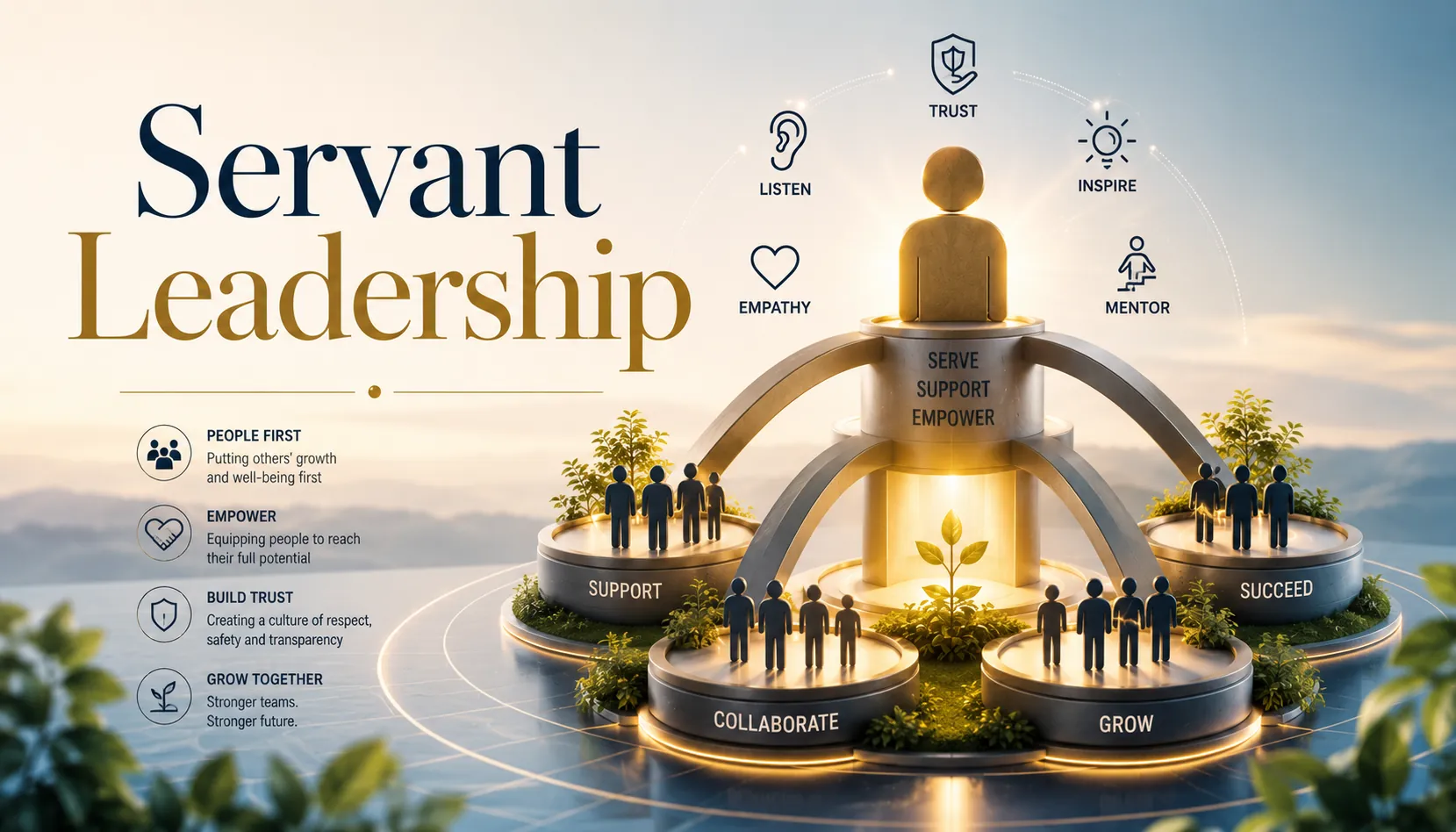
Robert Greenleaf introduced the concept of servant leadership in 1970 with a simple provocation: what if the leader’s primary job was to serve their team rather than direct it?
The idea was counterintuitive then and still requires some unpacking now. Servant leadership is not weakness or abdication. It is a deliberate choice to prioritize the growth, wellbeing, and effectiveness of the people you lead as the path to producing organizational results. Not despite results, but because of them.
The research supporting this model has accumulated substantially. Multiple studies show servant leadership positively affects work engagement, performance, retention, and organizational outcomes. In healthcare settings, it has been shown to reduce ‘quiet quitting’ and increase discretionary effort. In project-based organizations, it mediates work engagement through employee resilience and organizational support.
What Servant Leadership Actually Means
The traditional leadership model: the leader sets direction, the organization executes, and the leader’s role is to ensure execution. Authority flows from the position.
The servant leadership model inverts this: the leader asks ‘What does my team need to do their best work?’ and systematically removes obstacles. Authority flows from trust and demonstrated care, not position.
This does not mean the leader has no authority or avoids difficult decisions. It means the primary orientation is toward enabling others rather than directing them.
The Core Characteristics
| Characteristic | What It Looks Like in Practice |
| Active listening | Servant leaders listen to understand, not to respond. They create space for people to speak and genuinely process what they hear. |
| Empathy | Understanding what team members experience and are dealing with, not just their professional outputs. |
| Awareness | Understanding the broader context of decisions: how they affect people, teams, and the organization beyond the immediate task. |
| Persuasion over authority | Building consensus and trust rather than relying on positional power to enforce compliance. |
| Commitment to growth | Investing in the development of each person as a priority, not an afterthought. |
| Building community | Creating a sense of belonging and psychological safety within the team. |
Why It Produces Results in 2026
The business case for servant leadership has strengthened as the nature of work has changed. In 2026, knowledge work dominates. Compliance-based management produces minimum acceptable performance. Genuine engagement and discretionary effort require something more than instruction.
Research consistently shows that servant leadership positively affects work engagement through two mechanisms: it builds employee resilience (people feel supported enough to handle difficulty) and organizational support (people experience their environment as genuinely backing them). Both are measurable predictors of performance.
In remote and hybrid environments, the absence of physical proximity has made the trust and psychological safety that servant leadership produces more critical, not less. You cannot surveil your way to engagement when people work from home.
How It Differs From Other Leadership Styles
| Style | Approach | Outcome |
| Traditional / Transactional | Direct, control, reward compliance, penalize non-compliance | Gets minimum contracted performance; struggles with discretionary effort |
| Transformational | Inspire shared vision, motivate through meaning, model values | Strong on culture and motivation; can drift toward charisma over genuine service |
| Servant | Prioritize team’s needs, remove obstacles, invest in growth, build trust | Consistently highest engagement and retention metrics in research; requires patience and trust in the model |
Practicing It Day to Day
Servant leadership is not a once-monthly behavior. It shows up in specific daily choices:
- In 1:1 meetings, asking ‘What can I do to make your work easier or better?’ and acting on the answer
- When a team member makes a mistake, asking ‘What happened and what can we improve?’ rather than ‘Who is responsible?’
- Sharing recognition publicly and taking responsibility privately
- Removing bureaucratic obstacles that prevent the team from doing good work
- Investing in professional development budgets and actually encouraging people to use them
The Misconception: Servant Leadership Is Not Selfless Passivity
The most common misunderstanding is that servant leadership means never making difficult decisions, always deferring to the team, or prioritizing harmony over necessary action.
Servant leaders still hold people to high standards. They still make unpopular decisions when necessary. They give difficult feedback directly. The difference is that these actions are taken in service of the person’s growth and the team’s genuine wellbeing, not as expressions of authority for its own sake.
A servant leader who never challenges poor performance is not serving their team. They are avoiding discomfort at the team’s expense.
FAQ
What is servant leadership?
A leadership model, developed by Robert Greenleaf in 1970, where the leader’s primary orientation is toward serving the needs of their team: listening, removing obstacles, investing in development, and building trust. Results are achieved through the team’s genuine engagement and discretionary effort rather than compliance and control.
How is servant leadership different from traditional leadership?
Traditional leadership asks ‘How do I direct my team to achieve outcomes?’ Servant leadership asks ‘What does my team need to do their best work?’ The first flows authority from position; the second flows authority from trust. Research consistently shows servant leadership produces higher engagement, retention, and performance in knowledge work environments.
Does servant leadership produce better business outcomes?
Yes. Multiple peer-reviewed studies link servant leadership to higher work engagement, lower turnover, stronger organizational support, and better team performance. In healthcare research from 2025, servant leadership was specifically shown to reduce quiet quitting and increase discretionary effort, a finding with broad relevance across industries.
Leadership is not measured by authority alone but by the growth and success of the people you influence. WritoryBuzz creates practical business and leadership content that helps professionals build stronger teams, cultures, and careers.