
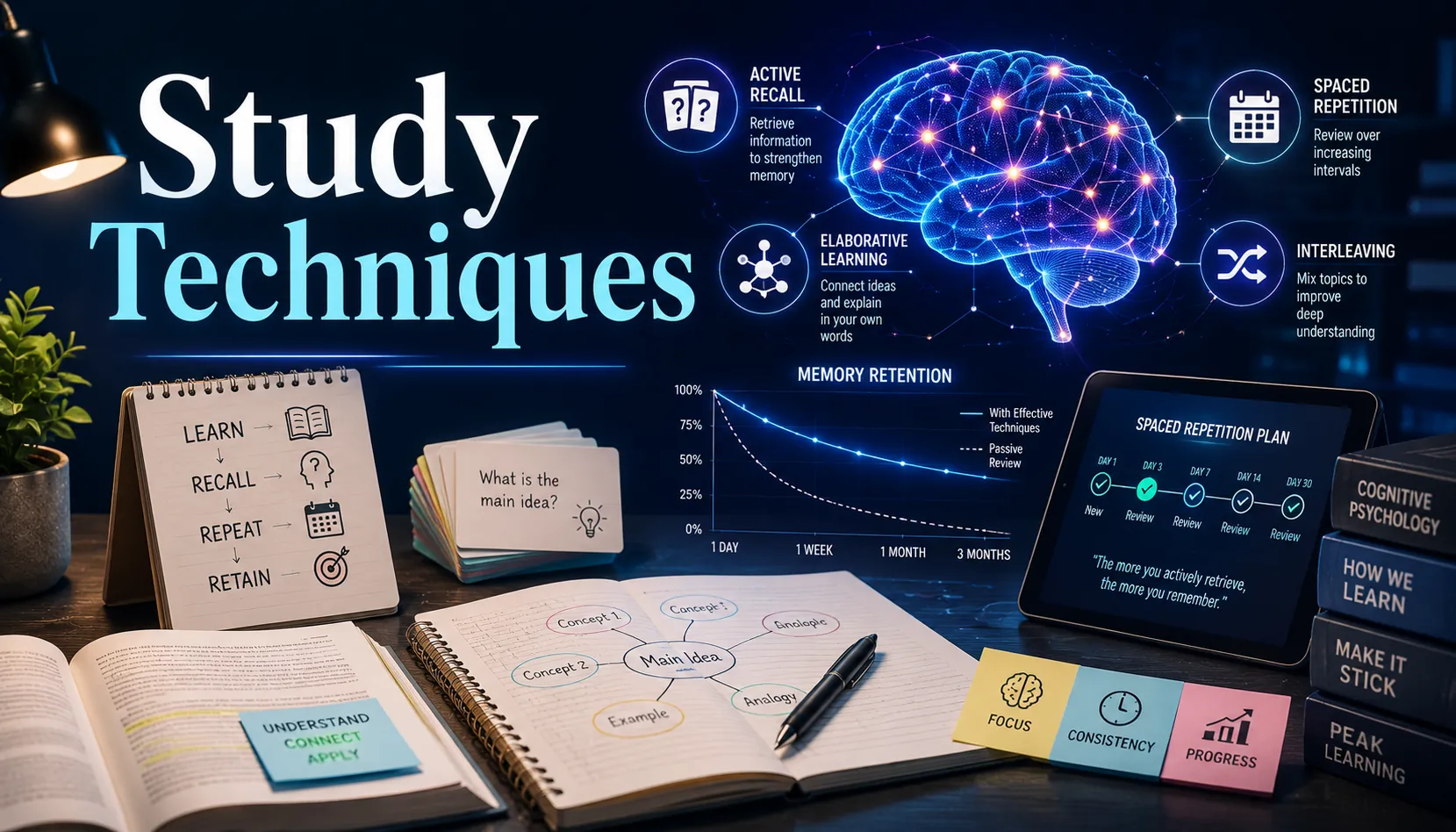
The most popular study methods are also some of the least effective. Students re-read notes and highlight text because these approaches feel productive. They create a sense of familiarity with the material that gets confused with actually knowing it.
Cognitive science has known this for decades. The techniques that produce durable learning are less comfortable because they require more mental effort. That effort is exactly what makes them work.
Here are the six methods with the strongest evidence behind them, how to use each one, and the tools that make implementation practical.
1. Spaced Repetition (The Most Important Method)
Spaced repetition means reviewing material at increasing intervals: day 1, day 3, day 7, day 14, day 30. Each review happens just before the memory would fade, which forces the brain to retrieve it and strengthens the memory trace in the process.
Studies show spaced repetition produces 200 to 300% better retention than cramming. Medical students using spaced repetition score 10 to 15% higher on exams. Research from BMC Medical Education found that combining spaced repetition with active recall improved exam performance by 15 to 20% compared to traditional study schedules.
The practical tool: Anki, which uses an algorithm (SM-2) to schedule cards based on your rated difficulty. Cards you find easy are pushed further out; cards you struggle with come back sooner. 15 to 20 minutes of Anki daily beats four hours of cramming the night before.
2. Active Recall (Retrieval Practice)
Instead of reading your notes, close them and write down everything you remember. Then check. The act of trying to retrieve information from memory, even imperfectly, strengthens the memory far more than passive review.
Re-reading creates an illusion of competence: the material looks familiar, so it feels known. Active recall reveals the gaps. The discomfort of not knowing when you try to recall is exactly what drives learning.
Use it with: practice questions, self-quizzing, writing summaries from memory, teaching what you know to someone else.
3. The Feynman Technique
If you cannot explain a concept in simple language, you do not fully understand it. The Feynman Technique: take a concept, close all references, and explain it as if teaching a child. Where your explanation becomes vague or falls back on jargon, that is your knowledge gap.
Go back, study specifically that gap, and try the explanation again. This cycle of explaining, identifying gaps, and studying the gaps produces understanding rather than familiarity.
4. Interleaving
Most students use blocked practice: study all of chapter 3, then all of chapter 4, then all of chapter 5. This feels efficient but often leads to an illusion of competence within each block.
Interleaving means mixing topics within a study session. Study 20 minutes of calculus, 20 minutes of chemistry, 20 minutes of history, then cycle back. Research by Rohrer and Taylor found that interleaving improves the brain’s ability to distinguish between different types of problems because it is what actually happens in an exam.
In 2026: shuffle your flashcard decks across subjects. Mix problem types in practice sessions. The additional difficulty is the mechanism.
5. The Practice Testing Effect
Taking practice tests is more effective than any other study method for improving exam performance, even when the practice test questions are different from the actual exam questions. The retrieval effort of a test, even with immediate feedback and corrections, produces stronger memory than a study session covering the same material.
This is why past papers are the most valuable study resource in almost any subject. Not for predicting questions, but for the retrieval practice they force.
6. Elaborative Interrogation
Instead of reading a fact, ask ‘why is this true?’ and generate your own explanation. This forces the brain to connect new information to existing knowledge, creating a richer and more durable memory network.
Simple version: as you read, pause regularly and ask ‘why does this work this way?’ and ‘how does this connect to what I already know?’ Writing the answer, even briefly, amplifies the effect.
What the Evidence Says Does Not Work
| Ineffective Method | Why It Fails |
| Re-reading notes | Creates familiarity, not knowledge. You recognize the content when you see it but cannot reproduce it. |
| Highlighting | Passive engagement. No retrieval practice. Feels productive, does not build memory. |
| Cramming the night before | Works for 24 hours, then disappears. Spaced review over days or weeks builds lasting memory. |
| Listening to lectures passively | Without note-taking and subsequent active recall, retention from passive listening is very low. |
FAQ
What is the most effective study technique according to science?
The combination of spaced repetition and active recall consistently outperforms every other study method in research. Together, they produce 200 to 300% better retention than cramming and improve exam performance by 15 to 20% over traditional study approaches.
How does spaced repetition work?
It schedules reviews at increasing intervals, targeting the moment just before you would forget the material. Each successful retrieval extends the interval and strengthens the memory. Apps like Anki automate this scheduling based on how easily you recalled each item.
Why is re-reading notes ineffective for studying?
Re-reading creates recognition, not recall. When you see familiar material, your brain signals familiarity, which feels like knowing. In an exam, that material will not be in front of you. Active recall, retrieving without cues, builds the kind of memory that actually shows up when you need it.
Success in learning is not about studying longer—it is about studying smarter. WritoryBuzz creates educational content that simplifies complex topics, engages readers, and builds lasting authority.