Eric Ries published The Lean Startup in 2011. Fifteen years later, the framework’s core vocabulary MVP, validated learning, pivot, build-measure-learn is so embedded in startup culture that it is easy to forget it was once a genuinely novel way of thinking about building companies.
That familiarity raises a fair question. When everyone uses the same framework, does it still give you an edge? And does a methodology built in a pre-AI, pre-generative-tool world still apply cleanly to the products being built now?
The short answer is yes, with important qualifications.
What the Lean Startup Method Actually Is
The core insight of the Lean Startup is that most startup failures come not from execution problems but from building something nobody wants. The method’s response is to replace the traditional plan-then-build approach with a continuous cycle of small experiments designed to test assumptions as cheaply and quickly as possible.
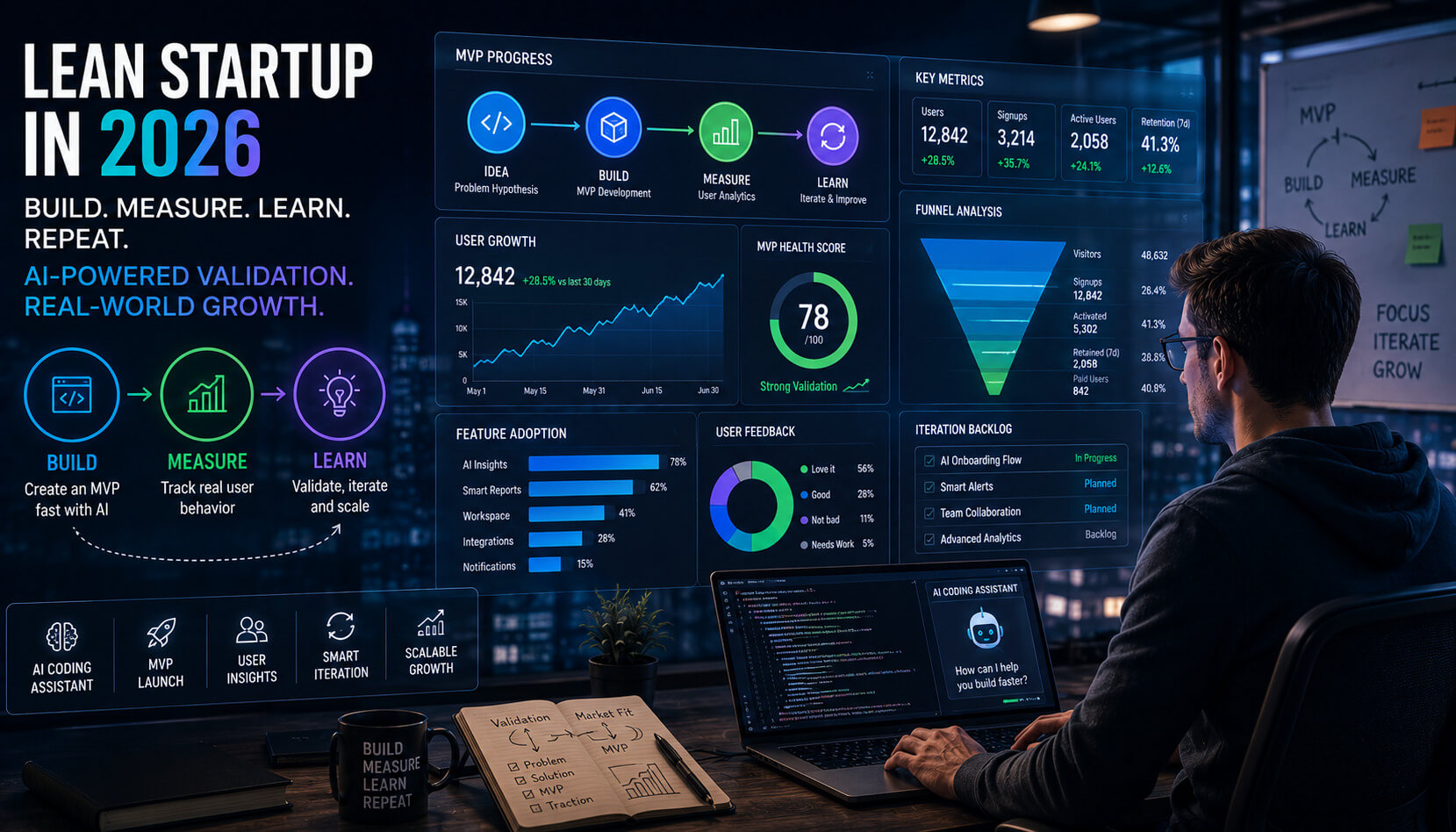
The three-part loop: Build a Minimum Viable Product (MVP) that tests one core assumption. Measure how real users interact with it. Learn whether the assumption was correct, and decide whether to persevere or pivot.
The MVP is the most misunderstood concept in the framework. It is not a half-finished product. It is the smallest thing you can build to test the riskiest assumption in your business model. Sometimes that is a landing page. Sometimes it is a manual process disguised as software. Sometimes it is a working prototype. The form depends on what you need to learn.
What Has Changed Since 2011
The environment is noisier: More founders know the lean vocabulary. More investors expect evidence of validated learning. The bar for what constitutes meaningful customer validation has risen because the framework is so widely known.
The cost of building has dropped dramatically: AI coding tools, no-code platforms, and pre-built infrastructure have reduced the time to build an MVP from weeks or months to days. The ‘minimum’ in MVP has shifted, because the cost of building more is lower.
Customer attention is harder to capture: A landing page MVP in 2011 could generate meaningful signal with modest paid traffic. The same approach in 2026 requires either a genuine community or significant distribution to generate statistically meaningful data. The testing infrastructure has become harder to bootstrap.
Regulation moves faster in some categories: Healthcare, fintech, and AI products face regulatory environments that did not exist in 2011. Regulatory requirements can constrain the speed of the build-measure-learn loop in ways that require earlier upfront planning than pure lean methodology advocates.
The Build-Measure-Learn Loop in 2026
Build
AI tools have genuinely compressed MVP build time. A working software prototype that would have taken a developer four weeks in 2020 can now take four days with AI-assisted development. This acceleration is largely positive for lean methodology shorter loops mean faster learning.
The risk is that cheap building reduces the discipline of asking ‘what exactly are we trying to learn?’ before building. If building is nearly free, the temptation is to build more rather than learn more. The lean discipline of starting with the riskiest assumption remains essential even when the cost of building has fallen.
Measure
The metrics layer of the framework has become more sophisticated. Validated learning requires choosing metrics that reflect real behaviour, not vanity metrics. Page views, download counts, and sign-ups are easy to generate and easy to misread. The metrics that matter are those that indicate whether people are getting real value: repeat usage, payment conversion, referral behaviour.
Learn
The decision to persevere or pivot is harder than the framework makes it sound. Most startups pivot gradually rather than in one clear decision. The lean method’s value is making the need for a pivot visible earlier, when the cost of changing direction is still low.
Where Lean Startup Works Best And Where It Doesn’t
Lean methodology works best when the core business risk is product-market fit uncertainty. If you genuinely do not know whether customers want what you are building, the lean loop is the right tool for reducing that uncertainty quickly.
It works less well when the core risk is something other than product-market fit. Capital-intensive industries (hardware, biotech, deep tech) have build cycles that do not compress to days or weeks. Regulated industries (healthcare, financial services) have compliance requirements that slow the loop regardless of methodology. Deep scientific research bets do not generate customer validation signals in the same way consumer products do.
Lean Startup and AI Products
AI-native products introduce a specific complexity the original framework did not account for. The quality of an AI product is often heavily dependent on data quality and quantity, which takes time to accumulate. You can build an MVP of an AI product quickly. Whether it works well enough to generate real user engagement depends on data that a brand-new startup does not have.
The practical adaptation for AI products: validate the problem and the willingness to pay using the leanest possible tools (even manual processes or non-AI software) before investing heavily in the AI layer. Confirm there is a real customer problem with real willingness to pay, then build the AI-powered version. This prevents spending engineering effort on an AI solution to a problem that does not need solving.
Common Mistakes
- Treating the MVP as a launch rather than an experiment. An MVP is a learning tool, not a product announcement.
- Measuring the wrong things. Sign-ups without measuring activation or retention produce misleading signals about whether the product is working.
- Pivoting too early. One bad week of metrics is not a data point. A persistent pattern across sufficient users is.
- Pivoting too late. The framework is designed to make pivots less costly. Staying too long with a clearly failing assumption wastes resources the framework was designed to protect.
FAQ
Is the Lean Startup method still the best approach in 2026?
For consumer and B2B SaaS products where product-market fit is the primary uncertainty, yes. The core principle test your riskiest assumption cheaply before scaling — is as sound as it was in 2011. The tactics for executing it have evolved with the availability of AI build tools and modern analytics.
What is the biggest criticism of the Lean Startup method?
The most substantive criticism is that it applies better to digital products than to hardware, scientific research, or regulated industries. A secondary criticism is that it can produce local optima — iterating to a version of your original idea that works minimally rather than discovering a much better opportunity that a more exploratory approach might have found.
Apply the Principle, Not the Prescription
The Lean Startup’s underlying principle is still correct: delay major commitments until you have real evidence. The specific tactics for gathering that evidence in 2026 look different from 2011. Build faster with AI tools. Test with more precision using modern analytics. Be more deliberate about what you are actually trying to learn before each cycle.
The framework ages well. The tactics that implement it need regular updating.
WritoryBuzz helps startups and SaaS brands publish research-driven, SEO-focused content that builds authority, attracts users, and supports long-term growth in competitive markets.