
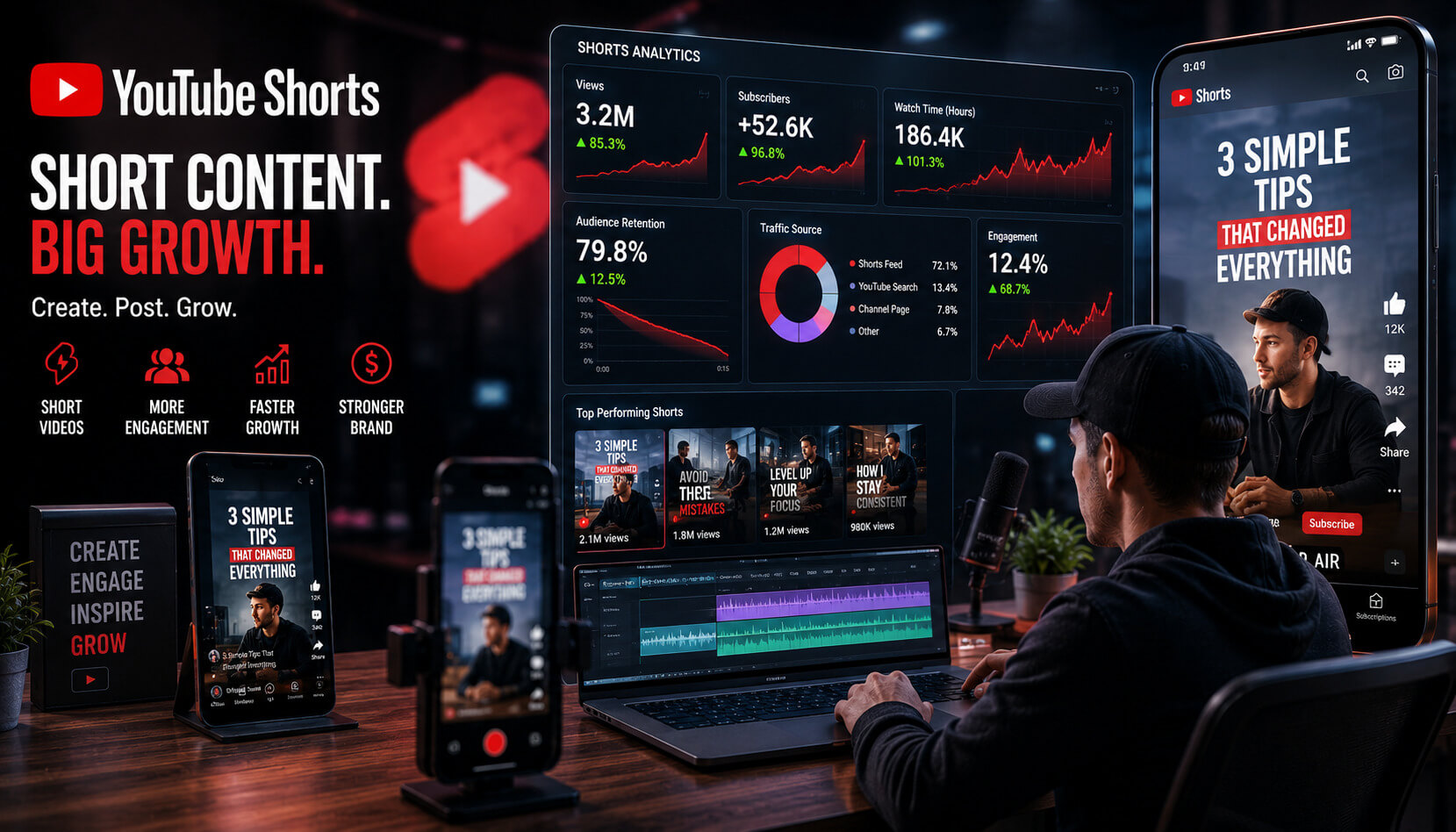
YouTube Shorts crossed 70 billion daily views in 2025. The format has moved from an experimental feature competing with TikTok into a dominant discovery channel in its own right. For brands and businesses, it now represents one of the most accessible paths to organic reach on any major platform.
The reasons are structural. YouTube’s search intent advantage means Shorts appear in results for topics people are actively searching for, not just in feeds they scroll passively. A Short about a product problem can surface to someone actively searching that problem. That does not happen on TikTok.
Why YouTube Shorts Is a Different Opportunity in 2026
The vast majority of brand accounts on YouTube primarily publish long-form content. Shorts are additive for these channels because they surface to audiences who would never find a 20-minute video through discovery. A subscriber gained through a Short often then watches long-form content, improving the channel’s overall watch time metrics.
The competitive landscape for Shorts is also less saturated than TikTok or Instagram Reels in most business and B2B niches. A brand in software, professional services, or a specialist trade can dominate Shorts in their topic area with relatively modest effort simply because most competitors are not trying.
How the YouTube Shorts Algorithm Works in 2026
YouTube’s Shorts algorithm prioritises two primary metrics: completion rate and swipe-away rate. Completion rate is the percentage of viewers who watch your Short all the way through. Swipe-away rate tracks how quickly viewers dismiss the Short when it appears. A Short with high completion and low swipe-away gets pushed to more feeds.
Secondary signals include like rate, comment rate, and share rate. These matter, but they are downstream of completion. If people are not watching to the end, likes and comments are rare anyway.
Crucially, Shorts do not require subscribers to reach new audiences. YouTube distributes Shorts based on content quality signals to non-subscribers. Your account size matters much less for Shorts discovery than it does for long-form video performance.
The 5-Part Formula for Shorts That Get Pushed
- Hook in the first 2 seconds: The first frame of a Short must create immediate curiosity, surprise, or relevance. ‘Here’s why X doesn’t work’ or ‘Most people get this wrong’ or showing the end result before explaining how you got there. The algorithm measures swipe-aways, and most swipe-aways happen in the first two seconds.
- Single clear point: Every Short should communicate exactly one idea. The temptation is to pack in multiple points. This fragments viewer attention and reduces completion rates. One point, communicated clearly, in under 60 seconds.
- Maintain visual pace: Shots that hold on a static talking head for more than 5 to 6 seconds see declining completion. Cut between angles, add text overlays, B-roll, or screen recordings. Motion and visual variety keep viewers watching.
- Captions always on: Over 60 percent of Shorts are watched without sound, based on platform data. Auto-captions are now good enough on YouTube to use without manual editing for most clear speech. Always have them on.
- End with something to act on: A question to answer in comments, a prompt to visit your channel, or a natural setup for another Short in a series. Open loops (telling viewers there’s more) drive both comments and return views.
Content Ideas That Work for Brand and Business Channels
- Behind-the-scenes process Shorts — how a product is made, how a service is delivered, a day in the office
- Quick-tip Shorts — one specific useful tip from your area of expertise in 30 to 45 seconds
- Myth-busting Shorts — common misconceptions in your industry, stated and corrected
- Before-and-after Shorts — client results, transformations, or demonstrations
- Question-and-answer Shorts — take the most common customer question and answer it in 30 seconds
- Repurposed long-form clips — the most interesting 45 seconds from a podcast, webinar, or YouTube video
YouTube Shorts vs TikTok vs Instagram Reels
| Platform | Discovery Type | B2B Suitability | Search Integration | Shelf Life of Content |
| YouTube Shorts | Search + feed | High | Full YouTube search | Weeks to months (evergreen possible) |
| TikTok | Feed-only (For You Page) | Low to moderate | Limited | Days to a week |
| Instagram Reels | Feed + Explore | Moderate | Minimal | Days to weeks |
YouTube Shorts’ integration with YouTube’s search engine gives content a longer lifespan than TikTok or Reels. A Short answering a common question can surface in search results months after posting. This evergreen potential makes it particularly valuable for brands in knowledge-intensive industries.
How to Turn Shorts Views Into Business Results
Views alone do not drive revenue. Converting Shorts viewers into business prospects requires a deliberate funnel.
The most effective pattern for B2B and service businesses: Shorts drive channel subscriptions, long-form video converts subscribers into deeper trust and email sign-ups, email converts to sales conversations. The Shorts are top-of-funnel awareness, not direct conversion tools.
For e-commerce and consumer brands, Shorts can link directly to product pages through YouTube Shopping integration. A Short demonstrating a product with a visible product card below it creates a direct path to purchase that is increasingly common in 2026 YouTube usage patterns.
Expert Tips
- Post 3 to 5 Shorts per week for the first 90 days to give the algorithm enough signal to understand your content category. Inconsistent or low-frequency posting makes it harder for YouTube to identify who to show your content to.
- Batch-record 10 to 15 Shorts in one session. This makes consistent posting sustainable without daily filming requirements.
- Reply to every comment on your first 50 Shorts. Early engagement signals help the algorithm treat your content as discussion-worthy.
- Check YouTube Analytics for Shorts specifically, not just overall channel analytics. Average view duration and the percentage of viewers who watch past the halfway point are the two most useful metrics to optimise.
FAQ
How does the YouTube Shorts algorithm work in 2026?
The Shorts algorithm primarily uses completion rate (percentage of viewers who watch all the way through) and swipe-away rate (how quickly viewers dismiss the Short). High completion and low swipe-away cause YouTube to distribute the Short more widely. Account size matters much less than these engagement quality signals.
How many Shorts should I post per week?
For new channels building momentum, 3 to 5 per week gives the algorithm enough signal to understand your content category. Established channels with existing audiences can see results from 1 to 2 per week, but higher frequency accelerates discovery.
Start Your First Batch This Week
Pick the five most common questions your customers or clients ask. Record one Short answering each one. Post one per day for five days. Review the completion rate on each through YouTube Analytics. The variation in performance across those five will tell you more about what resonates with your audience than any planning exercise.
From social media strategy blogs to authority-driven marketing content, WritoryBuzz helps brands publish SEO-optimized, research-backed articles that increase visibility, engagement, and long-term digital growth.